








What 'Predictive AI' Actually Means
For decades, weather forecasting has relied on broad models that tell you it might rain in a specific city tomorrow afternoon. Predictive AI forecasting is a different beast. Instead of just looking at atmospheric models, these tools ingest a massive
amount of real-time data from various sources: satellite imagery, radar, ground sensors, and even cell tower signals. The 'AI' part comes from algorithms that learn patterns from this data to make hyperlocal, short-term predictions. Think less '30% chance of rain' and more 'light rain starting on your route at mile marker 42 in 25 minutes.' This shift from general probability to specific, actionable intelligence is what makes these tools so powerful for road trippers. They can forecast conditions not just for a destination, but for the specific stretch of I-80 in Wyoming you'll be on at 2:00 PM on Tuesday.
Your New Digital Co-Pilots
Several consumer-facing apps are leading this charge. While your phone's default weather app is fine for deciding if you need a jacket, road trip planning requires a more robust co-pilot.
Tomorrow.io: Often cited as a leader in this space, Tomorrow.io provides 'weather and climate intelligence.' For drivers, its key feature is minute-by-minute precipitation forecasts and air quality alerts. The app excels at telling you precisely when and where conditions will change, allowing you to time your departure or a pit stop to miss the worst of a squall.
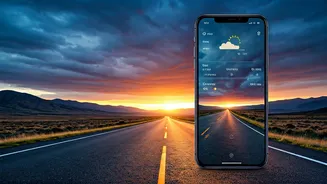
AccuWeather: This familiar name has integrated more advanced features, including its patented RealFeel® temperature and MinuteCast® predictions. The MinuteCast provides a play-by-play of precipitation for the next two hours, which is invaluable for navigating through shifting storm cells. Some premium versions also offer more detailed route-based weather analysis.
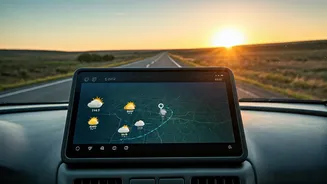
MyRadar: Known for its excellent animated radar maps, MyRadar also offers a feature called RouteCast. After you input your departure time and route, it provides a detailed weather forecast for points along your entire journey, keyed to the exact time you're predicted to be there. It visualizes where you'll encounter rain, snow, or high winds, turning your GPS route into a dynamic weather map.
From Forecast to Travel Plan
Having the tools is one thing; using them effectively is another. The goal is to move from being a passive recipient of weather news to an active planner. Here’s a simple workflow for your next holiday trip:
1. Map it out early: A week before you leave, plug your route into Google Maps or Waze to get a baseline drive time. Then, run that same route and departure time through a tool like MyRadar's RouteCast or check the forecast along the corridor in Tomorrow.io.
2. Identify the trouble spots: Look for potential weather systems crossing your path. Is a snowstorm moving across the Midwest? Will freezing rain be a risk in the Appalachians overnight? These tools help you see conflicts between your timing and the weather's timing.
3. Game out your 'Plan B': The power of predictive AI is the lead time it gives you to make better choices. If the forecast shows a blizzard hitting the mountain pass at your scheduled arrival, you have options. Can you leave six hours earlier to beat it? Is there an alternate, lower-elevation route that adds two hours but avoids the storm? Should you book a hotel halfway and split the drive into two safer, shorter days? This is where AI moves from a novelty to a critical safety tool.
Beyond the App: Human Intelligence
These AI tools are incredibly powerful, but they work best when paired with common sense. Always check state Department of Transportation (DOT) websites for the most current road closures, chain requirements, and official advisories; these sites often have live traffic cameras. Remember that weather in mountains or open plains can change faster than any model can predict. Build buffer time into your schedule—the last thing you want is to be racing a storm because you’re on a tight deadline. Finally, make sure your vehicle is prepared for the worst-case scenario your app shows you, with good tires, a full tank of gas, and an emergency kit. The tech can show you the risk, but it’s up to you to be ready for it.