






The Challenge: Finding Needles in a Cosmic Haystack
For a long time, our ability to spot potentially hazardous asteroids was surprisingly limited. We were good at finding the colossal, dinosaur-extinguishing ones—asteroids half a mile wide or larger. NASA has successfully cataloged over 90% of these giants,
and thankfully, none pose a threat for the foreseeable future. The real blind spot was the smaller, city-threatening objects. An asteroid just 150 yards across could devastate a metropolitan area, but finding these relatively tiny, dark, fast-moving rocks against the infinite black of space is incredibly difficult. It’s like trying to spot a chunk of charcoal from miles away, at night. Before recent upgrades, our sky surveys were only powerful enough to catch a fraction of the estimated 25,000 near-Earth asteroids in this dangerous size class, leaving a significant gap in our planetary awareness.
New Eyes on the Sky
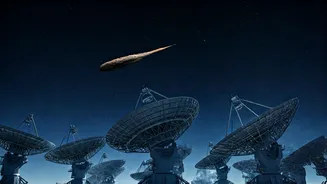
The game-changer is a new generation of incredibly powerful survey telescopes. The most anticipated is the Vera C. Rubin Observatory, perched high in the Chilean Andes. When it comes online, its enormous 3,200-megapixel camera—the largest ever built for astronomy—will photograph the entire visible southern sky every few nights. Its unprecedented field of view and sensitivity will allow it to detect fainter and smaller objects than ever before. Think of it as switching from a standard security camera to a state-of-the-art, wide-angle 8K system for the whole solar system. The Rubin Observatory will exponentially increase the rate of discovery, building a comprehensive catalog of our cosmic neighborhood. It joins an existing network of automated sentinels like the Pan-STARRS telescopes in Hawaii and the Asteroid Terrestrial-impact Last Alert System (ATLAS), which already scan the sky nightly, creating a more robust and redundant global warning network.
Smarter Brains to Analyze the Data
Having better eyes is only half the solution. These new telescopes will generate an almost unimaginable flood of data—about 20 terabytes every single night from the Rubin Observatory alone. No team of human astronomers could possibly sift through all those images to find the faint, moving dot that signifies a newly discovered asteroid. This is where artificial intelligence and advanced algorithms come in. Sophisticated software is being developed to automatically analyze the data streams in near-real-time. These AI systems can compare new images with previous ones, identify objects that have moved, calculate their preliminary orbits, and flag any that appear to be on a concerning trajectory. This automated process filters the signal from the noise, allowing scientists to focus their attention on the objects that actually matter, turning a firehose of data into actionable intelligence.
From Finding Them to Moving Them
Spotting an asteroid is crucial, but it's what you do next that counts. This is why NASA's recent DART (Double Asteroid Redirection Test) mission was so significant. In 2022, the DART spacecraft deliberately slammed into a small, non-threatening asteroid moonlet named Dimorphos, millions of miles from Earth. The goal wasn't to destroy it, but to see if a kinetic impact—basically, a cosmic nudge—could alter its path. The mission was a spectacular success. The impact changed Dimorphos's orbit around its parent asteroid by a much larger margin than most scientists had predicted. It was the first time humanity has ever purposefully changed the motion of a celestial object. This successful test proved that, with enough warning time, a kinetic impactor is a viable tool for deflecting a dangerous asteroid. Finding an asteroid decades in advance—something the Rubin Observatory will make possible—gives us a real chance to send a spacecraft to give it a tiny push, changing its course just enough to miss Earth entirely.