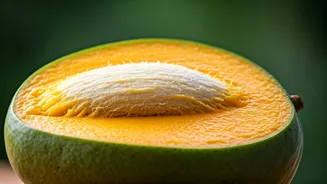










A Most Unexpected Family Tree
Let’s start with the mango’s family reunion, which would make for an awkward holiday dinner. You might think its closest relatives are other sweet, fleshy fruits like peaches or plums. You’d be wrong. The mango belongs to the Anacardiaceae family, which makes
its cousins the cashew and, brace yourself, poison ivy. That’s not just a weird piece of trivia; it has a real-world chemical connection. The skin, leaves, and sap of the mango tree contain trace amounts of urushiol, the same oily compound that gives poison ivy its infamous, itchy calling card. For most people, the amount in the fruit’s skin is negligible. But for a sensitive few, handling or biting into an unpeeled mango can cause a mild allergic reaction called contact dermatitis, sometimes mistaken for a simple rash around the mouth. It’s a potent reminder that in the botanical world, looks can be deceiving.
From Ancient India to Your Kitchen
Every mango you eat is the result of a 4,000-year-long journey. Originating in the foothills of the Himalayas in the Indo-Burma region, the mango, or *Mangifera indica*, was first cultivated by humans millennia ago. Its Sanskrit name, *āmra*, translates to “of the people,” signaling its early integration into daily life. From India, it traveled with Buddhist monks to Southeast Asia around the 5th century BCE, as the fruit was considered a sacred gift. Later, Persian traders carried it to the Middle East and Africa. It wasn't until the 16th century that Portuguese explorers, who established trade routes in western India, brought the mango to Brazil and the West Indies. From there, it slowly made its way north, eventually being planted in Florida in the 1830s. So when you slice into one, you’re tasting the final chapter of a story written on ancient trade winds and colonial shipping logs.
The Secret Inside the Seed
Wrestling with the large, fibrous pit at the center of a mango is a universal experience. But that stubborn seed, technically called an endocarp, hides a fascinating genetic secret: it can be a clone factory. Many mango varieties, particularly those from Southeast Asia, are polyembryonic. This means a single seed contains multiple embryos. One is the result of sexual reproduction (a combination of pollen and ovule), but the others are nucellar embryos—perfect genetic clones of the mother tree. If you plant the seed from one of these mangos, you might get several sprouts. One will be a unique new tree, a genetic wild card, while the others will grow into exact replicas of the parent. This trait allows farmers to reliably reproduce a beloved mango variety without the complex process of grafting. It’s nature’s very own copy-and-paste function, hidden inside that stringy husk.
A Thousand Fruits in One
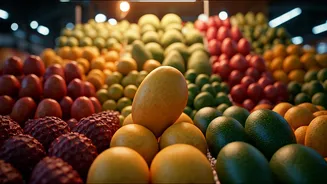
The mango you see in the average American supermarket—usually the round, reddish-green Tommy Atkins—is just one character in a cast of hundreds. Worldwide, there are over 500, and by some counts more than 1,000, cultivated varieties of mango. They come in a spectacular array of shapes, sizes, colors, and flavors. There’s the small, golden, honey-sweet Ataulfo from Mexico; the large, green, fiberless Kent from Florida; and the buttery, fragrant Alphonso from India, often hailed as the “king of mangos.” Some are spicy, some are tart, and some taste like a creamy blend of pineapple and citrus. This incredible diversity is a testament to centuries of cultivation, with farmers carefully selecting for traits that would thrive in their specific climate. Exploring the world of mangos means moving beyond a single flavor profile and discovering a whole spectrum of tropical perfection.
The Undisputed King of Fruits
In many parts of the world, the mango is not just a fruit; it's a cultural cornerstone. It’s the national fruit of India, Pakistan, and the Philippines, and the national tree of Bangladesh. In Hindu culture, a string of mango leaves is hung over a doorway during weddings and celebrations as a symbol of love and good fortune. The paisley pattern, a world-famous design motif, is said to be inspired by the shape of a curving mango. Giving a basket of mangos is a profound gesture of friendship and respect. Its status as “the king of fruits” is about more than just its heavenly taste. It represents prosperity, spirituality, and the welcoming warmth of summer. It’s a food so deeply woven into the fabric of society that its significance transcends the plate.