



It’s About Feeling, Not Just Seeing
Let’s be honest: the standard travel photo has become a form of digital taxidermy. We capture a moment, drain the life from it by selecting the most flattering filter, and mount it on the wall of our Instagram grid, where it sits perfectly still. A travel art
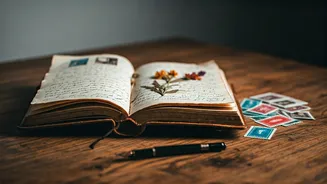
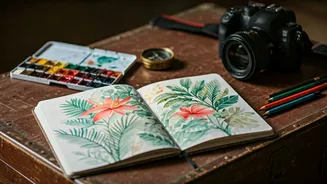
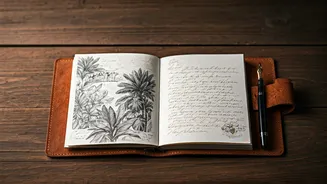
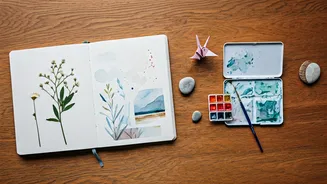
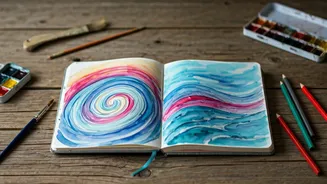
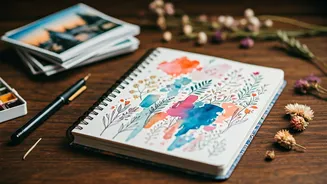
journal, however, is a living thing. It’s a messy, beautiful, and deeply personal collection of moments that prioritizes feeling over flawless composition. It’s the difference between a postcard and a letter. One shows you a picture of the Eiffel Tower; the other tells you how the crisp autumn air felt, the taste of the burnt-sugar crêpe you ate nearby, and the sound of the accordion player on the corner. The art journal holds the ticket stub from the Métro, a quick watercolor sketch of the afternoon light, and a few scribbled words about a conversation you overheard. It’s a repository for the sensory details that photos flatten out.
The Luxury of Slowing Down
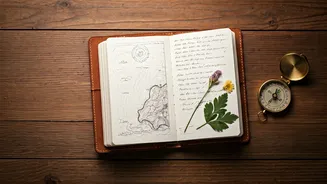
The greatest currency in modern travel isn't miles or money; it's attention. To create an art journal, you have to do something radical: stop. You have to sit on a bench for twenty minutes to sketch a fountain, press a fallen leaf into your notebook, and truly observe the architecture of a building instead of just snapping a photo and walking away. This act of slowing down is the core of the 'soft flex.' It communicates that you weren’t just rushing through a checklist of sights. You were present. You were engaged. In a world that prizes speed and efficiency, choosing to be deliberately slow and observant is its own kind of status symbol. It says, 'I had the time and mental space to truly be here.' An art journal is the proof.
A Memory Machine You Built Yourself
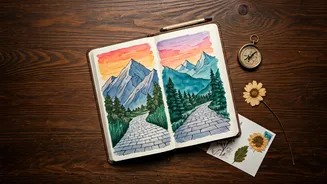
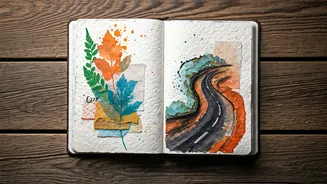
Years after a trip, scrolling through your phone’s camera roll can feel surprisingly hollow. The images are there, but the context and emotion are often gone. Flipping through a travel art journal is an entirely different experience. It’s an act of time travel. The texture of the paper, the faded ink of a receipt, the smear of a watercolor—these tactile elements trigger memories far more powerfully than a pixelated image ever could. Your slightly wobbly sketch of a Venetian canal is more evocative than a perfect photograph because it holds the memory of you, sitting there, trying to capture it. It contains your focus, your frustration, and your delight. You’re not just looking at a place; you’re reliving the experience of being you in that place. That’s a souvenir no shop can sell.
The Ultimate Conversation Starter
Here's where the 'flex' really lands. When someone sees your perfectly curated vacation photos, the conversation is usually a simple 'Wow, beautiful!' and a quick double-tap. But when a friend or family member flips through your art journal, the questions are different. 'What's this sketch of?' 'What does this note say?' 'Where did you get this ticket?' It invites storytelling. It’s a display not of wealth, but of creativity, patience, and perspective. It’s impressive because it reveals a skill and a sensibility. Sharing your art journal isn’t a boast about where you’ve been, but an invitation into how you see the world. It’s a quiet, confident display of a rich inner life, and in the noisy landscape of social media, that kind of quiet confidence is the most powerful flex of all.