



The World’s Largest Holy Kitchen
Deep inside the sprawling Jagannath Temple complex in Puri, a coastal city in eastern India, lies the Rosaghara—a kitchen unlike any other on Earth. Often called the world's largest kitchen, it’s a place where culinary tradition defies modern convenience.
There are no gas stoves or electric ovens. Instead, hundreds of cooks, known as ‘suaras,’ work over roaring wood fires, using ancient techniques passed down through generations. Their mission is to prepare ‘Mahaprasad,’ the sacred food offering for the temple's presiding deity, Lord Jagannath. This isn't a small-scale operation; on a typical day, the kitchen feeds tens of thousands of pilgrims. But during major festivals, that number swells to an almost unbelievable scale, transforming this sacred space into a hub of logistical precision fueled entirely by devotion.
More Than Just a Meal
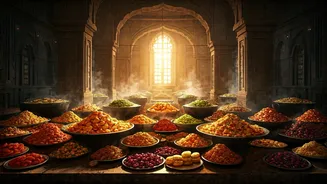
To understand the kitchen's Herculean effort, one must first understand that Mahaprasad is far more than just a meal. The term translates to “the great offering,” and it’s believed to be the food that has first been offered to Lord Jagannath, thereby receiving his divine blessing. Only then is it distributed to the public. This process sanctifies the food, turning consumption into a spiritual act. Mahaprasad comes in two forms: ‘Sankudi,’ which includes cooked items like rice, lentils, and vegetable dishes, and ‘Sukhila,’ consisting of dry sweets. The food is cooked exclusively in earthen pots called ‘kuduas,’ which are stacked seven-deep over open flames in a unique system that cooks the top pot first. Critically, according to tradition, all who partake in Mahaprasad are considered equal, regardless of caste or social standing—a powerful expression of unity. Devotees believe that eating it purifies the soul, making it the most sought-after element of a pilgrimage to Puri.
The Festival That Fuels the Feast
The primary driver behind the “record quantities” of Mahaprasad is the annual Rath Yatra, or Chariot Festival. This spectacular event sees the temple deities—Lord Jagannath, his brother Balabhadra, and sister Subhadra—paraded through the streets on colossal, ornately decorated wooden chariots. The festival draws millions of pilgrims from across India and the world, all converging on the small city of Puri. For the nine days of the festival, the city’s population explodes, and every single visitor hopes to receive Mahaprasad. In recent years, especially following periods of restricted access due to global events, the turnout has been immense, creating an unprecedented demand for the sacred food. The temple administration and the kitchen's servitors prepare for this surge months in advance, stockpiling ingredients and coordinating the massive workforce needed to meet the spiritual and physical hunger of the crowds.
An Unbelievable Logistical Feat
Dispatching record quantities of Mahaprasad is a masterclass in faith-driven logistics. During the Rath Yatra, over 600 cooks and 400 assistants work in shifts, often around the clock. The scale of ingredients is staggering: hundreds of tons of rice, lentils, and locally sourced vegetables are procured. The cooking process itself is a symphony of controlled chaos. Seventy-five-two clay hearths burn simultaneously, with cooks deftly managing the stacked pots to ensure everything is cooked to perfection. Once blessed, the Mahaprasad is moved to the Ananda Bazar, or “Market of Joy,” within the temple complex. Here, it is sold to devotees on a donation basis. The system runs on a deeply ingrained sense of duty and service ('seva') rather than commercial profit. The ability to scale up from feeding 50,000 people on a normal day to over a million during the festival peak is not just about manpower; it’s a testament to a system perfected over nearly a thousand years, operating on a foundation of unwavering spiritual commitment.