


Anatomy of a Delicious Crime
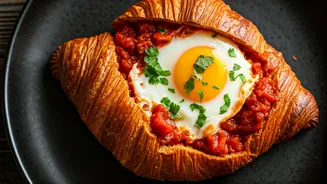
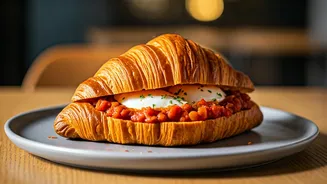
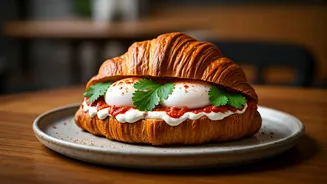
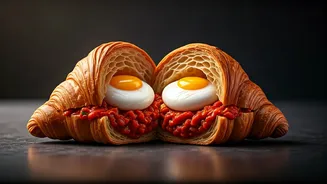
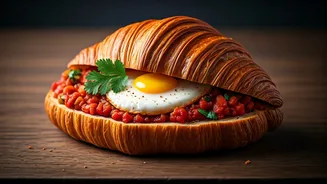
Let’s be clear about what we’re discussing. The shakshuka croissant is not a polite dish. It is a flagrant, glorious violation of culinary norms. Imagine a classic, impossibly flaky, butter-laminated croissant—the kind that shatters into a thousand delicate
shards at the slightest provocation. Now, hollow out its center and fill it to the brim with shakshuka: a simmering, vibrant stew of tomatoes, onions, bell peppers, and spices like cumin and paprika, often with a perfectly poached or baked egg nestled within, its yolk still lusciously runny. To call it a 'croissant' feels like an understatement; to call it 'shakshuka' feels incomplete. It’s a hybrid marvel, a carb-based vessel struggling valiantly to contain its molten, saucy cargo. The first bite is an act of faith. Will the pastry hold? Will the sauce spill? Will you get egg yolk on your shirt? The answers are: maybe, probably, and almost certainly. And that is precisely its charm.
A Tale of Two Continents
This dish is a delicious collision of cultures. On one side, you have the croissant, the icon of French pâtisserie. It represents precision, technique, and centuries of baking tradition that demand patience and an almost comical amount of butter. It is the sophisticated star of the Parisian breakfast table, best enjoyed with a simple café au lait. On the other side, you have shakshuka. With roots stretching across North Africa and the Middle East, it is a dish of humble, communal comfort. Traditionally cooked and served in the same skillet, it’s a rustic, one-pan meal designed for sharing, perfect for sopping up with crusty bread. It’s warm, spicy, and deeply satisfying—the antithesis of the croissant’s airy detachment. Fusing these two is like pairing a diplomat with a rock star. It’s an unlikely partnership that defies logic, yet somehow creates a harmony that is more interesting than either element on its own. The buttery richness of the croissant tempers the spicy kick of the sauce, while the shakshuka’s moisture prevents the pastry from feeling too dry.
The Engineering of Indulgence
Why does this improbable creation work so well? It’s all about the textural and flavorful counterpoints. A great dish is often a study in contrasts, and the shakshuka croissant is a masterclass. You get the crisp, shattering layers of the pastry against the soft, yielding sauce and peppers. You have the rich, savory flavor of the spiced tomatoes cutting through the fatty, buttery goodness of the croissant. The runny egg yolk acts as the ultimate diplomat, a creamy, emulsifying agent that ties everything together. When you finally breach the yolk and it spills into the tomato sauce and soaks into the croissant’s honeycomb interior, you achieve a moment of pure brunch nirvana. It’s the same principle that makes dipping fries in a milkshake so perversely satisfying—a combination of salty, sweet, soft, and crispy that lights up every pleasure center in your brain. This isn’t just food; it’s a brilliantly engineered experience.
More Than Just a Stunt
In an era of viral 'stunt foods'—from the cronut to the cheese-drenched everything—it’s easy to be cynical. Is the shakshuka croissant just another Instagram-bait creation destined for a fleeting moment of fame? Perhaps. But it also represents something more interesting: a playful and confident evolution in global food culture. Bakers and chefs are no longer bound by tradition. They are remixing the classics, borrowing freely from the world’s pantry to create new forms of delight. This dish isn't a replacement for a classic bowl of shakshuka or a perfect plain croissant. It’s an alternative, a 'what if?' scenario brought to delicious life. It’s proof that the rules are made to be broken, especially when the result is this enjoyable. It acknowledges the integrity of its source materials while daring to ask if they could be even more fun together.