







A Partnership with Nature
Deep in Meghalaya, a state known as the "abode of clouds," the indigenous Khasi and Jaintia peoples have practiced a unique form of natural engineering for centuries. Faced with powerful monsoon rivers that would wash away conventional wooden or bamboo
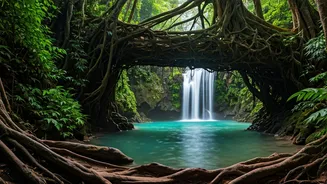
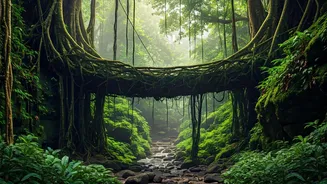
structures, they didn't seek to conquer nature; they partnered with it. The result is the Jingkieng Jri, or living root bridge. These are not carved or constructed objects but living, growing parts of the forest, coaxed into the shape of a bridge over decades.
The Patient Art of Bio-Engineering
The process begins with a specific tree: the Ficus elastica, or rubber fig tree. This species produces a network of strong, flexible aerial roots that stretch down from its branches. The Khasi bridge-builders have mastered the art of guiding these pliable roots across a river. They often use hollowed-out trunks of betel nut trees as temporary channels, training the roots to grow in the desired direction. Over 15 to 30 years, the roots reach the opposite bank and take hold. As they thicken and strengthen, they are woven together, forming a lattice-like structure. Over time, new roots overlay old ones, and the bridge literally repairs and reinforces itself, growing stronger with each passing year.
Stronger When It Rains
What makes these bridges so brilliant is how they are perfectly adapted to their environment. Meghalaya is one of the wettest places on Earth, and the constant moisture that would rot a wooden bridge only makes a living root bridge stronger. During the torrential monsoons, the roots swell and grip the soil and rocks more firmly. Unlike steel or concrete, which have a finite lifespan and require external materials for repair, these bridges are self-sustaining. Some of the oldest are believed to be over 500 years old, having supported countless generations of villagers carrying goods, connecting communities, and simply getting from one side of a valley to the other. They are a testament to patient, long-term thinking in a world obsessed with immediate results.
The Trek to a Living Wonder
Visiting these bridges is an adventure in itself. They aren't found by the side of a highway. Reaching them requires hiking steep, stone-paved trails through lush, humid jungle, often descending thousands of steps into a river valley. The most famous example is the Umshiang Double-Decker Bridge in the village of Nongriat. This two-tiered marvel is a breathtaking sight, with one bridge suspended gracefully above another. The journey is demanding, but the reward is profound. To walk across a structure that is as much a part of the forest as the trees around it, to feel the cool, gnarled roots under your feet, is to experience a connection to a landscape that feels ancient and truly alive. It’s less a walk through nature than a walk through a collaboration between humanity and nature.