





The Celestial Dance You're Watching
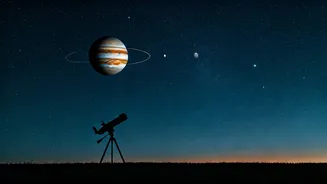
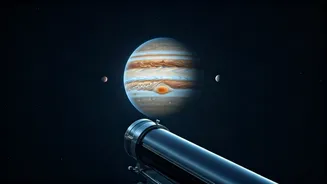
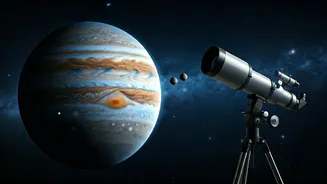
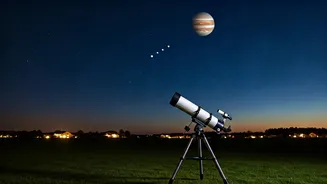
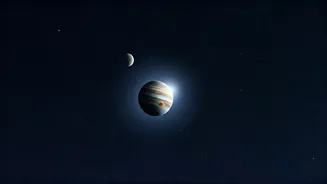
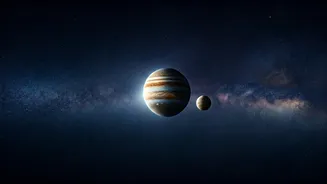
When you point a telescope at Jupiter, the first thing you’ll notice are four tiny dots of light flanking the planet in a neat line. These are the Galilean moons, discovered by Galileo Galilei in 1610: Io, Europa, Ganymede, and Callisto. They orbit Jupiter with
incredible speed, changing their position noticeably even over a single evening. The main event you’re looking for is a “transit.” This occurs when one of the moons passes directly between Jupiter and Earth, appearing to cross the planet’s cloudy face. Even more dramatic is the “shadow transit.” Because the sun is behind you (and Jupiter), the moon casts a shadow onto Jupiter’s cloud tops. These tiny, inky-black dots are often easier to see than the moons themselves, which can blend in with Jupiter’s bright surface. Seeing one of these shadows creep across the planet is a genuinely breathtaking experience, a direct visual confirmation of the three-dimensional reality of our solar system.
What 'Basic Telescope' Really Means
The phrase “basic telescope” can be misleading. You won't see this with toy-store models on wobbly tripods. However, you don’t need a professional observatory, either. A quality beginner’s telescope is more than enough. This typically means a reflecting telescope with at least a 4.5-inch (114mm) aperture mirror or a refracting telescope with a 3-inch (80mm) lens. More important than sheer size is a sturdy, stable mount. Any vibration will turn Jupiter into a wobbly mess. You'll also need enough magnification. While you can spot the moons with low power, you’ll need to push your magnification up to at least 100x, and ideally 150x, to have a good chance of resolving a moon or its shadow against the planet itself. Don’t worry if the image is small; your eye will adapt. The key is a stable, clear view, not a huge one.
Finding Jupiter and Timing Your View
Finding Jupiter is the easy part. For much of the year, it’s one of the brightest objects in the night sky, outshone only by the Moon and occasionally Venus. Unlike stars that twinkle, planets shine with a steady, unwavering light. If you see a brilliant “star” that isn’t twinkling, especially along the ecliptic (the path the sun and moon follow across the sky), you’ve likely found Jupiter. A simple sky-viewing app on your phone can confirm its location in seconds. Timing, however, is everything. Transits are specific, timed events. You can’t just look on a random Tuesday and expect to see one. Fortunately, the astronomy community provides excellent, free resources. Websites like Sky & Telescope and Astronomy Magazine have tools and tables that predict the exact times of moon and shadow transits for the coming weeks and months. You can also use free planetarium software like Stellarium, which allows you to enter your location and see exactly what Jupiter and its moons will be doing at any given minute.
Your Step-by-Step Viewing Guide
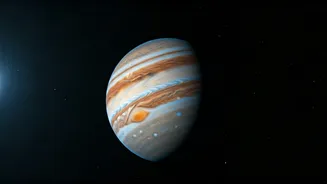
Once you’ve used an online tool to find a good transit time, get ready. First, set up your telescope at least 30 minutes before you plan to observe. This allows it to acclimate to the outside temperature, which prevents air currents inside the tube from distorting the view. Start by finding Jupiter with a low-power eyepiece, center it, and then switch to a higher-power one. Get the focus as sharp as you possibly can. You should be able to see Jupiter’s two main dark cloud bands. Now, be patient. The moon or shadow will appear as a tiny speck at one edge of the planet and slowly make its way across. A full transit can take a couple of hours. You may not notice the movement from second to second, but if you look away and come back in 10-15 minutes, you’ll see its position has clearly changed. This slow, steady march across a distant world is the real reward.