




More Than Just a Procession
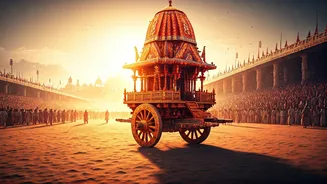
The event is Ratha Yatra, or the Festival of Chariots, one of the most important Hindu festivals. Originating in Puri in the Indian state of Odisha, it celebrates the annual journey of the deity Jagannath, along with his elder brother Balabhadra and sister
Subhadra, from their home temple to another temple understood to be their aunt's residence. This journey isn't just a symbolic parade; for believers, it is a deeply spiritual event where the deities come out from the sanctuary to grace the public with their presence. Devotees believe that pulling the ropes of these massive chariots is an act of great religious merit, offering a chance for direct participation in a divine procession. The entire festival is a vibrant, powerful expression of collective faith and community celebration.
The Anatomy of a Divine Chariot
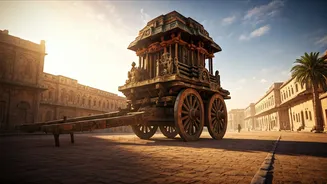
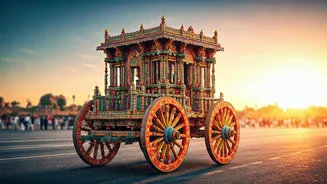
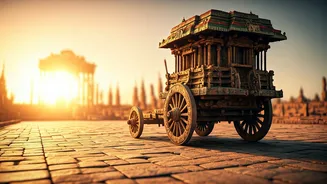
The 'raths' themselves are monumental feats of traditional engineering and artistry. Built anew each year from specified types of wood, these towering structures are constructed without a single nail, using ancient joinery techniques of mortise and tenon. Each of the three main chariots has its own name, specific dimensions, and distinct color scheme. Jagannath’s chariot, Nandighosha, stands roughly 45 feet tall, rolling on 16 massive wheels and draped in red and yellow cloth. Balabhadra’s chariot, Taladhwaja, is covered in red and green, while Subhadra’s, Darpadalana, is cloaked in red and black. These are not merely vehicles; they are meticulously designed sacred architecture on wheels, built to precise specifications passed down through generations.
A Symphony of Craftsmanship
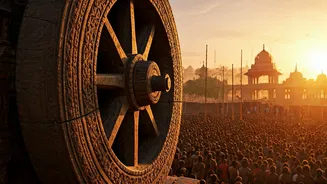
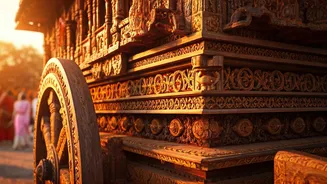
The true wonder of the raths lies in the intricate, handcrafted details that adorn every surface. The headline isn't an exaggeration; the level of artistry is staggering. A dedicated team of artisans, known as 'Chitrakaras' (painters), 'Rupakaras' (sculptors), and 'Dorzis' (tailors), work for weeks to bring the chariots to life. The wooden structures are covered in elaborate paintings of floral motifs, divine figures, and scenes from mythology. Carved wooden horses appear to pull the chariots, while sculptures of deities and celestial guardians are mounted on the sides. Even the massive wheels are painted with symbolic designs. The vibrant canopies and flowing banners are hand-stitched with applique work, creating a kaleidoscope of color and texture that moves and billows as the chariots proceed.
Generations of Sacred Duty
The construction of the chariots is not a commercial enterprise but a sacred service, or 'seva.' The skills are hereditary, passed down from father to son within specific families who have held these responsibilities for centuries. These artisans don't see it as just a job; it is their ancestral right and religious duty. From the carpenters who begin their work on an auspicious day to the painters who add the final, sacred brushstrokes, every step is steeped in ritual and devotion. This deep connection transforms the act of creation into an offering. The beauty of the raths is a direct reflection of the faith of the people who build them, a physical manifestation of their love and reverence for the deities.
From Puri to a City Near You
While the grandest Ratha Yatra takes place in Puri, the festival has become a global phenomenon. Thanks to the efforts of organizations like the International Society for Krishna Consciousness (ISKCON), Ratha Yatra processions are now held in over a hundred cities worldwide, including New York, Los Angeles, Chicago, and Washington, D.C. While often on a smaller scale, these festivals capture the same spirit of devotion and community. They offer a unique opportunity for Americans of all backgrounds to witness this stunning display of living tradition and perhaps even lend a hand in pulling the ropes, connecting with a cultural and spiritual event that bridges continents and centuries.