








The Old 'Goldilocks' Problem
Think back to any elementary school classroom, and you'll find a system for organizing books by reading difficulty. Whether using Lexile measures, Fountas & Pinnell levels, or another rubric, the goal has always been the same: match a child to a book that’s
not too hard, not too easy, but 'just right.' This is the Goldilocks principle of literacy. While essential, this system has a fundamental limitation: it’s static. A student is assigned a level, and they work through books in that category. But a child’s reading ability isn't a fixed point. It can fluctuate based on tiredness, interest in the topic, or even the time of day. A book that was 'just right' on Monday might feel overwhelmingly difficult by Friday, leaving the student frustrated and the teacher with an outdated data point.
Enter the AI Reading Coach
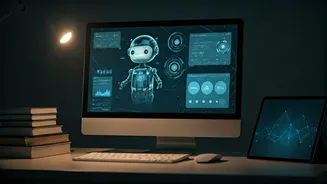
This is where real-time AI tutors come in. These aren't just glorified e-books or digital flashcards. Imagine an endlessly patient, expert reading coach sitting next to a child, listening to them read aloud. That’s the concept. Using a device's microphone, these software programs, like Amira Learning or Ello, analyze a student's oral reading fluency on the fly. They hear every word, every pause, every stumble, and every smooth passage. The revolutionary part isn't just the listening; it's the immediate, automated response. Instead of waiting for a teacher to assess a running record, the AI provides in-the-moment support and adjustments, turning a simple reading exercise into a dynamic, responsive coaching session.
How 'Dynamic Adjustment' Actually Works
So, what does “dynamically adjust” mean in practice? It’s a series of micro-interventions. If a student reads a sentence fluently and quickly, the AI might subtly increase the complexity of the next sentence, introducing a slightly more challenging vocabulary word or syntactical structure. It’s pushing the student just beyond their comfort zone, which is where learning thrives. Conversely, if the student begins to struggle, mispronouncing several words or reading at a halting pace, the system doesn't just wait for them to fail. It might intervene by phonetically sounding out a tricky word, providing a simple definition, or even slightly simplifying the next passage to help them regain confidence and momentum. The text itself becomes fluid, adapting to the reader's immediate needs rather than forcing the reader to conform to a pre-determined difficulty level.
More Than Just a Pacesetter
The technology’s power goes far beyond simply speeding up or slowing down. Because the AI is analyzing the specific errors a child makes, it can identify underlying patterns. For instance, it might notice a student consistently struggles with digraphs like 'sh' and 'ch,' or has trouble with multi-syllable words. This detailed diagnostic information is a goldmine for educators. Instead of getting a generic score that says a student is 'below grade level,' a teacher receives a detailed report highlighting the exact skills that need reinforcement. The AI can run the drills on those specific skills, freeing the teacher to focus on higher-order thinking, comprehension, and fostering an actual love of stories—the things a machine can't do.
The Human Element Isn't Going Away
Naturally, the rise of AI in the classroom raises the question: Are we replacing teachers with robots? The developers of these tools and the educators using them are clear: the goal is to supplement, not supplant. An AI tutor can provide the one-on-one, repetitive practice that is incredibly effective but nearly impossible for one teacher to deliver to 25 different students simultaneously. It acts as a tireless teaching assistant, handling the foundational mechanics of reading so the human teacher can guide students in making meaning from the text. Of course, challenges remain. Ensuring equitable access to the required technology, navigating data privacy concerns, and guarding against an over-reliance on screens are all critical conversations that school districts must have. But the potential to offer personalized support at scale is undeniable.