







From State Monopoly to Open Skies
For over half a century, space exploration in India was synonymous with ISRO, the Indian Space Research Organisation. Much like NASA in the U.S., ISRO was the sole driver of the nation’s cosmic ambitions, from launching its first satellite in 1975 to
its celebrated missions to the Moon and Mars. It was a model of frugal innovation, achieving remarkable feats on shoestring budgets. But it was a closed ecosystem. Private companies could be vendors, supplying components, but they couldn't dream of launching their own missions. That all changed in 2020. In a landmark policy shift, the Indian government threw open the doors to the final frontier. It established a new regulatory body, IN-SPACe (Indian National Space Promotion and Authorisation Centre), to act as a bridge between ISRO and private players. The goal was clear: to let ISRO focus on deep-space science and exploration while empowering a new generation of entrepreneurs to build a commercial space economy. The government wasn’t just giving permission; it was offering to share ISRO’s world-class facilities, testing infrastructure, and decades of expertise.
Meet the Trailblazers
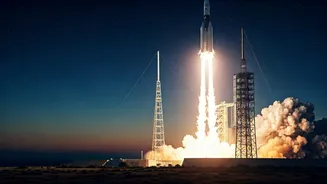
The policy shift quickly bore fruit. In November 2022, a company called Skyroot Aerospace made history by launching Vikram-S, India’s first-ever privately developed and operated rocket. The suborbital flight was a modest but profound proof of concept. Founded by former ISRO engineers, Skyroot embodies the new spirit: nimble, ambitious, and funded by venture capital. Their goal isn't to compete with ISRO's heavy-lift rockets, but to build a fleet of smaller vehicles designed to deploy satellites quickly and cheaply. They aren't alone. Another Chennai-based startup, Agnikul Cosmos, is grabbing headlines for its innovative approach to manufacturing. Their Agnibaan rocket is powered by a single-piece, 3D-printed engine—a world first. By 3D printing the entire complex engine assembly, they drastically cut down on production time and cost. Like Skyroot, Agnikul is targeting the burgeoning small satellite market, promising on-demand launches like a cosmic Uber ride. These companies, and dozens of others, are the new face of India's space program.
The 'Small Satellite' Gold Rush
So why the sudden explosion of interest? The business case is simple: the global demand for launching small satellites is exploding. These shoebox-to-microwave-sized devices are used for everything from Earth imaging and weather monitoring to broadband internet (think Starlink) and IoT communications. In the past, getting a small satellite into orbit meant hitching a ride on a massive rocket like a SpaceX Falcon 9, often waiting months or years for a slot. Indian startups are betting they can offer a better service. By building smaller, dedicated rockets, they can provide a more frequent and flexible “cab service” to low-Earth orbit. Their key advantage is cost. Leveraging India's lower manufacturing and labor costs, they aim to offer some of the most competitive launch prices in the world. This isn't about challenging SpaceX for missions to Mars; it's a savvy business play to capture a significant slice of the $1 trillion global space economy projected for the coming decades.
A New Strategic Asset
For the U.S. and the rest of the world, this development is more than just a compelling business story. It signals India’s evolution from a regional space power to a potential global hub for space commerce. A thriving private space sector gives the country strategic depth, reducing its reliance on foreign launch providers and fostering a high-tech domestic manufacturing base. It also makes India a more attractive partner for international collaborations, including with NASA and American companies. As the space race becomes increasingly crowded and commercialized, having a democratic partner with a robust and cost-effective launch ecosystem is a significant geopolitical asset. India is no longer just a nation that can send probes to other planets; it's building the industrial foundation to become a critical node in the supply chain that will support humanity's future in space.