








A Fully Functional Horn
In the United States, a car horn is an instrument of aggression, a last resort to signal danger or extreme frustration. In India, it's your primary means of communication. It’s a polite 'hello, I’m here' as you approach a blind corner, a request to pass,
or a warning to a pedestrian who has casually strolled into traffic. Drivers use short, gentle beeps constantly, not out of anger, but as a form of automotive sonar to announce their presence to the swarm of cars, auto-rickshaws, motorcycles, and cows sharing the road. A silent car is an invisible car, and an invisible car is a hazard. The first item on any checklist isn't an option; it's a vital piece of safety equipment used more than the turn signal.
The Correct Paperwork, Laminated
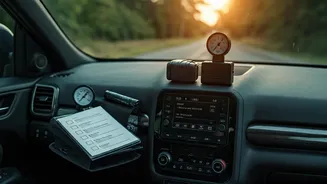
While American drivers worry about their license and registration, Indian drivers carry a whole file. This includes the Registration Certificate (RC), a valid driver's license, car insurance papers, and the crucial PUC (Pollution Under Control) certificate. The PUC is a mandatory emissions test document that must be renewed regularly. Getting pulled over by the police is common, and not having the exact, correct, and up-to-date document can lead to fines and significant hassle. Many drivers keep laminated copies in their glove box at all times. The universal lesson here is simple but profound: in any bureaucratic system, being impeccably prepared is your best defense.
A High-Quality Dash Cam
In a place where minor scrapes are frequent and determining fault can feel subjective, a dash cam is non-negotiable. It’s your unbiased witness. It’s not just for capturing a major collision; it’s for proving that a motorcyclist scraped your door while weaving through traffic or that a fender-bender wasn't your fault. Insurance claims and police reports can become a 'he said, she said' affair, and video evidence cuts through the noise. For U.S. drivers, a dash cam is a smart investment for fighting insurance fraud or contested tickets. In India, it’s a fundamental tool for navigating the daily reality of unpredictable roads and a complex legal system.
An Understanding of 'Right of Way'
American driving manuals have entire chapters on right of way, with clear rules for four-way stops and intersections. In India, the primary rule of right of way is 'might is right.' The larger vehicle—the bus, the truck—generally has the psychological, if not legal, advantage. Drivers learn to be deferential to size. A small hatchback will yield to a sedan, which will yield to an SUV, which will yield to a bus. It’s a fluid, intuitive dance of assertiveness and deference. This isn't about lawlessness; it's a practical, unspoken code that keeps the chaotic traffic flowing. The takeaway for any driver is to drive based on what's actually happening, not just what the rules say should be happening.
A Spare Tire and Basic Tools
This might seem like a universal tip, but its importance is magnified in India. Road quality can vary dramatically, with potholes that can swallow a small wheel, and debris is common. Getting a flat tire is not a matter of 'if' but 'when.' Furthermore, while cities have plenty of mechanics, on highways or rural roads, help can be miles away and take hours to arrive. Self-reliance is key. Having a properly inflated spare tire, a jack, and a lug wrench—and knowing how to use them—is a core driving skill. It’s the difference between a 30-minute inconvenience and a day-long ordeal stranded on the side of the road.
An Infinite Supply of Patience
This is the most critical item, and you can’t buy it. Traffic jams ('jams' being a polite understatement) can appear without warning and last for hours. You'll be cut off constantly. You’ll share the road with everything from luxury cars to ox-carts. Getting angry is a futile exercise that only raises your own blood pressure. Veteran Indian drivers develop a zen-like acceptance of the chaos. They understand that the goal is not to get there fast, but to get there in one piece, mentally and physically. This is perhaps the most valuable lesson for stressed-out American commuters: the road is a shared space, and your journey is just one of millions. A little patience goes a long way, no matter what country you're driving in.