




The Ailing Gyroscope
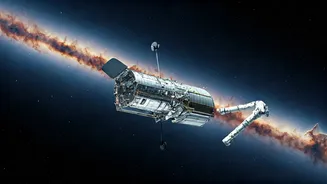
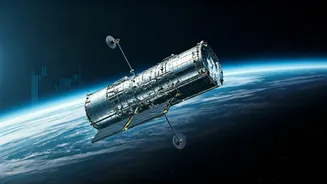
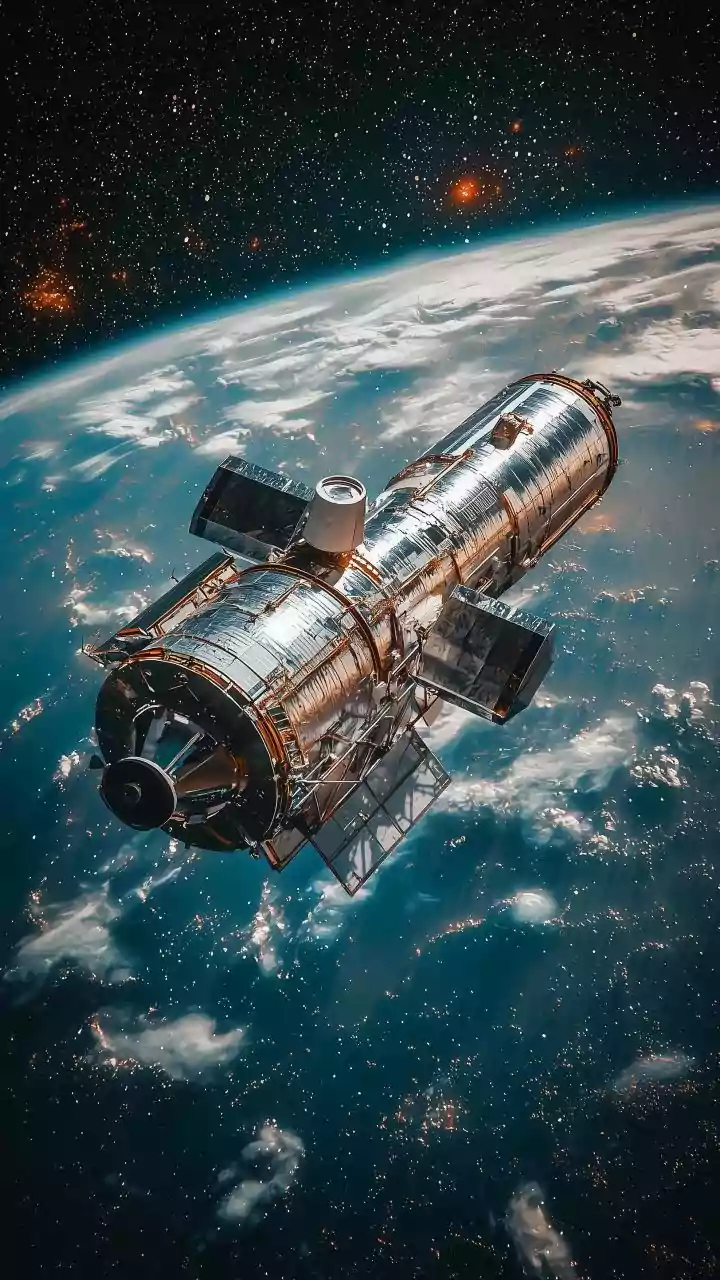
Imagine trying to hold a camera perfectly still to take a long-exposure photo of a distant star. That’s Hubble’s job, and it relies on a set of spinning wheels called gyroscopes to do it. These devices measure the telescope’s turn rates, allowing the pointing
system to keep it locked on a target with pinpoint precision. Originally launched with six gyros, it’s designed to operate with at least three for optimal efficiency. Over the years, they’ve failed one by one. Recently, another gyro began acting up, forcing NASA to put Hubble into a protective safe mode. The agency has now made the tough call to operate the telescope on a single gyroscope, with one left as a final backup. While this one-gyro mode is functional and has been tested, it makes Hubble less efficient. It will take longer to slew to new targets and will have some limitations on what it can observe, effectively reducing its scientific output. This isn't a catastrophic failure, but it’s a significant degradation for an aging superstar.
The Billion-Dollar Question
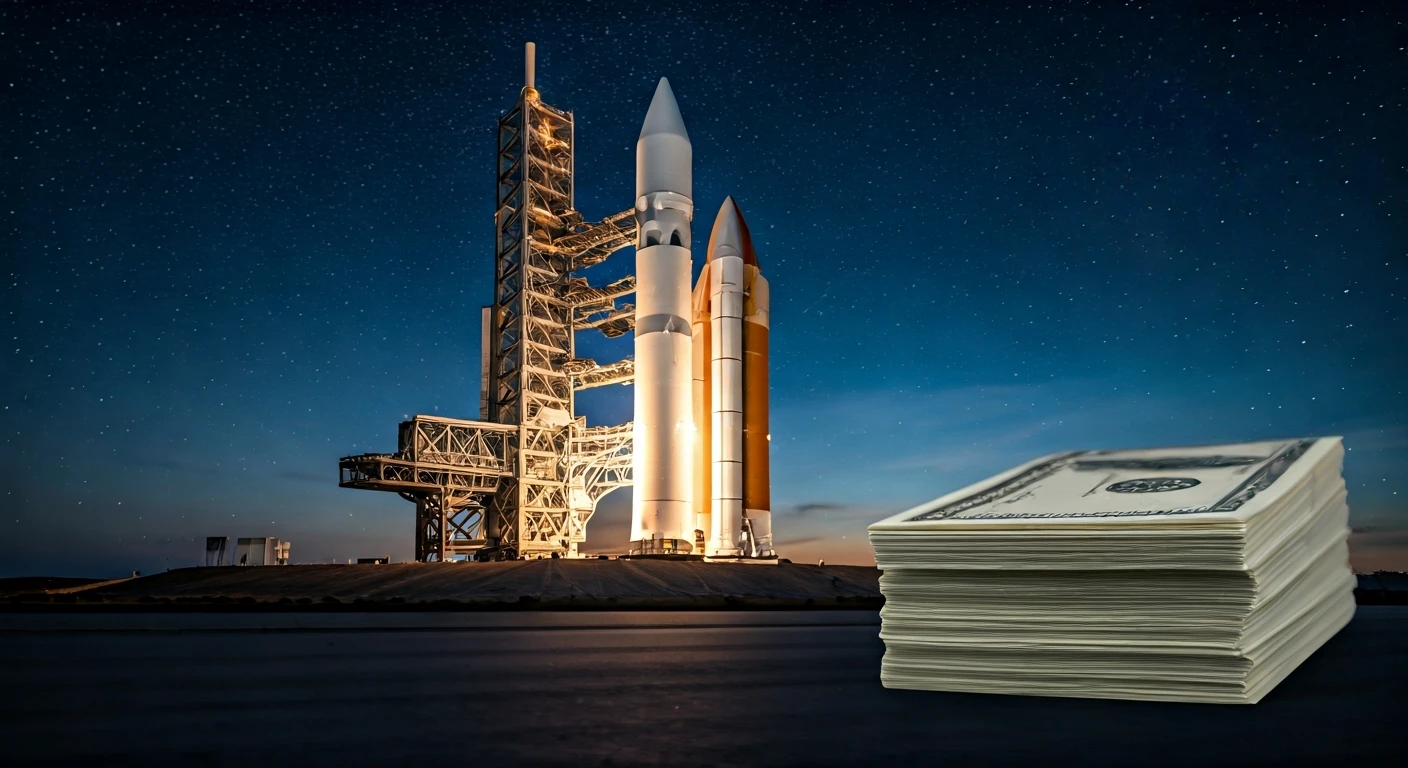
Fixing the problem isn’t as simple as sending up a space shuttle like in the old days. The shuttle program is long retired. The new question is whether to fund a first-of-its-kind mission to visit Hubble. A commercial proposal, led by billionaire astronaut Jared Isaacman and SpaceX, has been floated to use a Dragon capsule to dock with the telescope. This mission could serve two purposes: physically “reboost” Hubble into a higher orbit to extend its life by years, and potentially allow astronauts to service the aging hardware. This sounds like a perfect solution, but it’s not free. While Isaacman’s Polaris Program has offered to fund much of the development, any mission would still require significant NASA resources, time, and risk assessment. The agency would have to divert personnel and funds to support it. So the problem shifts from engineering to economics: Is it worth the investment to save the old champion, or are there better places to put that money?
The Shadow of James Webb
The elephant in the room is the James Webb Space Telescope (JWST). As Hubble’s successor, JWST is a technological marvel, peering deeper into the universe’s infrared spectrum than ever before. It’s a stunning success and the new darling of space science. And it’s expensive. NASA’s astrophysics budget is a finite pie, and every dollar spent maintaining Hubble’s roughly $100 million-per-year operating cost is a dollar not being spent on operating JWST or developing the *next* great observatory, like the Nancy Grace Roman Space Telescope. This is the classic business dilemma of legacy assets. Hubble is a reliable, beloved, and still productive platform. But at what point does maintaining the old workhorse stop making financial sense when you have a newer, more advanced tool demanding its own resources? For budget planners in Washington, D.C., keeping two flagship telescopes running at full tilt represents a massive financial commitment in an era of competing priorities, including the moon-bound Artemis program.
The Science We Would Lose
Retiring Hubble isn't a simple decision because JWST can’t do everything Hubble does. The two telescopes are complementary, not redundant. Hubble primarily sees the universe in visible and ultraviolet (UV) light, while Webb is optimized for infrared. It’s like having two senses instead of one. Many cosmic phenomena, from the atmospheres of nearby exoplanets to the behavior of stars in our own galaxy, are best studied in the UV spectrum. Losing Hubble means losing our best eye on that entire domain of astrophysics. There is currently no other telescope planned that can replace its unique UV capabilities. So the choice isn’t just between an old telescope and a new one; it’s about whether to voluntarily go blind to a whole spectrum of cosmic light. This is the scientific cost that must be weighed against the financial cost of keeping Hubble online, making NASA's decision incredibly difficult.