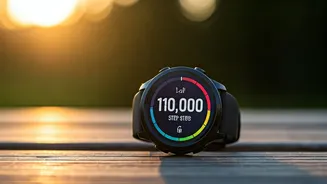









The Birth of a Marketing Slogan
First, a reality check: the 10,000-steps-a-day target didn’t come from a doctor or a global health organization. It was born from a marketing campaign. Ahead of the 1964 Tokyo Olympics, a Japanese company created a device to capitalize on the budding
fitness craze. It was a pedometer called the Manpo-kei, which translates to “10,000 steps meter.” The name was catchy, the number was round and satisfyingly large, and an arbitrary fitness goal was born. With no scientific backing, the number simply sounded good. It was a brilliant piece of marketing that has embedded itself so deeply into our wellness culture that we’ve accepted it as medical fact. For decades, it has served as the default setting on fitness trackers and the unquestioned advice doled out in magazines and morning shows, all without a shred of initial scientific validation.
What Science Actually Says
So if 10,000 is just a number from a 1960s ad campaign, what’s the real target? Thankfully, modern science has finally caught up. A landmark 2019 study from Harvard Medical School published in JAMA Internal Medicine looked at nearly 17,000 older women and found that health benefits began far earlier than 10,000 steps. Women who averaged just 4,400 steps per day had a 41% lower mortality rate compared to those taking only 2,700 steps. The benefits continued to increase but eventually leveled off around 7,500 steps per day. More recent research has confirmed this for broader populations. A 2021 study in The Lancet found that for adults over 60, the risk of premature death stabilized at around 6,000-8,000 steps a day. For adults under 60, that number was a bit higher, around 8,000-10,000. The key takeaway is that significant, life-changing benefits happen long before you reach that intimidating five-digit number. Any movement is better than none, and every step truly does count.
It’s Not Just How Many, but How
Fixating on a single number also misses another crucial part of the equation: intensity. While the total volume of steps is important, the pace at which you take them can provide an extra health boost. Strolling casually through a department store and taking a brisk walk that gets your heart rate up are not the same activity, even if they rack up the same number of steps. Studies have shown that including periods of moderate-intensity walking—fast enough that you can talk but not sing—is associated with even greater health benefits, including improved cardiovascular health and weight management. This doesn't mean every step needs to be a power-walk. Instead, think about integrating purpose into your movement. Can you turn a 30-minute walk into a slightly more vigorous one three times a week? Focusing on adding just 10-20 minutes of brisk walking to your daily routine can make a huge difference, regardless of your final tally.
Moving Beyond the Numbers Game
The gamification of fitness has been a powerful motivator for millions, but it also has a downside. The relentless pursuit of a numerical goal can turn movement, an inherently joyful activity, into a chore. Missing your goal can lead to feelings of guilt or failure, potentially discouraging you altogether. It also ignores other vital forms of exercise, like swimming, cycling, strength training, and yoga, none of which add to your daily step count but are critical for overall health. The healthiest mindset might be to treat the 10,000-step goal as a loose guideline, not a rigid rule. Use it as a tool to gauge your general activity level, but don't let it become your sole measure of success. Did you spend 30 minutes stretching? Did you lift weights? Did you go for a bike ride with your kids? These are all victories for your health that your pedometer will never recognize.