




The Classic Mood Board's Problem
Imagine hiring an interior designer. They return with a board covered in fabric swatches, photos of sun-drenched Italian villas, a paint chip named ‘Gentle Fawn,’ and a picture of a vintage armchair. This is a mood board. Its job is to capture a feeling,
an aesthetic direction. For decades, it’s been the essential first step in any creative project, from fashion to branding to architecture. The problem? It’s pure interpretation. You see a relaxing, earthy space. Your client sees ‘old and brown.’ The gap between the *vibe* on the board and the final, tangible product is where miscommunications, budget overruns, and creative disappointments are born. The process of translating that collage into a coherent blueprint or product requires a huge imaginative leap—one that not everyone, especially clients, can make.
How AI Becomes a Translator
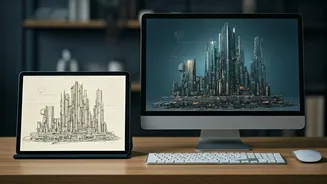
Enter generative artificial intelligence. Tools like Midjourney, Stable Diffusion, and DALL-E 3 are image-creation platforms that operate on text prompts. You describe an image, and the AI generates it. Young, digitally native designers are weaponizing this technology to bridge the gap left by traditional mood boards. Instead of just presenting the collage, they deconstruct it into descriptive language. That Italian villa, the warm light, the earthy tones, and the vintage furniture become a prompt: “A photorealistic interior of a modern minimalist living room with terracotta-colored walls, bathed in warm afternoon sunlight, with a distressed leather armchair and large olive trees in ceramic pots.” Within seconds, the AI produces not a collage, but a series of fully-rendered, photorealistic *images* of what that room could actually look like. The mood is no longer an abstract collection of parts; it’s a finished scene.
The Power of Speed and Iteration
The most immediate impact of this new workflow is speed. A process that once took days of sketching, 3D modeling, or searching for stock photos now takes minutes. A designer can generate ten different versions of a room, a logo, or a fashion line before their coffee gets cold. This allows for an unprecedented level of creative exploration early in the process. For client relationships, it’s a game-changer. By showing a photorealistic render instead of an abstract mood board, designers can get buy-in almost instantly. The client isn’t guessing what the final product will look like; they’re seeing a version of it from day one. Revisions are faster, too. If the client wants a different sofa or a cooler color palette, the designer simply adjusts the prompt and generates a new set of images. This rapid iteration cycle reduces friction and helps projects move forward with more confidence and clarity.
Redefining the Designer's Skillset
This shift is also changing what it means to be a designer. While a strong sense of taste, color theory, and composition remains essential, a new skill is emerging: prompt engineering. The designer’s new talent lies in their ability to articulate a visual idea with language that the AI can understand and execute beautifully. They are becoming creative directors for an artificial intelligence. This isn't necessarily replacing human creativity but augmenting it. The AI is a powerful tool for ideation, a way to visualize possibilities at lightning speed. The human designer is still the curator, the editor, and the strategist who guides the tool. They select the best outputs, refine the concepts, and weave them into a coherent and functional final design. The AI generates options; the human makes decisions.
The Unspoken Risks and Criticisms
Of course, this trend isn't without controversy. Critics worry about the potential for aesthetic homogenization, as different designers using the same tools might inadvertently produce similar-looking, “AI-style” results. There are also significant ethical questions. Generative AI models are trained on vast datasets of existing images, many of which are copyrighted. This raises complex issues of artistic ownership and intellectual property that the industry is still grappling with. Furthermore, there's a concern that over-reliance on AI for concepting could atrophy fundamental design skills like sketching and manual rendering. While many see AI as a co-pilot, others fear it could become a crutch, leading to a generation of designers who are more adept at prompting a machine than creating from a blank page.