






What You’re Looking For
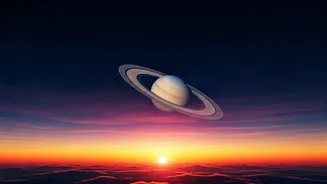
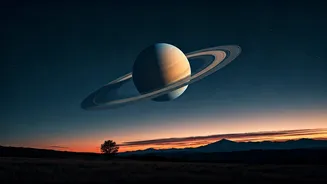
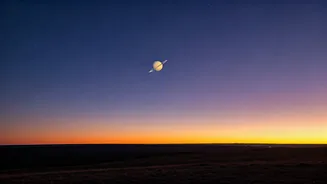
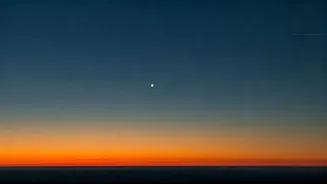
Forget what you’ve seen in textbooks for a moment. To the naked eye, Saturn won’t appear as a world with visible rings. Instead, it presents itself as a serene, steady point of light. The key identifier is its color: a distinct, creamy, yellowish-white.
It’s a mellow glow, not a sharp, brilliant sparkle. Unlike the frantic twinkling of distant stars, Saturn shines with a calm, unwavering confidence. It’s the sixth planet from the sun, a colossal gas giant nearly 800 million miles away, and its reflected sunlight travels all that way to appear as a peaceful beacon in our morning sky. When you scan the heavens, look for the object that seems oddly tranquil among its shimmering neighbors. That’s your target.
When and Where to Look
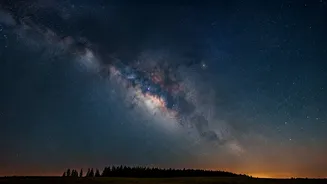
Timing and direction are everything for this celestial treasure hunt. You’ll want to head outside about 90 minutes to an hour before your local sunrise. This gives you a dark enough sky to spot Saturn easily, but it’s late enough that the planet will have risen above the horizon haze. Any earlier, and it might be too low; any later, and the approaching dawn will wash it out. Your viewing direction is east, or more precisely, southeast. Face the direction where the sun will eventually rise. Depending on the time of year and your location, Saturn will be climbing up from that direction. A good compass app on your phone can help you get oriented, but simply facing the general direction of the sunrise will put you in the right ballpark. Find a spot with an unobstructed view of the eastern horizon—a park, a field, or even an east-facing window in an upper-story apartment can work.
The Only Equipment You Need
Here’s the best part: you don’t need any expensive equipment. This is a show you can enjoy with just your eyes. The beauty of planetary viewing is its accessibility. While a powerful telescope is required to resolve Saturn’s famous rings, the simple act of finding and identifying a whole other world with your naked eye is a profound experience in itself. If you happen to have a pair of binoculars, by all means, bring them. They won’t show you the rings, but they will stabilize Saturn’s light, making its yellowish color more apparent and resolving it into a tiny, sharp disk rather than a point. A basic telescope, even a beginner model, might give you a hint of the rings—a suggestion that the planet is not perfectly round. But don't let a lack of gear stop you. The core experience is available to everyone.
The “Twinkle Test” Pro Tip
If you’re scanning the sky and see a few bright objects, how do you know which one is Saturn? Use the “twinkle test.” Stars, which are unimaginably distant suns, are effectively single points of light from our perspective. As their light travels through Earth’s turbulent atmosphere, it gets bounced around, causing the signature twinkling or scintillating effect. Planets in our solar system, on the other hand, are vastly closer. Even though they look like points, they are actually tiny disks in the sky. Their light comes from a slightly larger area, and this makes them much less susceptible to atmospheric distortion. As a result, planets tend to shine with a steady, solid light. So, if you see a bright yellowish “star” that isn’t twinkling, you’ve almost certainly found Saturn.
Check for Cosmic Neighbors
Saturn is rarely alone in its patch of sky. Depending on the month, you may spot other celestial travelers nearby. Often, the reddish planet Mars will be in the same pre-dawn neighborhood. If you see a distinctly reddish-orange point of light in addition to a yellowish one, you’re likely seeing Mars and Saturn in the same field of view. Comparing their colors side-by-side can be a rewarding observation. Using a free stargazing app on your smartphone (like Star Walk, SkyView, or Stellarium) for just a moment can confirm your finding. Simply point your phone at the object you’re looking at, and the app will identify it for you. This can turn a simple viewing into a more confident and educational experience, helping you map out the cosmic geography right above your head.