




What Exactly Is Rath Yatra?
Rath Yatra, which translates to “Chariot Journey,” is an annual Hindu festival held in the coastal city of Puri in Odisha, India. While the headline pins it to June, this massive event follows a lunisolar calendar, typically falling in late June or early
July. At its heart, the festival celebrates the journey of three deities—Lord Jagannath, his elder brother Balabhadra, and their sister Subhadra—as they travel from their home in the main Jagannath Temple to the Gundicha Temple, said to be their aunt's home, for a nine-day visit. It’s not just a procession; it's a public audience with gods who are typically cloistered inside a temple accessible only to Hindus. During Rath Yatra, the deities come out for everyone, making it a profoundly inclusive and unifying event.
The Stars: Deities with a Unique Form
Unlike the intricately sculpted marble or bronze idols common in many Hindu temples, the figures of Jagannath, Balabhadra, and Subhadra are distinct and captivating. Carved from sacred neem wood, they are characterized by large, round eyes, a lack of defined limbs, and bold, abstract forms. This iconic, almost primal look has deep theological roots, representing a form of the divine that is accessible and universal. The wooden idols are ceremonially replaced every 12 or 19 years in a highly sacred ritual known as Nabakalebara (“New Body”), adding another layer of cyclical renewal to the tradition. For the procession, smaller, mobile versions of the deities are brought out to ride in the chariots, ready for their annual public outing.
The Colossal Chariots
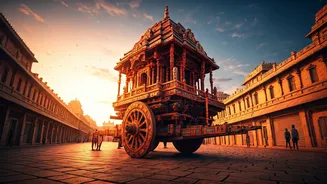
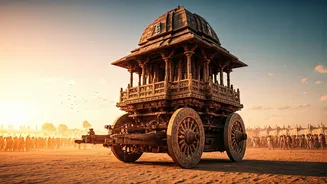
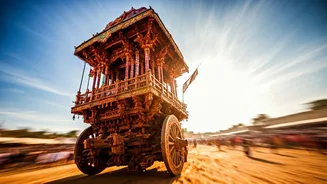
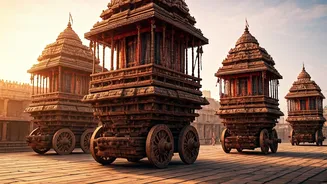
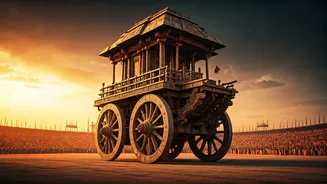
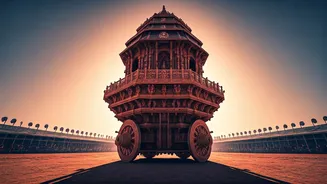
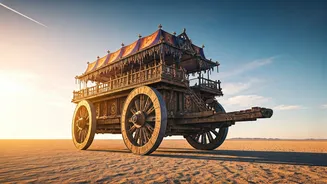
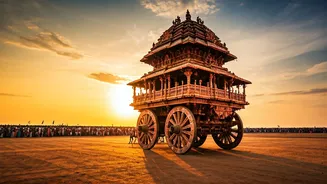
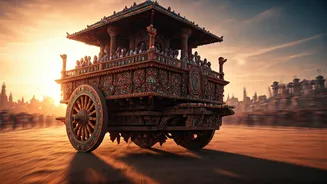
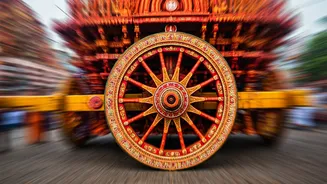
The chariots themselves are masterpieces of sacred engineering and artistry, built fresh every year by a dedicated community of hereditary carpenters. These are not mere floats. Each is a towering, temple-like structure built to specific dimensions prescribed by ancient texts. Lord Jagannath’s chariot, Nandighosa, stands about 45 feet tall and rolls on 16 massive wheels. Balabhadra’s chariot, Taladhwaja, is nearly as large, while Subhadra’s, Darpadalana, is slightly smaller. Decorated with vibrant fabrics, flags, and carvings, each chariot is a moving shrine. The construction process begins months in advance and is a ritual in itself, using specific wood from designated forests. Once completed, they become the centerpiece of a sea of humanity.
A Pilgrimage of Millions
The scale of the Rath Yatra is staggering. On the main festival day, the wide avenue leading from the Jagannath Temple, known as the Bada Danda, transforms into a dense river of people. Estimates often place the crowd at over a million strong, all gathered for a single purpose: to get a glimpse of the deities and, if possible, to touch the thick coir ropes used to pull the chariots. In Hindu belief, pulling the chariot of the gods is an act of immense devotion that can wash away sins. The air thickens with the sound of gongs, conch shells, and rhythmic chanting as the immense structures begin their slow, swaying journey. It’s a powerful, overwhelming, and deeply personal experience for the pilgrims who travel from across India and the world to participate.
More Than Just a Parade
While the spectacle is undeniable, the Rath Yatra is saturated with symbolism. The journey of the deities from their formal, structured temple environment out into the public sphere is seen as an act of divine compassion. For this one period, Lord Jagannath, whose name means “Lord of the Universe,” makes himself visible to all, breaking down barriers of caste and religion. The festival demonstrates a democratic and accessible aspect of faith. The physical act of pulling the chariots together, with people from all walks of life heaving on the same rope, is a powerful metaphor for collective spiritual effort and community solidarity.