






Beyond the Textbook Diagram
For generations, science education has wrestled with a fundamental challenge: how to teach complex, dynamic, three-dimensional concepts using flat, static, two-dimensional tools. A textbook illustration of protein folding or a whiteboard drawing of planetary
orbits can only convey so much. Students are often left to memorize facts rather than build an intuitive understanding of the systems at play. This gap between abstract information and tangible comprehension is where many students lose interest or fall behind, convinced that science is just too hard.Now, a growing number of classrooms are turning to a solution that feels like it’s pulled from science fiction. By integrating interactive digital environments, often described as “AI sandboxes,” educators are giving students the power to not just see, but to touch, manipulate, and experiment with the very building blocks of science. It’s a shift from passive observation to active, hands-on discovery.
What Is an 'AI Sandbox'?
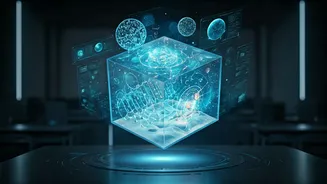
The term “AI sandbox” might sound technical, but the concept is beautifully simple. Imagine a digital playground with no set rules, where the toys are scientific models. In this virtual space, a student can grab a carbon atom, bond it to an oxygen atom, and see how the structure changes in real-time. They can introduce a catalyst and watch a reaction speed up, or change the temperature and see a protein denature. It’s a space for consequence-free experimentation.The “AI” component often works in the background. It’s not necessarily a conversational chatbot, but a sophisticated simulation engine that ensures the virtual world behaves according to the real laws of physics, chemistry, and biology. The AI governs the simulation, provides adaptive feedback based on a student’s actions, and can generate new scenarios or problems tailored to their learning level. It’s less about artificial intelligence in the popular sense and more about an intelligently designed, responsive learning environment.
From Abstract to Actionable
The applications for these tools span the scientific curriculum. In biology, students can shrink down to a microscopic level and navigate the bustling interior of a human cell, identifying organelles by actually flying up to and interacting with them. They can construct a DNA double helix strand by strand, gaining a tactile sense of its structure that a diagram could never provide.In chemistry, they can build molecules and see their 3D geometry form automatically, helping them understand why molecular shape is critical to function. In Earth science, they can manipulate tectonic plates to see how mountains form or how earthquakes are generated. In physics, they can build a virtual roller coaster to learn about potential and kinetic energy, adjusting the height of the hills and the mass of the cart to see the immediate effects. The sandbox transforms abstract variables in an equation into tangible levers a student can pull.
The Promise and the Hurdles
The educational promise is immense. Proponents argue these tools foster deeper, more intuitive learning and significantly boost student engagement. For students who learn best by doing, or those who struggle with abstract thought, these sandboxes can be revolutionary, leveling the playing field. They encourage a scientific mindset based on curiosity, experimentation, and learning from failure.However, the path to widespread adoption is not without its hurdles. The most significant are cost and equity. The software and the necessary hardware—whether it’s a tablet, a powerful computer, or a full VR headset—can be expensive, creating a potential digital divide between well-funded and under-resourced school districts. Furthermore, effective integration requires more than just buying the technology; it demands comprehensive teacher training. Educators need to learn not only how to operate the software but also how to design lesson plans that leverage its unique exploratory capabilities, moving beyond traditional instruction methods. Without that support, even the most advanced tools risk becoming little more than a high-tech novelty.