




What Exactly Is Walking Yoga?
Walking yoga, sometimes called mindful walking, isn't about attempting a downward dog in the middle of a public park. Instead, it’s a hybrid practice that infuses a regular walk with the core principles of yoga: conscious breathing (pranayama), mindful awareness,
and simple, modified poses (asanas). Think of it as elevating your daily stroll into a moving meditation. The focus shifts from speed or distance to the quality of your movement and the connection between your body, breath, and surroundings. It trades the yoga mat for a sidewalk, trail, or beach, making the practice accessible to almost anyone, anywhere.
The ‘Gentle’ Advantage
The primary appeal of walking yoga is its low-impact nature. For many, high-intensity workouts can be punishing on the joints, and traditional yoga classes can feel intimidating or inaccessible. Walking yoga removes these barriers. It puts minimal stress on the knees, hips, and ankles, making it an ideal choice for beginners, older adults, people recovering from injuries, or anyone simply seeking a more compassionate form of exercise. Unlike a fast-paced vinyasa flow, the rhythm is dictated by your own breath and comfort level. There’s no pressure to keep up or achieve a perfect pose, only an invitation to move in a way that feels good and nourishing for your body.
Making Fitness ‘Shareable’
While traditional yoga is often a solitary, internal practice, walking yoga is inherently social. It’s an activity that can be easily shared with a friend, partner, or a small group. Walking and talking is already a natural way to connect, and adding a mindful, gentle layer of movement only enhances the experience. It becomes a shared ritual rather than a competitive workout. This social component is a powerful motivator, helping you stay consistent with your fitness goals because it feels less like a chore and more like quality time. All you need is a willing partner and a safe place to walk, transforming exercise into a tool for both physical health and social connection.
How to Start Your First Walk
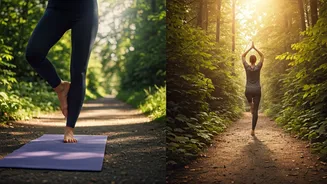
Getting started is simple. You don't need any special gear, just comfortable shoes and an open mind. 1. **Warm-up:** Begin by standing still for a minute. Take a few deep breaths and set an intention for your walk, such as to feel calm or energized. 2. **Sync Breath to Steps:** As you start walking, coordinate your breath with your stride. A common pattern is to inhale for four steps and exhale for four steps. Find a rhythm that feels natural and calming, not forced. 3. **Stay Present:** Tune into your senses. Notice the feeling of your feet on the ground, the temperature of the air, and the sounds around you. When your mind wanders, gently guide it back to the sensation of walking and breathing. 4. **Incorporate Poses:** You don’t need to stop for a full sequence. You can integrate gentle movements as you go, such as rolling your shoulders back and down or lifting your arms overhead for a full-body stretch. You can also pause for a simple standing pose, like Mountain Pose (Tadasana) to reset your posture or Tree Pose (Vrksasana) using a park bench or tree for balance.
Tips for a Better Practice
To deepen your walking yoga experience, consider leaving your headphones at home. Allowing yourself to listen to the ambient sounds of your environment is a key part of the mindful experience. Choose a route that is visually pleasing and safe, like a quiet neighborhood street, a park trail, or a beach. The goal is to feel relaxed, not on high alert. Finally, let go of expectations. Some days your walk will feel deeply meditative, and other days it might just feel like a nice walk. Both are perfectly fine. The practice is about showing up and moving with intention, whatever that looks like for you on any given day.