

What Exactly Is a 'Food Rave'?
Forget white tablecloths and hushed conversation. The term 'food rave' might sound like a marketing gimmick, but it captures a seismic shift in what we expect from a night out. Think of it less as a restaurant and more as a festival with a culinary focus.
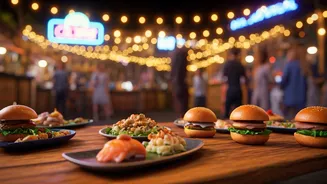
These are large-scale, ticketed events that fuse food with spectacle. We’re talking about warehouse spaces transformed by projection mapping, internationally renowned DJs providing a thumping soundtrack, and a dozen different food stations helmed by acclaimed chefs. It’s not about sitting down for a three-course meal; it's about wandering, tasting, socializing, and immersing yourself in a fully produced environment. The food is a central character, but it shares the stage with music, art, and a powerful sense of communal energy. The goal isn’t just satiety; it's sensory overload.
The Experience Economy Hits the Dinner Plate
This trend didn't appear in a vacuum. It’s the logical endpoint of the 'experience economy,' a concept that’s been reshaping consumer behavior for over a decade. Driven largely by Millennials and Gen Z, the preference has tilted away from owning things and toward doing things—and, crucially, documenting them. A food rave is infinitely more shareable on social media than a beautifully cooked but visually standard steak frites. It provides a story, a backdrop, and a set of FOMO-inducing moments. For the price of a nice dinner, consumers can get a meal, a concert, and a gallery visit all in one. This multi-layered value proposition is incredibly powerful. Restaurants traditionally sold food and service. Food raves sell an entire evening’s worth of entertainment, with the meal woven into the fabric of the event.
Where Traditional Restaurants Get Left Behind
Here's the rub for the 'basic' restaurant—a term that, in this context, simply means a traditional establishment focused on food and service quality without a major experiential hook. Their entire model is built on consistency, quiet excellence, and a predictable, pleasant experience. But that very predictability can be a liability when competing for the attention of a diner seeking novelty and excitement. A traditional restaurant cannot realistically compete on scale or spectacle with an event that takes over a 50,000-square-foot venue. They can’t book a world-famous DJ. They can’t offer the same sprawling variety. Their core strengths—intimacy, personal service, a carefully controlled environment—are the exact opposite of what a food rave delivers. They are playing a different game, but they are increasingly fishing from the same pond of discretionary spending.
Is There Still Room for a Quiet Dinner?
So, is every neighborhood bistro doomed? Not exactly. The headline’s claim that they “cannot compete” is strong, but the reality is more nuanced. While they may not be able to out-dazzle a food rave, they can thrive by doubling down on what makes them special. The desire for a loud, communal spectacle on a Saturday doesn't negate the need for a quiet, intimate anniversary dinner on a Tuesday. The antidote to the food rave isn’t to try to become one. It’s to become the best possible version of a traditional restaurant. This means flawless service, exceptional and consistent food, a deep connection to the local community, and creating a sanctuary from the sensory overload of modern life. Some restaurants are also finding a middle ground, incorporating lighter experiential elements like themed tasting menus, live music nights, or exclusive chef’s table events. They are learning to create their own, smaller-scale 'moments' that are just as memorable, albeit in a different way.