




The Journey to the Middle Land
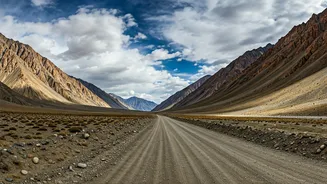
Getting to Kaza is a pilgrimage in itself. Tucked away in the Spiti Valley of Himachal Pradesh, a region often called “Little Tibet,” Kaza is sealed off by snow for nearly half the year. But come June, the high mountain passes creak open, revealing a road
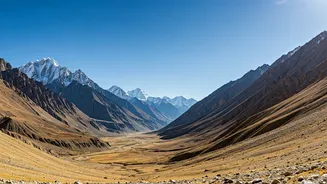
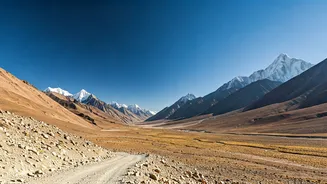
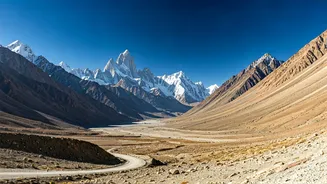
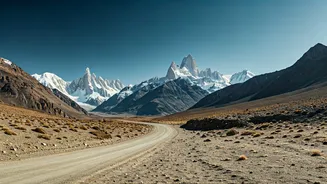
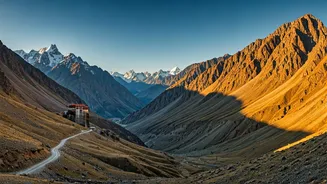
that’s as much a part of the adventure as the destination. Whether you arrive from the lush green side of Manali or the winding cliff-hugging roads from Shimla, the journey is an acclimatization process, both for your body and your senses. The air thins, vegetation vanishes, and the landscape transforms into a dramatic canvas of dust, rock, and sky. This isn't a commute; it’s an ascent into another realm, where every hairpin turn reveals a vista more stark and stunning than the last. The rumbling engine and the vast, silent emptiness outside your window are the first signs you’re leaving the familiar world far behind.
An Oasis in the Cold Desert
After hours navigating raw, elemental scenery, the sight of Kaza is almost a mirage. As the administrative headquarters of the Spiti Valley, it's a bustling hub of activity, but “bustling” here is relative. The town, sitting at over 12,000 feet, is a small grid of guesthouses, cafes serving momos and thukpa, and shops selling prayer flags and trekking gear. It’s a base camp for the soul. Trekkers, monks, motorcyclists, and travelers from around the globe converge here, all drawn by the valley’s magnetic pull. Kaza itself isn’t a polished tourist town; its charm lies in its authenticity. It’s a functional, hardy settlement where modern conveniences meet ancient traditions, all set against the staggering backdrop of jagged, snow-dusted peaks that dominate every view.
Monasteries Suspended in Time
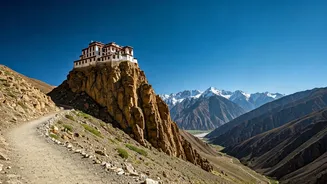
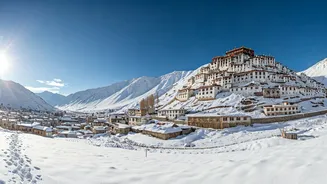
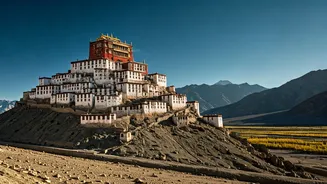
The true soul of Spiti is found in its monasteries, and none is more iconic than Key (or Kye) Gompa. Just a short drive from Kaza, this Tibetan Buddhist monastery appears to be tumbling down a conical hill, a chaotic jumble of white-washed rooms and prayer halls built atop one another over centuries. It looks less like a building and more like a natural growth, an extension of the mountain itself. Standing on its rooftop, with prayer flags whipping in the wind and young monks chanting in a distant hall, the silence of the valley below is profound. These are not museums; they are living, breathing centers of faith that have anchored the community for a thousand years, their vibrant murals and ancient texts preserved by the dry, cold air.
Land of Fossils and Postcards
The villages surrounding Kaza add layers to its otherworldly character. A short, bumpy drive takes you to Langza, a village marked by a colossal golden Buddha statue that gazes serenely over the valley. Here, children play in fields where villagers casually find marine fossils—ammonites millions of years old, remnants of a time when the Himalayas were the floor of the Tethys Sea. A little further on is Hikkim, home to the world’s highest post office. Sending a postcard from this tiny, hand-painted building is a rite of passage, a tangible connection back to a world that feels a million miles away. These small outposts of human resilience, set in a landscape of unimaginable scale, are what make the region feel so uniquely special.
The Palette of a High-Altitude Desert
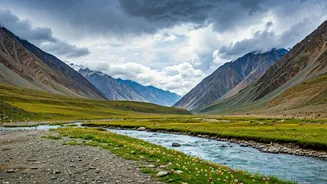
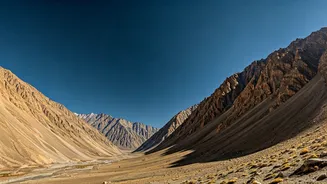
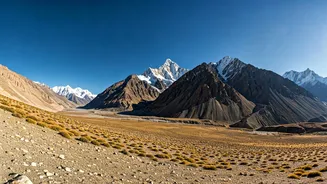
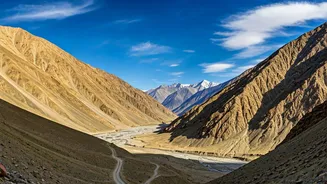
Ultimately, the “otherworldly” feeling comes from the light and the land itself. In June, the sun is sharp and intense, casting deep, dramatic shadows across the landscape. The Spiti River, a ribbon of turquoise meltwater, cuts through the broad, beige valley floor. The mountains are not green but a hundred shades of brown, ochre, and gray, their textures changing with the passing sun. Above it all, the deep blue, pollution-free sky is so vast it feels infinite. This isn't the gentle beauty of a meadow or a forest. It’s a raw, powerful, and humbling beauty that recalibrates your sense of scale and reminds you of the planet's raw power.