






An Alien Rock on Earth
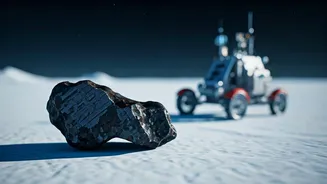
First, let's talk about the rock. It’s not just any meteorite. Recently classified by researchers, this particular space rock was discovered in Antarctica, a pristine environment that acts as a natural cold storage for objects that fall from the sky.
This one, however, didn't come from the asteroid belt between Mars and Jupiter. Geochemical analysis confirmed its origin: the Moon. Specifically, it’s a piece of lunar anorthosite. That might sound like technical jargon, but it’s a critical material. Anorthosite is a type of igneous rock rich in a specific mineral (plagioclase feldspar) and is believed to make up the Moon's primordial crust. Think of it as the Moon’s original building block, formed from a vast magma ocean that cooled billions of years ago. Finding a piece of it on Earth is exceptionally rare. These lunar meteorites are blasted off the Moon's surface by asteroid impacts and, after drifting through space, eventually get caught in Earth's gravity. They are, quite literally, free samples from our celestial neighbor.
India's Historic Touchdown
Now, let’s pivot 239,000 miles away to the Moon itself. In August 2023, India's Chandrayaan-3 mission made history by successfully landing its Vikram lander near the lunar south pole—a region no other country had reached. This achievement wasn't just about planting a flag; it was a complex scientific expedition. Once settled, the lander deployed a small, six-wheeled rover named Pragyan. The rover's primary job was to roam the unexplored terrain and analyze its chemical and mineralogical composition. It was equipped with sophisticated instruments, including a Laser-Induced Breakdown Spectroscope (LIBS). The goal of LIBS was to zap lunar soil and rocks with a high-powered laser, vaporize a tiny amount of material, and then analyze the light emitted from the resulting plasma. This process allows scientists to determine precisely what elements are present on the surface, giving them an on-site chemical inventory of the lunar south pole for the first time.
The Scientific Handshake
Here’s where the two stories merge. One of Chandrayaan-3's key findings, revealed by the Pragyan rover's instruments, was the unambiguous confirmation of sulfur in the lunar soil, along with expected elements like aluminum, calcium, iron, and silicon. These are the very elements that constitute anorthosite—the exact material of that meteorite sitting in a lab back on Earth. This is the connection. The Antarctic meteorite is a physical piece of the Moon's ancient crust that scientists can hold, slice, and study with powerful laboratory equipment. Meanwhile, the Chandrayaan-3 rover was performing the same fundamental analysis *in situ* on the Moon's surface. It’s a perfect scientific partnership. The rover’s data provides ground truth and context from the original location, while the meteorite provides a tangible sample that can be subjected to tests far too complex to be performed by a small rover. It's like a detective having both a DNA sample from a suspect and video footage of them at the crime scene; each piece of evidence makes the other more valuable.
Why This Changes the Game
This synergy between meteorite science and space exploration is a powerful tool for understanding our solar system. The data from Pragyan helps confirm that the anorthositic meteorites found on Earth are representative of the lunar highlands, reinforcing our theories about the Moon's formation. It validates our models of how the Moon evolved from a molten ball into the rocky world we see today. For India, it’s a monumental success. The Chandrayaan-3 mission wasn’t just a technological triumph that placed the country in an elite club of space-faring nations; it produced high-quality, impactful science that is now being used by researchers globally. The mission's findings, when combined with the analysis of rare lunar meteorites, provide a much richer, more complete picture of the Moon’s geology and history. This two-pronged approach—studying celestial bodies both remotely with robots and directly with samples that fall to Earth—is accelerating planetary science in ways that were once unimaginable.