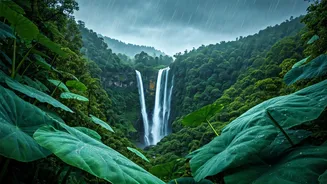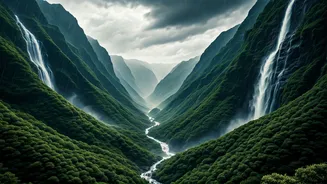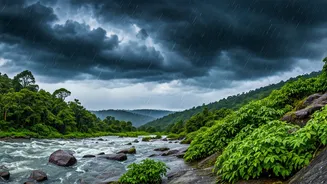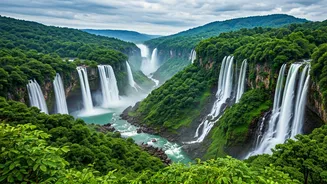




Mawsynram, India: The Reigning Champion
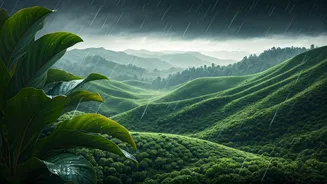
Deep in the rolling hills of northeastern India, the village of Mawsynram holds the Guinness World Record for the highest average annual rainfall on Earth. We're not talking about a few extra showers; we're talking about a staggering 467 inches of rain per
year. For perspective, that’s nearly 40 feet of water—enough to submerge a three-story building. The reason for this deluge is simple geography. During the monsoon season, moisture-laden clouds sweep in from the Bay of Bengal and slam directly into the Khasi Hills, forcing them to dump their watery cargo right on top of Mawsynram. Life here has adapted in beautiful ways. Villagers wear traditional full-body umbrellas called ‘knups,’ woven from bamboo and banana leaves. Homes are soundproofed with extra insulation to dull the deafening roar of constant rain. And most famously, locals have spent centuries guiding the roots of rubber trees across ravines to form incredible, living bridges strong enough to withstand the wettest place on the planet.
Tutunendo, Colombia: The Tropical Contender
While Mawsynram officially holds the record, many climatologists argue the true winner might be in South America. Welcome to Tutunendo, a small town in Colombia’s Chocó department, a region known for its hyper-humid climate and staggering biodiversity. Reliable weather data is harder to come by here, but studies suggest the area receives around 450-500 inches of rain annually. Unlike Mawsynram, which has a distinct dry season, Tutunendo is drenched almost year-round. Located near the Equator and nestled between the Andes and the Pacific coast, it's in a perfect storm of weather patterns. The result isn't a dreary landscape but an explosion of life. The region is a biodiversity hotspot, home to poison dart frogs, jaguars, and countless species of orchids that thrive in the perpetual moisture. For the Afro-Colombian communities here, the rivers born from this rain are their highways, their source of food, and the center of their world.
Mount Waialeale, Hawaiʻi: America's Weeping Mountain
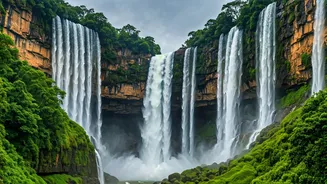
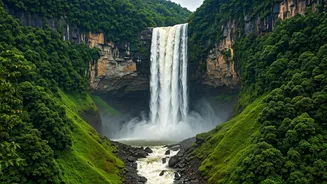
You don't have to leave the U.S. to find one of Earth's wettest spots. On the island of Kauaʻi, the summit of Mount Waialeale (pronounced 'wai-ah-lay-ah-lay') is a sacred, mist-shrouded peak that receives an average of 450 inches of rain a year. Its name translates to 'rippling water' or 'overflowing water,' and it's easy to see why. The mountain’s steep, conical shape is perfectly positioned to catch the moisture-heavy trade winds coming off the Pacific. As the air is forced upward, it cools and condenses, creating near-constant rainfall. This process, known as orographic lift, turns the mountain's peak into one of the most inaccessible and otherworldly landscapes in America. The summit is almost always cloaked in clouds, and the constant runoff has carved deep, dramatic valleys and created the island’s famous waterfalls. For Native Hawaiians, it is a sacred place, the origin of the island's life-giving water.
Cherrapunji, India: The Famous Runner-Up
Just ten miles from Mawsynram lies Cherrapunji, the town that for decades was known as the wettest place on Earth before its neighbor stole the crown. While its annual average is slightly lower than Mawsynram's, Cherrapunji is no slouch. In fact, it still holds the world records for the most rainfall in a single calendar month (a mind-boggling 366 inches in July 1861) and in a single year. The rivalry between the two villages is friendly, but it highlights just how uniquely intense the weather is in this small pocket of the world. Like Mawsynram, Cherrapunji is home to the Khasi people and their spectacular living root bridges. Its presence on this list is a reminder that extreme weather is often a regional phenomenon, a product of mountains, wind, and water conspiring to create something truly extraordinary.