






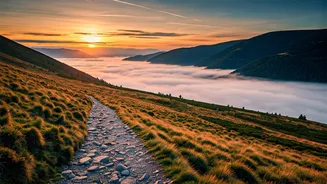
What Exactly Is Quiet Travel?
Forget whirlwind tours of Europe or back-to-back excursions in a tropical paradise. Quiet travel is the antithesis of the jam-packed, performative vacation. At its core, it’s about prioritizing peace, relaxation, and introspection over a crowded itinerary.
Think of it as a travel philosophy centered on minimal stress, slow pacing, and genuine disconnection. The goal isn't to 'see it all,' but to truly rest and recharge. This might look like renting a secluded cabin with no agenda, spending a week in a small town with one good bookstore, or simply choosing a hotel with a focus on tranquility over a central, noisy location. It’s a deliberate move away from the pressure to have the 'best' or 'most exciting' trip and a move toward one that is personally restorative. The metric for success isn't the number of landmarks ticked off a list, but the feeling of calm you bring home.
A Reaction to Digital Burnout
It’s no surprise that this trend is finding a foothold with Gen Z, a generation that has grown up terminally online. The concept of the 'Instagrammable' vacation—where every meal, view, and outfit is curated for an online audience—created a form of travel that felt more like work than leisure. Quiet travel is a direct and pointed rebellion against this. After years of pressure to document and perform, the ultimate luxury is now the ability to put the phone down and simply exist in a place. This isn't just a digital detox; it's a fundamental re-evaluation of a vacation's purpose. For a generation acutely aware of mental health and burnout, a trip that adds to their stress load by demanding constant content creation is no longer appealing. Instead, they’re seeking experiences that offer an escape not just from their hometowns, but from the digital panopticon of social media itself.
The Anti-Hustle Holiday
The quiet travel trend fits perfectly within Gen Z's broader rejection of hustle culture. The same generation popularizing 'quiet quitting' and 'lazy girl jobs' is now applying that same logic to their time off. If the workplace is no longer seen as the sole source of identity and fulfillment, then a vacation doesn't need to be a hyper-productive achievement either. The pressure to optimize every waking moment—a hallmark of millennial hustle culture—is being actively dismantled. A quiet vacation is an act of defiance. It says that rest is not just a 'nice to have,' but a non-negotiable necessity. It values stillness in a world that fetishizes motion. This mindset reframes travel from an opportunity to accumulate experiences and social capital into an opportunity for deep, unapologetic rest.
What It Looks Like in Practice
So, what does a quiet traveler's itinerary look like? Often, it barely looks like an itinerary at all. It might involve booking a train trip through a scenic region with no specific stops planned, just the goal of watching the world go by. It could be a stay at a wellness retreat that focuses on silence and meditation over group activities. Or it might be as simple as visiting a familiar national park during the off-season to hike empty trails and avoid the crowds. Destinations are chosen for their atmosphere, not their fame. Think less Paris, Rome, and Tokyo, and more of the Scottish Highlands, the coast of Maine, or a quiet village in the Japanese countryside. The focus is on immersive, low-stimulus environments where the main attractions are nature, silence, and the freedom from obligation.