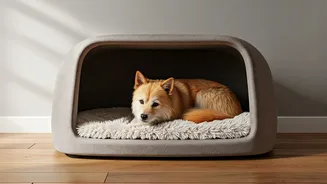




Why Every Pet Needs a 'Den'
A “den” isn't just a cute marketing term for a pet bed. It’s a foundational element of your pet's psychological well-being. For both dogs, whose ancestors were den animals, and cats, who are masters of finding secure hiding spots, having a personal sanctuary
is non-negotiable. This space is more than a place to sleep; it’s a retreat from the chaos of a human household. Think of the doorbell ringing, the vacuum cleaner roaring, or unfamiliar guests arriving. A safe den provides an 'off-switch' for stress, giving your pet a predictable place to decompress where they know they won't be bothered. When a pet has a secure base, they can explore the world with more confidence, knowing they have a safe spot to return to. Without one, they may live with a low-grade, constant anxiety, which can manifest as destructive behavior, reactivity, or reclusiveness.
How to Create the Perfect Sanctuary
Building a proper den is an exercise in respecting your pet’s instincts. For dogs, a crate can be a wonderful den—if it’s introduced correctly. It should never be used for punishment. Instead, make it a five-star canine hotel: furnish it with comfortable bedding, leave the door open, and offer high-value treats and toys inside. Place it in a quieter corner of a living area, not isolated in a basement. For cats, think vertically and horizontally. They need options. A high perch on a cat tree, a cardboard box in a closet, or a cozy covered bed under a table can all serve as dens. The cardinal rule for any pet’s den is that it is their space. Instruct family members and guests, especially children, that when the dog is in his crate or the cat is in her box, they are not to be disturbed. This inviolable boundary is what transforms a simple bed into a true sanctuary.
Making the Shift to 'Smarter Care'
'Smarter care' doesn't mean buying the most expensive tech toy; it means becoming a more observant and proactive guardian. It’s about moving beyond the basics of food, water, and shelter and focusing on your pet’s mental and emotional state. This starts with environmental enrichment. A sterile home is a boring home for an animal with a brain wired for sniffing, hunting, and exploring. Smarter care means creating a more stimulating environment that allows them to express these natural behaviors. It’s a shift from simply containing an animal to actively helping them thrive. This approach recognizes that boredom and a lack of agency are significant sources of stress and behavioral problems in modern pets.
Rethinking Mealtime and Play
Ditch the boring bowl. For thousands of years, your pet’s ancestors worked for their food. Dumping a pile of kibble into a dish twice a day removes one of the most enriching activities from their lives. 'Smarter' feeding incorporates puzzle feeders, snuffle mats, and food-dispensing toys that require your pet to forage, problem-solve, and use their nose. This simple change can alleviate boredom, build confidence, and slow down fast eaters. Similarly, play should be more than just endlessly throwing a ball. Engage your pet’s mind with games like 'find it,' where you hide treats around a room, or teach them new tricks. For cats, interactive wand toys that mimic the hunt-catch-kill sequence are far more satisfying than a pile of animatd toy mice.
Learn to 'Listen' to Your Pet
The final piece of smarter care is learning your pet’s language. They are constantly communicating their emotional state, but often in subtle ways we miss. A dog yawning when it isn't tired is likely a sign of stress. A cat with a slightly twitching tail might be signaling growing irritation. Pay attention to these quiet signals. This understanding is the foundation of 'cooperative care,' a modern training approach that empowers pets to participate in their own handling. Instead of wrestling your dog to trim his nails, you can train him to offer his paw willingly. Instead of chasing your cat with a pill, you can teach her to take it voluntarily in a treat. This transforms potentially terrifying experiences into predictable, consent-based interactions, building a profound level of trust between you and your animal.