


What is the story about?
In an industry that often confuses visibility with vitality, Jessie Buckley has built a career on something rarer: volatility. She is not an actress who settles into a persona. She flares, recedes, reshapes. Across musicals, psychological dramas and caustic comedies, Buckley has cultivated a screen presence that feels both feral and rigorously controlled.
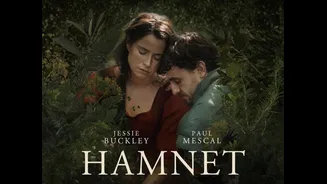
Now, with her incandescent performance in Chloe Zhao’s Hamnet, she stands as the clear front-runner for this year’s Best Actress prize at the Academy Awards—having already secured a BAFTA, a Golden Globe, SAG’s Actor Award and the Critics Choice Movie Award. If she also bags an Oscar for her blistering portrayal in the biographical period drama that also stars a terrific Paul Mescal, it will not be a coronation but a culmination.
Buckley’s ascent has been anything but linear. After first drawing attention in the BBC talent show
I’d Do Anything (2008), she resisted the easy route of West End ingénue-dom. Instead, she gravitated toward roles that tested her elasticity. In Tom Harper’s Wild Rose (2018), she detonated onto the international stage as Rose-Lynn Harlan, a Glaswegian ex-con with delusions—or perhaps premonitions—of Nashville grandeur.
It was a performance of startling musicality and emotional candour. Buckley sang live, her voice veering from raw to rapturous, but what lingered was her refusal to sentimentalise Rose-Lynn’s selfishness. The film might have been a plucky underdog story, but Buckley made it a study in arrested adolescence. Stardom, for her, was never about polish. It was about abrasion.
That willingness to court discomfort reached a new register in Charlie Kaufman’s psychodrama I’m Thinking of Ending Things (2020). As the unnamed young woman trapped in a snowbound surrealist thriller, Buckley navigated dialogue that looped and fractured, embodying a consciousness that seemed to splinter in real time. Her performance was intellectual without being bloodless. She made abstraction tactile—her smiles tightening by millimetres, her voice cooling almost imperceptibly as the film’s existential dread thickened. In a career defined by risk, this was perhaps the moment she announced herself as an actress unafraid of opacity.
Yet Buckley has also demonstrated a wicked instinct for tonal play. In Thea Sharrock's period black comedy Wicked Little Letters (2024), she weaponised profanity with comic precision, sparring opposite Olivia Colman in a seaside scandal that doubled as a sly critique of misogynistic hysteria. Her performance was bawdy but calibrated, revealing how quickly society can brand a woman monstrous for speaking too loudly. Even in lighter fare, Buckley resists caricature. She locates the bruise beneath the punchline.
But it was in Maggie Gyllenhaal’s
The Lost Daughter (2021) that Buckley offered perhaps her first glimpse of awards-season inevitability. As the younger version of Leda, the ambivalent mother played in middle age by Colman, she delivered a performance of unnerving candour. Buckley refused to soften Leda’s cruelty or her yearning. Motherhood, in her hands, became a site of claustrophobia and intellectual hunger. The camera lingered on her face as if studying a fault line; Buckley allowed us to see the tectonic plates shift.
All of which prepared her for her character Agnes in
Hamnet, an adaptation of Maggie O’Farrell’s 2020 historical fiction novel of the same name. The film, set in plague-ravaged Elizabethan England, reimagines the grief of a mother who loses her son—an event that shadows the life of her husband, the celebrated thespian William Shakespeare.
It would have been easy to treat Agnes as a vessel for tragedy, an icon of maternal suffering. But Buckley does something braver. She plays grief as a contagion that alters the body. Her Agnes is earthy, intuitive, almost pagan in her intimacy with the natural world. Early scenes show her moving through orchards and apothecary jars with feline assurance; after her son’s death, that assurance fractures into stillness. Buckley’s face becomes an elemental landscape—eyes clouded yet searching, jaw clenched against a scream that never quite arrives.
The performance is remarkable for its restraint. In the film’s central mourning sequence, Buckley barely speaks. Instead, she registers loss in micro-gestures: a hand hovering over an empty bed, a breath caught halfway to a sob. It is acting that trusts silence. Where many performers might telegraph devastation, Buckley internalises it, allowing the audience to feel complicit in Agnes’s solitude. When she does erupt—her voice cracking as she confronts the inadequacy of language to contain her pain—the moment lands with seismic force.
Critically, Buckley avoids sanctifying Agnes. She permits flashes of anger, even resentment, toward a husband whose art will transmute their son’s memory into literature. This ambivalence gives the performance its modern charge. Agnes is not a muse; she is a woman whose interior life dwarfs the myth of the genius beside her. Buckley renders that interiority palpable. It is, without question, a career-defining turn—one that synthesises the musical ferocity of Wild Rose, the psychological dexterity of Kaufman’s labyrinth and the maternal complexity of The Lost Daughter into something wholly her own.
Awards momentum can sometimes feel like industry choreography, but in Buckley’s case, it reads as recognition. The BAFTA and Golden Globe wins signalled consensus; SAG’s Actor Award suggested peer reverence. An Oscar would merely formalise what has been evident for years: that Buckley belongs to the small cadre of actors who expand the emotional vocabulary of contemporary cinema.
And she shows no inclination to calcify. Her next collaboration with Gyllenhaal, The Bride!, pairs her with Christian Bale in what promises to be an eccentric reimagining of the Frankenstein mythos. Early reports hint at a performance that veers toward the operatic, even grotesque, territory Buckley has long circled but never fully claimed. If Hamnet proves her mastery of restraint, The Bride! may well unleash her appetite for theatrical excess.
For now, though, it is Agnes who lingers: a woman etched in shadow and light, carried by an actress who understands that greatness lies not in volume but in depth. Jessie Buckley has spent a decade refusing to be predictable. In Hamnet, unpredictability becomes transcendence.
Now, with her incandescent performance in Chloe Zhao’s Hamnet, she stands as the clear front-runner for this year’s Best Actress prize at the Academy Awards—having already secured a BAFTA, a Golden Globe, SAG’s Actor Award and the Critics Choice Movie Award. If she also bags an Oscar for her blistering portrayal in the biographical period drama that also stars a terrific Paul Mescal, it will not be a coronation but a culmination.
Buckley’s ascent has been anything but linear. After first drawing attention in the BBC talent show
It was a performance of startling musicality and emotional candour. Buckley sang live, her voice veering from raw to rapturous, but what lingered was her refusal to sentimentalise Rose-Lynn’s selfishness. The film might have been a plucky underdog story, but Buckley made it a study in arrested adolescence. Stardom, for her, was never about polish. It was about abrasion.
That willingness to court discomfort reached a new register in Charlie Kaufman’s psychodrama I’m Thinking of Ending Things (2020). As the unnamed young woman trapped in a snowbound surrealist thriller, Buckley navigated dialogue that looped and fractured, embodying a consciousness that seemed to splinter in real time. Her performance was intellectual without being bloodless. She made abstraction tactile—her smiles tightening by millimetres, her voice cooling almost imperceptibly as the film’s existential dread thickened. In a career defined by risk, this was perhaps the moment she announced herself as an actress unafraid of opacity.
Yet Buckley has also demonstrated a wicked instinct for tonal play. In Thea Sharrock's period black comedy Wicked Little Letters (2024), she weaponised profanity with comic precision, sparring opposite Olivia Colman in a seaside scandal that doubled as a sly critique of misogynistic hysteria. Her performance was bawdy but calibrated, revealing how quickly society can brand a woman monstrous for speaking too loudly. Even in lighter fare, Buckley resists caricature. She locates the bruise beneath the punchline.
But it was in Maggie Gyllenhaal’s
All of which prepared her for her character Agnes in
It would have been easy to treat Agnes as a vessel for tragedy, an icon of maternal suffering. But Buckley does something braver. She plays grief as a contagion that alters the body. Her Agnes is earthy, intuitive, almost pagan in her intimacy with the natural world. Early scenes show her moving through orchards and apothecary jars with feline assurance; after her son’s death, that assurance fractures into stillness. Buckley’s face becomes an elemental landscape—eyes clouded yet searching, jaw clenched against a scream that never quite arrives.
The performance is remarkable for its restraint. In the film’s central mourning sequence, Buckley barely speaks. Instead, she registers loss in micro-gestures: a hand hovering over an empty bed, a breath caught halfway to a sob. It is acting that trusts silence. Where many performers might telegraph devastation, Buckley internalises it, allowing the audience to feel complicit in Agnes’s solitude. When she does erupt—her voice cracking as she confronts the inadequacy of language to contain her pain—the moment lands with seismic force.
Critically, Buckley avoids sanctifying Agnes. She permits flashes of anger, even resentment, toward a husband whose art will transmute their son’s memory into literature. This ambivalence gives the performance its modern charge. Agnes is not a muse; she is a woman whose interior life dwarfs the myth of the genius beside her. Buckley renders that interiority palpable. It is, without question, a career-defining turn—one that synthesises the musical ferocity of Wild Rose, the psychological dexterity of Kaufman’s labyrinth and the maternal complexity of The Lost Daughter into something wholly her own.
Awards momentum can sometimes feel like industry choreography, but in Buckley’s case, it reads as recognition. The BAFTA and Golden Globe wins signalled consensus; SAG’s Actor Award suggested peer reverence. An Oscar would merely formalise what has been evident for years: that Buckley belongs to the small cadre of actors who expand the emotional vocabulary of contemporary cinema.
And she shows no inclination to calcify. Her next collaboration with Gyllenhaal, The Bride!, pairs her with Christian Bale in what promises to be an eccentric reimagining of the Frankenstein mythos. Early reports hint at a performance that veers toward the operatic, even grotesque, territory Buckley has long circled but never fully claimed. If Hamnet proves her mastery of restraint, The Bride! may well unleash her appetite for theatrical excess.
For now, though, it is Agnes who lingers: a woman etched in shadow and light, carried by an actress who understands that greatness lies not in volume but in depth. Jessie Buckley has spent a decade refusing to be predictable. In Hamnet, unpredictability becomes transcendence.