








What is the story about?
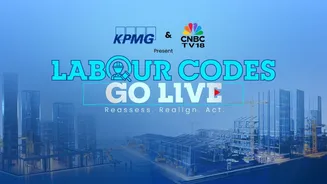
KPMG and CNBC-TV18’s special presentation on India’s newly notified labour codes unfolded as far more than a policy update. It opened a wider conversation on how decades of scattered labour legislation have finally converged into a single, modern framework aimed at clarity, transparency, and worker-centric progress.
The dialogue brought together Parizad Sirwalla (National Leader, Global Mobility Services Tax, KPMG India), Manu Wadhwa (CHRO, Sony Pictures Networks), and Manoj Garg (Group CHRO, Dr. Lal PathLabs), each offering a distinct vantage point on a reform moment set to reshape India’s workforce landscape.
Two Decades in the Making
The journey toward consolidation began with the Second National Commission on Labour’s 2002 recommendation to merge India’s complex labour laws into broad, streamlined categories.
The Ministry of Labour and Employment built on this foundation through extensive consultations, draft codes, and stakeholder engagement that eventually produced four landmark Acts—the Code on Wages, the Social Security Code, the Occupational Safety, Health and Working Conditions Code, and the Industrial Relations Code.
Their notification on November 21, 2025, marks a milestone in India’s regulatory landscape, even as certain provisions, such as the Provident Fund Act, remain in effect until the final Central and State rules are published.
Host Gautam Shrinivasan captured the significance of this transition when he said the codes are “not just about compliance… They are about transforming workplace culture, enhancing transparency, and ensuring social security for all categories of workers.”
Progressive Framework for a Changing Workforce
Parizad Sirwalla described the moment as “a monumental piece of legislation… very comprehensive, very progressive, and toward India’s development and growth trajectory.”
Her framing places the labour codes alongside significant national reforms that modernised taxation and indirect tax systems. The consolidation of 29 laws into four codes simplifies interpretation and strengthens the foundation for long-term regulatory stability.
Manu Wadhwa added a global perspective, pointing out that many countries, from Brazil to Australia to regions across Europe, have modernised labour rights in recent years. India’s reforms, she noted, align well with global trends. “What’s striking is that India’s reforms have resonated with these global trends… We are positioning ourselves as progressive in shaping a very inclusive, future-ready labour standard.”
Industry-Wide Disruption, Uneven Yet Unavoidable
The scale of change is extensive. Manoj Garg articulated this clearly: “The whole labour legislation in this country is getting completely revamped… every establishment, every industry is going to get impacted.”
Industries reliant on temporary, contractual, or gig-based work are likely to experience deeper adjustments. The new definitions for fixed-term employees, gig workers, and platform workers bring structure to categories previously characterised by ambiguity.
Organisations that already follow broader wage bases or maintain stronger compliance may transition more smoothly, yet none are untouched. Garg believes that over time, the framework will become easier to navigate, explaining that compliance will “become much simplified and thus… a much easier regimen over a bit of time.”
Preparing for Implementation: Coordination and Digital Readiness
Parizad Sirwalla emphasised that the first step toward readiness lies in internal alignment. She recommended “a cross-pollinated internal stakeholder team between HR, finance, legal, and tax” to interpret provisions comprehensively and assess organisation-wide impact.
A central feature of the codes, the universal wage definition, demands careful modelling. Manu Wadhwa called it “the biggest bold statement in the labour reforms.” For the first time, a single definition will anchor calculations for overtime, leave encashment, gratuity, and social security.
The expansion of gratuity to fixed-term employees, those engaged for contracts longer than one year, requires updated financial planning. Workforce models involving freelancers, consultants, or project-based specialists must be re-evaluated in light of clearer statutory guidelines. Digital systems also need upgrading to meet expectations around accurate, timely reporting.
Putting People at the Centre: Inclusion as Policy
The codes mark a strong shift toward inclusivity and worker protection. Manu Wadhwa highlighted provisions allowing women to work flexible or late-night shifts with consent, acknowledging caregiving responsibilities, and enabling returning mothers to work remotely where feasible.
She described the reforms as “a very progressive step towards getting gig platform workers, unorganised interstate workers… all towards taking India to the next step.”
Her reference to the media industry illustrated how the codes bring structure to semi-formal segments. Audiovisual workers will now receive appointment letters, predictable payments, overtime, and social security. “Mandatory appointment letters, timely wage payments, timely overtime, and social security inclusions ensure fitness and accountability to help attract the right talent,” she said.
Employee well-being also receives emphasis. Manoj Garg noted that codifying preventive health checkups “reflects that employee’s health is directly linked to the company’s success.”
Accelerating Toward a New Workplace Reality
Even with clear intent, operational realities demand new systems and processes. The mandate to settle wages within two days of separation raised practical questions. Manoj Garg acknowledged the complexity but expressed confidence from experience. “If the intent is there, the systems will follow,” he said, adding that his organisation has already implemented this for a large portion of its workforce.
Parizad Sirwalla reinforced that implementation is a collaborative journey. She called the codes “forward-looking… transformative… inclusive,” and emphasised the need for industry feedback and ongoing regulatory engagement as the rules evolve.
Reform as the Blueprint for India’s Future Workforce
As Gautam Shrinivasan observed, “We are seeing the foundation of a future-ready workforce being laid out.”
The transition will demand intent, coordination, and investment. Organisations must strengthen their systems, redesign policies, reassess workforce models, and adopt digital readiness not as an obligation but as a competitive advantage. The codes provide a unified framework, but the true transformation lies in how leaders embed this framework into everyday practice.
India now stands at a moment of possibility. The labour codes offer a blueprint, but the future will be shaped by those who act with foresight, businesses willing to realign with purpose, and leaders willing to build workplaces that reflect India’s ambition for growth, dignity, and long-term sustainability.
The dialogue brought together Parizad Sirwalla (National Leader, Global Mobility Services Tax, KPMG India), Manu Wadhwa (CHRO, Sony Pictures Networks), and Manoj Garg (Group CHRO, Dr. Lal PathLabs), each offering a distinct vantage point on a reform moment set to reshape India’s workforce landscape.
Two Decades in the Making
The journey toward consolidation began with the Second National Commission on Labour’s 2002 recommendation to merge India’s complex labour laws into broad, streamlined categories.
The Ministry of Labour and Employment built on this foundation through extensive consultations, draft codes, and stakeholder engagement that eventually produced four landmark Acts—the Code on Wages, the Social Security Code, the Occupational Safety, Health and Working Conditions Code, and the Industrial Relations Code.
Their notification on November 21, 2025, marks a milestone in India’s regulatory landscape, even as certain provisions, such as the Provident Fund Act, remain in effect until the final Central and State rules are published.
Host Gautam Shrinivasan captured the significance of this transition when he said the codes are “not just about compliance… They are about transforming workplace culture, enhancing transparency, and ensuring social security for all categories of workers.”
Progressive Framework for a Changing Workforce
Parizad Sirwalla described the moment as “a monumental piece of legislation… very comprehensive, very progressive, and toward India’s development and growth trajectory.”
Her framing places the labour codes alongside significant national reforms that modernised taxation and indirect tax systems. The consolidation of 29 laws into four codes simplifies interpretation and strengthens the foundation for long-term regulatory stability.
Manu Wadhwa added a global perspective, pointing out that many countries, from Brazil to Australia to regions across Europe, have modernised labour rights in recent years. India’s reforms, she noted, align well with global trends. “What’s striking is that India’s reforms have resonated with these global trends… We are positioning ourselves as progressive in shaping a very inclusive, future-ready labour standard.”
Industry-Wide Disruption, Uneven Yet Unavoidable
The scale of change is extensive. Manoj Garg articulated this clearly: “The whole labour legislation in this country is getting completely revamped… every establishment, every industry is going to get impacted.”
Industries reliant on temporary, contractual, or gig-based work are likely to experience deeper adjustments. The new definitions for fixed-term employees, gig workers, and platform workers bring structure to categories previously characterised by ambiguity.
Organisations that already follow broader wage bases or maintain stronger compliance may transition more smoothly, yet none are untouched. Garg believes that over time, the framework will become easier to navigate, explaining that compliance will “become much simplified and thus… a much easier regimen over a bit of time.”
Preparing for Implementation: Coordination and Digital Readiness
Parizad Sirwalla emphasised that the first step toward readiness lies in internal alignment. She recommended “a cross-pollinated internal stakeholder team between HR, finance, legal, and tax” to interpret provisions comprehensively and assess organisation-wide impact.
A central feature of the codes, the universal wage definition, demands careful modelling. Manu Wadhwa called it “the biggest bold statement in the labour reforms.” For the first time, a single definition will anchor calculations for overtime, leave encashment, gratuity, and social security.
The expansion of gratuity to fixed-term employees, those engaged for contracts longer than one year, requires updated financial planning. Workforce models involving freelancers, consultants, or project-based specialists must be re-evaluated in light of clearer statutory guidelines. Digital systems also need upgrading to meet expectations around accurate, timely reporting.
Putting People at the Centre: Inclusion as Policy
The codes mark a strong shift toward inclusivity and worker protection. Manu Wadhwa highlighted provisions allowing women to work flexible or late-night shifts with consent, acknowledging caregiving responsibilities, and enabling returning mothers to work remotely where feasible.
She described the reforms as “a very progressive step towards getting gig platform workers, unorganised interstate workers… all towards taking India to the next step.”
Her reference to the media industry illustrated how the codes bring structure to semi-formal segments. Audiovisual workers will now receive appointment letters, predictable payments, overtime, and social security. “Mandatory appointment letters, timely wage payments, timely overtime, and social security inclusions ensure fitness and accountability to help attract the right talent,” she said.
Employee well-being also receives emphasis. Manoj Garg noted that codifying preventive health checkups “reflects that employee’s health is directly linked to the company’s success.”
Accelerating Toward a New Workplace Reality
Even with clear intent, operational realities demand new systems and processes. The mandate to settle wages within two days of separation raised practical questions. Manoj Garg acknowledged the complexity but expressed confidence from experience. “If the intent is there, the systems will follow,” he said, adding that his organisation has already implemented this for a large portion of its workforce.
Parizad Sirwalla reinforced that implementation is a collaborative journey. She called the codes “forward-looking… transformative… inclusive,” and emphasised the need for industry feedback and ongoing regulatory engagement as the rules evolve.
Reform as the Blueprint for India’s Future Workforce
As Gautam Shrinivasan observed, “We are seeing the foundation of a future-ready workforce being laid out.”
The transition will demand intent, coordination, and investment. Organisations must strengthen their systems, redesign policies, reassess workforce models, and adopt digital readiness not as an obligation but as a competitive advantage. The codes provide a unified framework, but the true transformation lies in how leaders embed this framework into everyday practice.
India now stands at a moment of possibility. The labour codes offer a blueprint, but the future will be shaped by those who act with foresight, businesses willing to realign with purpose, and leaders willing to build workplaces that reflect India’s ambition for growth, dignity, and long-term sustainability.