
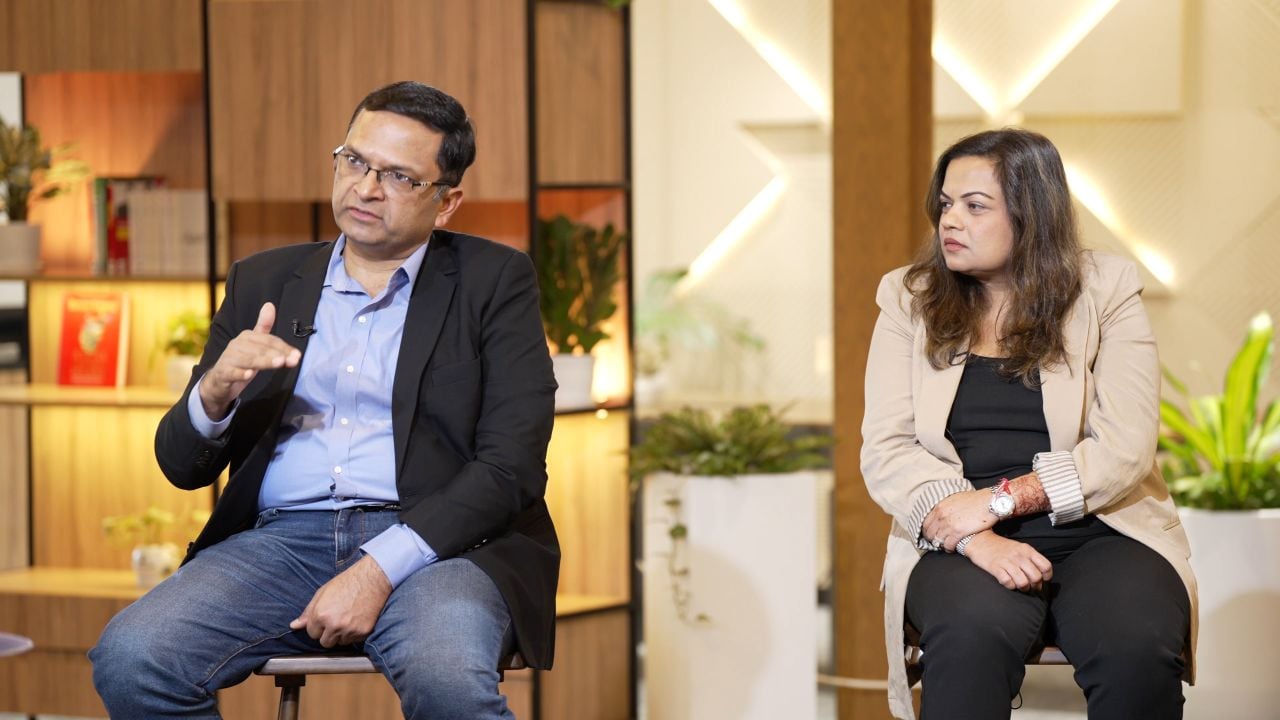
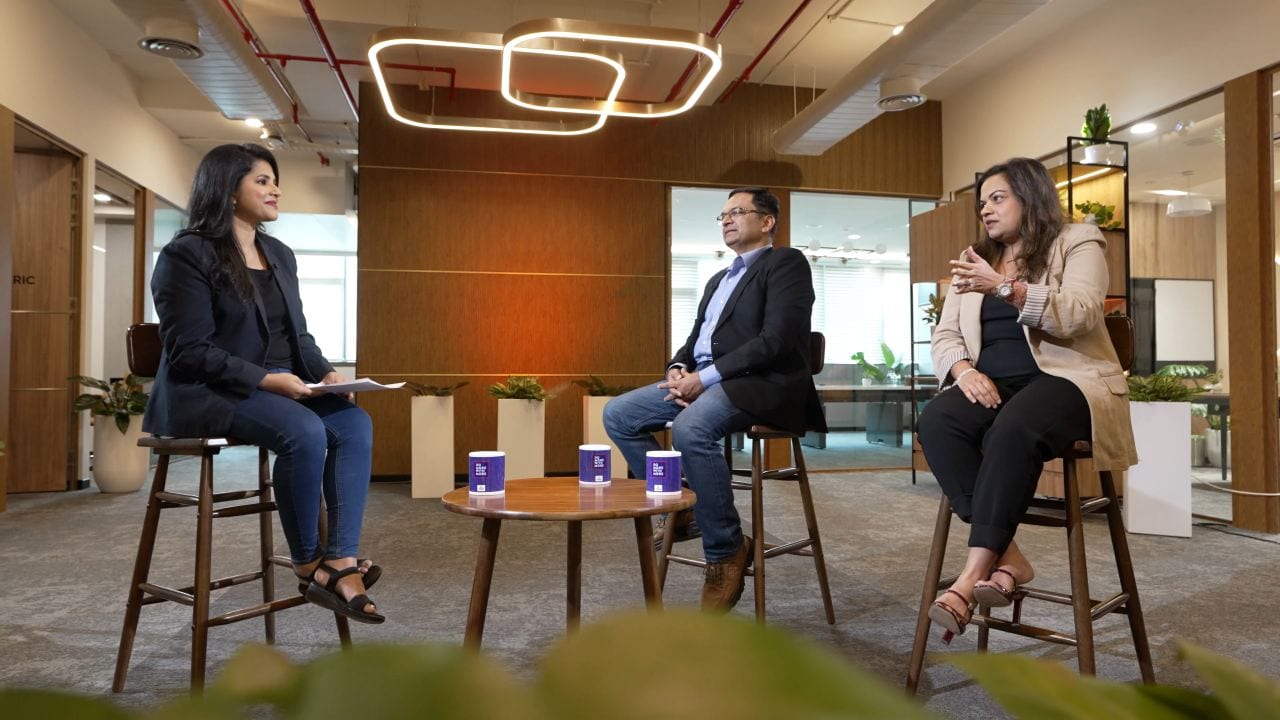
From origins sparked by chance, IndiQube has grown into a ₹1,000-crore powerhouse operating across 100+ properties and serving some of the fastest-growing companies in the country—from unicorns and high-growth start-ups to global capability centres (GCCs). As the conversation unfolds, it’s clear that IndiQube’s rise mirrors the evolution of India’s own workplace imagination.
Accidental Origin and Intentional Scale
Prior to IndiQube’s inception, Meghna and Rishi ran a consulting business. Having leased a large office, they sublet unused spaces. To achieve better efficiency and maintain their focus on their core competencies, their tenants began relying on IndiQube for everything—the food court, transport, meeting rooms, boardrooms, and maintenance. Then, it was only a matter of time before clients began requesting IndiQube to manage their offices entirely, on a professional basis. Within months, the founders leased a 1.5 lakh sq. ft. building and filled it in under six months.
Building for India’s New Work Order
Rather than a plug-and-play office management firm, Rishi describes IndiQube as a “workspace outsourcing and partnership” platform which operates across the entire workspace lifecycle.
Around 30% of IndiQube’s inventory today consists of renovated spaces, and many of these were transformed into green buildings under IndiQube’s stewardship. More than 40% of its portfolio is now occupied by GCCs and some of their clients who are unicorns today began their journeys with IndiQube, when they were still just start-ups.
Technology sits at the company’s core with IndiQube’s MyQ platform managing everything from parking spot allocations to meeting room bookings to consumption analytics. IoT-led energy optimisation has reduced energy costs by 20–30% across properties. Every asset is bar-coded, and every operational rhythm is data-driven. Effectively, IndiQube’s business goes beyond real estate into the realm of engineered workspace intelligence.
Flexibility in a Distributed Talent Future
Many companies that once insisted on owning their real estate now prefer flexible workspaces, and AI-led uncertainty is accelerating the shift. “Flexibility is the new stability,” says Rishi, noting that co-working and managed offices have grown from 2% of commercial real estate absorption in 2015 to 20–22% today—a ten-fold rise.
Looking ahead, Meghna points out that the US has nearly 10 billion sq. ft. of commercial office stock while India has just about 900 million. “We have a 10x gap to fill,” she remarks. “India’s office growth story is just beginning.”
Human-Centred Vision Beyond Workspaces
Since its inception, IndiQube’s philosophy remains unchanged: The employee is the hero of the story and ease of doing business is the ultimate metric. Meghna affirms, “If what we build improves the employee’s experience and makes operations frictionless for companies, we are moving in the right direction.”
The Future of Work seeks to explore this idea by bringing together business leaders, policy voices, HR thinkers and technology partners to define what India’s next era of work should look like. As the campaign unfolds over the coming months, the IndiQube–Network18 partnership promises to surface insights that will help India’s employers, workers, and cities navigate this new era.