






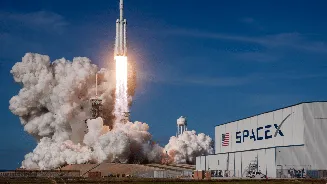
Future Frontiers Unveiled
SpaceX has recently adopted a notably reserved stance regarding some of its most visionary undertakings, including the establishment of artificial intelligence
(AI) data centers in orbit and the ambitious plans for human habitation on the Moon and Mars. In its pre-initial public offering filing, the company communicated to investors that these groundbreaking projects are in their nascent stages. The viability and eventual profitability of these ventures are subject to considerable doubt, as they rely on technologies that are still under development and have yet to be proven at a large scale. This cautious outlook, as reported by Reuters, provides a stark contrast to the typically optimistic narrative surrounding the company's futuristic endeavors, acknowledging the substantial engineering hurdles and the inherent risks associated with operating in the extreme environment of space.
Navigating Celestial Challenges
The path to realizing space-based computing and extraterrestrial settlements is fraught with significant engineering complexities. Designing AI data centers for orbit demands systems that can withstand harsh conditions like intense radiation, dramatic temperature fluctuations, and the inherent difficulty of performing repairs. These environmental factors dramatically increase the potential for system malfunctions and can lead to unforeseen escalations in costs. While such detailed risk assessments are standard practice in filings for public offerings, SpaceX's explicit acknowledgment of these challenges underscores a more pragmatic appraisal of the execution risks involved in projects that have often been presented with grand, forward-looking language. This measured approach suggests a growing awareness of the practical difficulties that must be overcome before these ambitious visions can become a commercial reality.
Public Optimism vs. Filing Reality
This recent expression of caution stands in notable contrast to the consistently optimistic pronouncements made by SpaceX's chief executive, Elon Musk. Musk has frequently championed the economic potential of orbital AI infrastructure, even describing such facilities as a "no-brainer" and a highly efficient method for expanding computational capacity. Following the integration of xAI into SpaceX, the company has also emphasized the critical role of space in the broader expansion of AI capabilities. However, the formal S-1 filing presents a more grounded perspective, indicating that the path to commercial success for these cutting-edge ventures is far from guaranteed and is subject to substantial technological and financial uncertainties, prompting investors to consider both the potential rewards and the significant risks involved.
AI Growth and Acquisition Strategy
Beyond its long-term extraterrestrial aspirations, SpaceX is actively pursuing opportunities within terrestrial AI markets. The company has disclosed an option to acquire Cursor, a startup specializing in code generation, for a substantial $60 billion, or alternatively, to establish a $10 billion partnership. This strategic move is intended to bolster the position of xAI, which is now integrated into SpaceX, within the rapidly expanding market for AI developer tools, where established players like OpenAI and Anthropic have already made significant inroads. SpaceX has articulated that merging Cursor's developer-focused solutions with its own "Colossus" supercomputer cluster, reputed to be among the world's largest, could significantly accelerate the advancement of sophisticated AI models. This potential acquisition also highlights SpaceX's readiness to invest heavily to bridge existing gaps in AI infrastructure and capabilities.
IPO Scale and Market Realities
These detailed disclosures coincide with SpaceX's preparation for a potentially record-shattering market debut, with aspirations for a valuation of approximately $1.75 trillion and the possibility of raising as much as $75 billion. This timing aligns with a global surge in AI investment, with industry forecasts predicting over $600 billion in capital expenditure this year alone. Despite its own increasing investments, SpaceX has acknowledged that it still lags behind leading technology firms in terms of the sheer scale of its AI infrastructure. The company's candid reporting in its S-1 filing serves as a reality check for investors, balancing the excitement around its revolutionary space ambitions with a pragmatic assessment of the competitive landscape and the immense resources required to achieve its goals.