





Mission Culmination Approaches
As NASA's Artemis II mission reaches its zenith, the four-person crew is gearing up for the most challenging segment: returning to Earth after an unprecedented
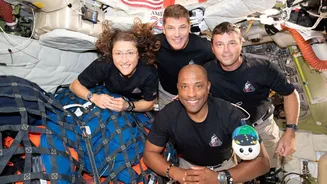
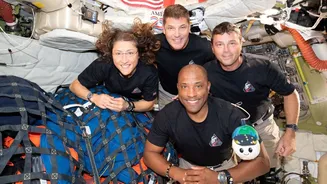
journey around the Moon. This mission has already etched its name in history, pushing the boundaries of space exploration and advancing our understanding of the cosmos. The crew, comprising Reid Wiseman, Victor Glover, Christina Koch, and Jeremy Hansen, is poised to conclude their near-ten-day odyssey with a splashdown in the Pacific Ocean near San Diego. This return marks a pivotal moment, signifying the first crewed circumlunar flight since the Apollo 17 mission and serving as a crucial stepping stone for NASA's ambitious long-term lunar objectives under the Artemis program. The voyage itself has been record-breaking, with the astronauts venturing approximately 252,000 miles from Earth, surpassing the previous record held by Apollo 13 by a significant margin. At its furthest point, the spacecraft achieved a remarkable 252,760 miles (406,778 kilometers) from our planet, setting a new benchmark for human exploration.
Lunar Flyby Insights
The Artemis II crew's historic lunar flyby included venturing across the far side of the Moon, a celestial region perpetually hidden from Earth's view. From an altitude of about 4,000 miles, they gained an unparalleled perspective on the lunar surface. Unlike missions relying solely on remote sensing or satellite imagery, Artemis II facilitated direct, real-time human observation. Scientists on Earth, coordinating from NASA's Mission Control in Houston, closely followed the crew's communications, analyzing live and recorded transmissions. This collaborative effort allowed for the documentation of vital insights and engaging discussions with astronauts positioned over a quarter-million miles away. The Moon, in this context, serves as a "witness plate" of the solar system's nascent stages, bearing imprints of processes that shaped planets billions of years ago. The six-hour flyby fostered dynamic exchanges, bridging the gap between theoretical planetary science and direct human experience, offering a unique vantage point on celestial evolution.
Free-Return Trajectory Explained
A defining characteristic of the Artemis II return voyage is its adherence to a precisely calculated orbital path known as a free-return trajectory. This ingenious method leverages the gravitational pull of celestial bodies, allowing the spacecraft, christened 'Integrity' by the crew, to journey around the Moon and naturally return to Earth without constant engine thrust. The path traces a figure-eight pattern, with Earth and the Moon acting as the focal points of the spacecraft's orbit. As the Orion capsule neared the Moon, it entered a zone where lunar gravity became the dominant force. The Moon effectively 'intercepted' the spacecraft, altering its course and redirecting it back toward Earth. This maneuver is deeply rooted in orbital mechanics, particularly the complex "three-body problem," which accounts for the gravitational interplay between Earth, the Moon, and the spacecraft. While Earth's gravity initiates the journey, the Moon's influence becomes paramount as the spacecraft enters its gravitational sphere. Even the Sun's gravitational pull plays a minor, yet crucial, role, necessitating meticulous adjustments to maintain the intended course. Experts explain that this trajectory involves a subtle transfer of angular momentum between the spacecraft and the Moon. As Orion passed in front of the Moon, it shed a portion of its momentum, enabling lunar gravity to modify its trajectory and guide it back home. This principle is akin to gravitational slingshot techniques employed in interplanetary missions, where spacecraft gain or lose velocity by passing near massive celestial objects.
Reentry: The Fiery Descent
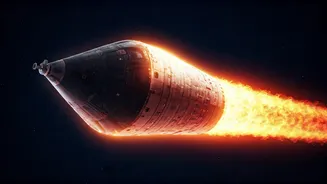
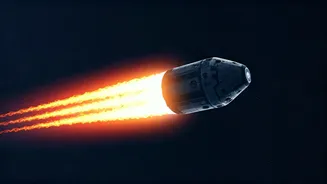
The reentry phase is characterized by the spacecraft's high-velocity plunge into Earth's atmosphere, generating immense heat and pressure. The Orion capsule is anticipated to reach speeds nearing 23,839 miles per hour (38,365 kilometers per hour) as it interacts with the upper atmospheric layers. At these extraordinary velocities, friction with atmospheric particles creates temperatures so extreme that they ionize the air, forming a plasma sheath around the spacecraft, often perceived as a blazing fireball. Astronaut Victor Glover has spoken about anticipating this moment, noting its profound nature. The spacecraft's heat shield is engineered to withstand these intense conditions, safeguarding the crew from the severe thermal and mechanical forces encountered during descent. This critical component is undergoing a vital test during Artemis II, as it will be instrumental in future missions, including lunar landings and potential voyages to Mars. NASA officials project the reentry sequence to last approximately 13 minutes, commencing with atmospheric entry and concluding with the splashdown in the Pacific Ocean. Throughout this period, Orion will utilize its thrusters for stabilization and deceleration, followed by a multi-stage parachute deployment to further slow its descent.
Splashdown and Recovery
The final descent of Artemis II is a meticulously choreographed event designed for a safe landing. As the spacecraft decelerates, it will deploy drogue parachutes to stabilize its orientation, followed by pilot parachutes that assist in unfurling the main parachutes. These main chutes drastically reduce the capsule's velocity, bringing it down to approximately 25 feet per second just before it meets the ocean's surface. NASA's recovery operations have been planned with extreme precision, with the U.S. Navy taking a central role. The USS John P Murtha has been dispatched to the designated splashdown zone in the Pacific Ocean to oversee the retrieval of both the crew and the spacecraft. Divers will approach the capsule shortly after touchdown, securing it and assisting the astronauts as they egress. The crew will then be transferred to an inflatable platform, known as the 'front porch,' before being brought aboard the recovery vessel. This entire process has undergone extensive rehearsal to ensure maximum efficiency and safety. The selection of the splashdown site near San Diego is driven by practical considerations and mission prerequisites. While the free-return trajectory naturally directs the spacecraft towards the Pacific, minor course corrections fine-tuned the precise landing zone. This area offers advantageous weather conditions, readily available naval support, and established recovery infrastructure.
Crew Preparedness and Mission Significance
As the spacecraft makes its homeward journey, the Artemis II crew has been diligently preparing both technically and psychologically for the reentry phase. NASA officials have outlined a series of crucial activities to ensure all systems are functioning optimally and that the astronauts are ready for this final mission segment. The crew has conducted tests to validate Orion's manual control capabilities, a vital requirement for upcoming missions involving orbital docking. These preparations are part of a larger effort to certify Orion's systems for future Artemis endeavors. Certain planned activities have been adjusted to prioritize reentry preparations, such as the cancellation of an exercise related to constructing a radiation shelter within the capsule, allowing more time for configuring the spacecraft for its descent. On the day before reentry, astronauts are scheduled to perform simulations and system checks, confirming that all components are operating as intended. Mission leaders have expressed confidence in the spacecraft's performance thus far, emphasizing that Artemis II is a test flight providing invaluable data for subsequent operations. The broader significance of Artemis II lies in its contribution to NASA's long-term exploration strategy, which aims to establish a sustainable human presence on the Moon and eventually facilitate missions to Mars. Astronaut Christina Koch aptly described the program as a relay, with each mission building upon the successes of its predecessors, carrying a symbolic baton to the next crew.