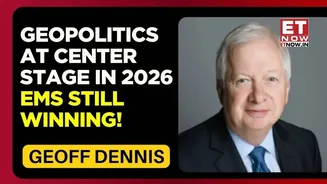


After 2025 emerged as the year of artificial intelligence-led market optimism, 2026 is shaping up to be the “year of geopolitics,” according to Geoffrey
Dennis, Independent Emerging Markets Commentator. In an interview with ET Now, Dennis said global markets are facing an unusually complex geopolitical environment, even as investors continue to show resilience and appetite for emerging markets. Dennis flagged multiple geopolitical flashpoints that could influence global markets, including a potential attack on Iran, rising tensions over Taiwan, concerns about US actions in regions such as Mexico or Colombia, and the ongoing Russia–Ukraine war. Despite these risks, he noted that markets have so far reacted in a relatively calm manner. “Although oil prices have moved higher, broader markets have remained composed,” Dennis said, adding that crude prices are being supported by concerns over Iran’s oil exports and the realisation that reviving Venezuelan oil supply will take significant time and capital. Interestingly, emerging markets have continued to outperform even as the US dollar has strengthened modestly. The dollar index is up about 1 per cent year-to-date, yet emerging markets have gained close to 5 per cent so far this year. “Typically, a stronger dollar is not associated with strong emerging market performance,” Dennis said. “But there has been a substantial flow of money into emerging markets since the latter part of 2025, and that trend is continuing into 2026. EM remains the flavour of the year.”
Japan influencing global capital flows
On global money flows, Dennis said Japan is currently playing a critical role, particularly within developed markets. He pointed out that the possibility of an early election in Japan could create some near-term uncertainty, but expectations of fiscal expansion are supporting Japanese equities.
“The Japanese stock market likes a weak yen, and that’s what we’re seeing right now,” he said, adding that geopolitical tensions involving Japan and China are also influencing currency and equity movements. According to Dennis, the weakening yen is helping drive equity market gains in Japan.
Fed likely to cut rates by 50 basis points in 2026
On US monetary policy, Dennis said he expects the US Federal Reserve to deliver two rate cuts totalling 50 basis points in 2026, with a possible cut as early as January. While recent inflation data has come in slightly better than expected, he cautioned that inflation remains above the Fed’s target.
“The Fed is going to move slowly,” Dennis said, noting that Chair Jerome Powell has reiterated the central bank’s commitment to data-driven policy decisions and institutional independence.
He added that aggressive rate cuts are unlikely, as the Fed remains mindful of risks linked to the US’s large fiscal deficit and the possibility of bond market instability if monetary easing is perceived as excessive.
“The US economy looks okay in 2026, and that supports a cautious approach,” Dennis said. “For now, 50 basis points of easing seems reasonable, though expectations can always shift as new data comes in.”
(Disclaimer: The above article is meant for informational purposes only, and should not be considered as any investment advice. ET NOW DIGITAL suggests its readers/audience to consult their financial advisors before making any money related decisions.)