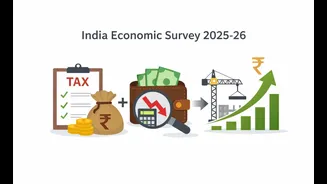










India’s domestic demand and investment in new assets in the financial year ending March 2026 (FY26) have been supported by a careful fiscal policy approach,
with the government improving its overall revenue streams and keeping spending in check, according to the Economic Survey 2025-26.
The survey notes that “gross tax revenue collection has progressed resiliently during the year, with direct tax collections reaching nearly 53% of the budgeted annual target (as on November 2025). Indirect tax collections also remained robust despite lower inflation and import volatility, with gross GST collections in absolute terms recording multiple all-time highs during the year.”
It added that recent tax policy reforms, including the restructuring of personal income tax and the rationalisation of the GST rate, have supported consumption demand while sustaining revenues in absolute terms.
On the expenditure front, the survey highlighted a healthy year-over-year increase in spending on infrastrcture and long term projects, reaching nearly 60% of the budgeted allocation by November 2025. "Also, the growth in revenue expenditure remained contained, reinforcing the quality of public spending,” it stated.
The Survey further pointed out that India’s fiscal path balances combines consolidation with sustained investment, noting that between FY20 and FY25, the share of capital spending in total central government expenditure increased from about 12.5% to 22.6%, while effective capex as a share of GDP rose from roughly 2.6% to 4.0%.
It also cited the role of states, stating that through the Special Assistance to States for Capital Expenditure/Investment (SASCI), the States have maintained capital expenditure at around 2.4% of GDP.
Markets have taken note of this fiscal discipline, with sovereign bond yields easing and ratings agencies upgrading India's outlook. “S&P Ratings has acknowledged the credibility of and the commitment to the fiscal glide path, while upgrading India’s rating from ‘BBB-’ to ‘BBB’. CareEdge Global, in initiating its coverage of India, too assigned a ‘BBB+’ rating, underscoring India’s robust economic performance and fiscal discipline,” the Survey noted.
On the monetary side, the survey highlighted that alongside the fiscal stimulus provided by higher public capital expenditure and tax reductions, monetary support was delivered through a cumulative reduction of 125 basis points in the policy repo rate since February 2025… These measures have been effectively transmitted to the banking system.
Non-bank financing has also played a key role. The flow from non-bank sources rose by 29.3% YoY, alongside a robust expansion in non-food bank credit of 18.3%, the Survey noted.
Also Read: Economic Survey flags surge in gold and silver as signal of global risk
Also Read: Rupee is punching below its weight, says India's latest economic survey