







What is the story about?
The defence sector continues to remain a long-term theme as India aims to become a global superpower. The Nifty Defence Index has surged by over 21% since the last Union Budget, thanks to the government's focus on 'Make in India' and indigenisation, as well as geopolitical tensions around the world.
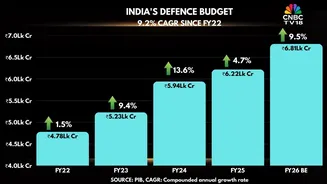
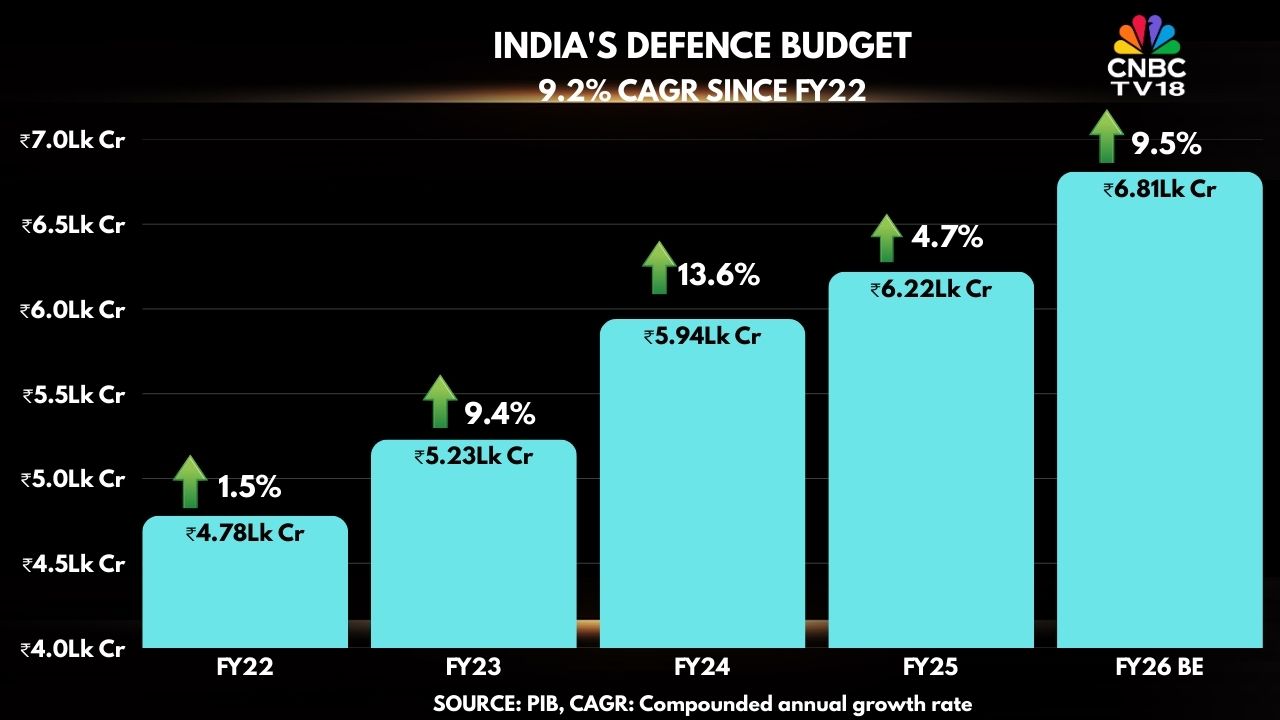
Union Budget 2025 allocated ₹6.81 lakh crore for defence, which was a 9.5% increase compared to the previous year. However, experts are divided on the increase in defence allocation this year despite the prevailing geopolitical situation.
"The increase in the defence budget will be somewhere between 7 and 12%. That has generally been the trend in recent years," said Lt Gen SL Narasimhan (Retd), Adjunct Distinguished Fellow for China and National Security Studies at Mumbai-based Gateway House.
Defence analyst Sanket Kulkarni concurred with Narasimhan, adding that the allocation may increase steadily but in a conservative manner.
India’s defence expenditure has grown by over 40% since the 2020 Budget. On an average annual basis, the growth has been around 9.2% over the last five years.
Narsimhan believes Operation Sindoor is unlikely to have any major impact on the budget allocation for the defence sector. “If that’s the case, then after 2020, there should have been a very large increase in the budget. But that did not happen. One or two budgets are not going to set these things going,” he argued.
Even so, market sentiment around defence remained strong. Tensions between India and Pakistan after the Pahalgam terror attack and Operation Sindoor led to defence stocks adding over ₹1.2 lakh crore to their market capitalisation between April 25 and May 14.
*From Feb 1, 2025 To Jan 23, 2026
Former Defence Secretary Girdhar Aramane, however, thinks a 20–25% rise in capital outlay looks feasible given recent geopolitical tensions and the need to refill inventories.
He explained that many large orders placed in recent years are now reaching the payment stage, while emergency purchases and investments in new technologies are also likely to push up spending.
Kulkarni hopes that the Budget focuses on boosting its drone warfare capabilities following the May 2025 conflict. “Operation Sindoor was the first full blown contest between the two countries in drone warfare. While India came out with flying colours in mitigating drone attacks, this was the beginning of a new kind of warfare in South Asia,” he said. He added that the government must expand the counter drone ecosystem across the border and coastline.
Defence modernisation and indigenisation
India has been pushing for self-reliance (Aatmanirbharta) in defence procurement, with its push towards indigenisation leading to a significant boost to India’s domestic defence industry. According to the government, at least 65% of defence equipment is now manufactured domestically, a significant shift from the earlier 65-70% import dependency.
The annual defence production soared to a record high figure of ₹1.51 lakh crore in FY25. The government aims to increase defence manufacturing to ₹3 lakh crore by 2029. Meanwhile, defence exports touched an all-time high figure of ₹23,622 crore in FY25, growing 12.04% over FY24. The government wants defence exports to reach ₹50,000 crore by 2029.
India still remains the world’s second-biggest arms importer, as per Sweden-based SIPRI.
Kulkarni said that the government needs to focus more on innovation and R&D for fast-tracking indigenisation and attracting foreign partnerships. “A sustained momentum in R&D spending will safeguard India from geopolitical uncertainties and its impact on defence technology partnerships,” he added.
The 2025 Budget allocated ₹1,48,722.80 crore for the modernisation of the Armed Forces. On the other hand, ₹31,277 crore was allocated for R&D and creation of infrastructural assets.
According to PRS Legislative Research, the share of the defence budget spent on capital outlay has decreased in recent years. In FY14, 32% of the defence budget was spent on capital outlay. This share declined to less than 30% of the defence budget in FY26.
Aramane noted that defence expenditure as percentage of gross domestic product (GDP) has been around 1.5% to 1.9% over a period of time However, he argued that looking at defence spending only as a share of GDP does not give the full picture for India.
"Percentage of GDP is not the right measure for a country like us, a middle income country, which was importing lot of equipment from outside, so whatever we spend on importing is going out of the country and not contributing to our long term capabilities. So percentage of GDP, I will discount as a measure," he said.
Instead, he said it is more useful to look at defence as a share of the overall government budget, where it already takes up a sizeable portion. He added that spending through other departments on areas such as space, science and research also supports defence capability and should be seen as part of the broader effort.
While a big increase in the defence budget, especially in capex, seems unlikely on February 1, Narasimhan said the focus must remain on better utilisation of existing funds. “While we would like to have an even bigger defence budget, there are other social realities that the government needs to focus on,” he said.
The army veteran also added that some funds from the Ministry of Defence go back to the Ministry of Finance almost every year. This suggests the ministry is not able to spend the money that has been given. “We must focus on getting good value for our money,” he noted.
Union Budget 2025 allocated ₹6.81 lakh crore for defence, which was a 9.5% increase compared to the previous year. However, experts are divided on the increase in defence allocation this year despite the prevailing geopolitical situation.
"The increase in the defence budget will be somewhere between 7 and 12%. That has generally been the trend in recent years," said Lt Gen SL Narasimhan (Retd), Adjunct Distinguished Fellow for China and National Security Studies at Mumbai-based Gateway House.
Defence analyst Sanket Kulkarni concurred with Narasimhan, adding that the allocation may increase steadily but in a conservative manner.
India’s defence expenditure has grown by over 40% since the 2020 Budget. On an average annual basis, the growth has been around 9.2% over the last five years.
Narsimhan believes Operation Sindoor is unlikely to have any major impact on the budget allocation for the defence sector. “If that’s the case, then after 2020, there should have been a very large increase in the budget. But that did not happen. One or two budgets are not going to set these things going,” he argued.
Even so, market sentiment around defence remained strong. Tensions between India and Pakistan after the Pahalgam terror attack and Operation Sindoor led to defence stocks adding over ₹1.2 lakh crore to their market capitalisation between April 25 and May 14.
| % Rise In Index* | |
| Nifty Defence India | 21.4% |
| Nifty Bank | 18.1% |
| Nifty 50 | 6.7% |
| Nifty Midcap 150 | 6.2% |
| Sensex | 5.2% |
*From Feb 1, 2025 To Jan 23, 2026
Former Defence Secretary Girdhar Aramane, however, thinks a 20–25% rise in capital outlay looks feasible given recent geopolitical tensions and the need to refill inventories.
He explained that many large orders placed in recent years are now reaching the payment stage, while emergency purchases and investments in new technologies are also likely to push up spending.
Kulkarni hopes that the Budget focuses on boosting its drone warfare capabilities following the May 2025 conflict. “Operation Sindoor was the first full blown contest between the two countries in drone warfare. While India came out with flying colours in mitigating drone attacks, this was the beginning of a new kind of warfare in South Asia,” he said. He added that the government must expand the counter drone ecosystem across the border and coastline.
Defence modernisation and indigenisation
India has been pushing for self-reliance (Aatmanirbharta) in defence procurement, with its push towards indigenisation leading to a significant boost to India’s domestic defence industry. According to the government, at least 65% of defence equipment is now manufactured domestically, a significant shift from the earlier 65-70% import dependency.
The annual defence production soared to a record high figure of ₹1.51 lakh crore in FY25. The government aims to increase defence manufacturing to ₹3 lakh crore by 2029. Meanwhile, defence exports touched an all-time high figure of ₹23,622 crore in FY25, growing 12.04% over FY24. The government wants defence exports to reach ₹50,000 crore by 2029.
India still remains the world’s second-biggest arms importer, as per Sweden-based SIPRI.
Kulkarni said that the government needs to focus more on innovation and R&D for fast-tracking indigenisation and attracting foreign partnerships. “A sustained momentum in R&D spending will safeguard India from geopolitical uncertainties and its impact on defence technology partnerships,” he added.
The 2025 Budget allocated ₹1,48,722.80 crore for the modernisation of the Armed Forces. On the other hand, ₹31,277 crore was allocated for R&D and creation of infrastructural assets.
According to PRS Legislative Research, the share of the defence budget spent on capital outlay has decreased in recent years. In FY14, 32% of the defence budget was spent on capital outlay. This share declined to less than 30% of the defence budget in FY26.
Aramane noted that defence expenditure as percentage of gross domestic product (GDP) has been around 1.5% to 1.9% over a period of time However, he argued that looking at defence spending only as a share of GDP does not give the full picture for India.
"Percentage of GDP is not the right measure for a country like us, a middle income country, which was importing lot of equipment from outside, so whatever we spend on importing is going out of the country and not contributing to our long term capabilities. So percentage of GDP, I will discount as a measure," he said.
Instead, he said it is more useful to look at defence as a share of the overall government budget, where it already takes up a sizeable portion. He added that spending through other departments on areas such as space, science and research also supports defence capability and should be seen as part of the broader effort.
| Year | R&D funding as % of defence budget |
| 2014-15 | 4.7% |
| 2020-21 | 3.2% |
| 2025-26 | 3.9% |
While a big increase in the defence budget, especially in capex, seems unlikely on February 1, Narasimhan said the focus must remain on better utilisation of existing funds. “While we would like to have an even bigger defence budget, there are other social realities that the government needs to focus on,” he said.
The army veteran also added that some funds from the Ministry of Defence go back to the Ministry of Finance almost every year. This suggests the ministry is not able to spend the money that has been given. “We must focus on getting good value for our money,” he noted.













![[WATCH] Gautam Gambhir ignores question on Pakistan's T20 World Cup boycott against India](https://g-mob.glance-cdn.com/public/fc/image/mfxFqQixrDW0.webp)