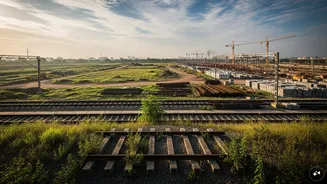










The Comptroller and Auditor General (CAG) has flagged serious shortcomings in the functioning of the Rail Land Development Authority (RLDA), pointing to years
of delays, poor execution and massive revenue losses in the development of railway land.
The audit examined two key activities of RLDA between 2018-19 and 2022-23 — commercial development of vacant railway land and construction of multi-functional complexes. The findings reveal that despite being entrusted with large tracts of prime railway land, the authority has failed to deliver tangible outcomes.
As of March 2023, the Railway Board had entrusted RLDA with the development of nearly 998 hectares of vacant railway land. However, while contracts were awarded for 35 commercial sites, not even a single site had been developed by the end of the audit period.
Performance in multi-functional complexes was equally weak. RLDA awarded contracts for 53 such sites, but only 14 projects, or 26%, were completed by March 2023.
The audit also reviewed 17 commercial sites entrusted to RLDA prior to 2016-17 and found that none of these sites had been developed, highlighting long-standing execution failures.
Financial performance remained far below expectations. Between 2017 and 2022, RLDA projected earnings of ₹3,281.32 crore, but managed to earn only ₹332.79 crore, 10.14% of the expected earnings. During the 2017-22 Five Year Plan period, earnings fell short by ₹8,689.59 crore rupees, a shortfall of over 94%, largely due to non-entrustment of sites, cancellation of awards and prolonged litigation.
During the same plan period, RLDA awarded only two sites. Against expected earnings of ₹3,650 crore, actual earnings stood at just ₹15.29 crore, just 0.41% of the target.
The audit also pointed to weak consultant management. Eight out of 10 empanelled consultants participated in less than one-third of the requests for proposals. Despite this poor participation, RLDA failed to take action to remove underperforming consultants.
Significant irregularities were found in the assessment of reserve prices. Errors in applying rates, area and floor area ratio led to undervaluation of multiple sites. In three out of 19 commercial sites examined, undervaluation amounted to ₹287.76 crore. The Ashok Vihar site in Delhi alone was undervalued by ₹204.22 crore, while the Bandra East site saw undervaluation of ₹1.84 crore.
RLDA also allowed discounts of ₹135.76 crore across 14 of 21 sites by not using the prescribed evaluation methods. The audit noted that RLDA failed to explore more remunerative development models with private developers, despite provisions allowing this under its own regulations.
Execution delays further dented revenues. Agreements were delayed by an average of 118 days across sampled commercial and multi-functional complex projects, reducing effective lease periods. Delays in 14 multi-functional complex projects alone resulted in non-monetisation of ₹3.49 crore.
Between 2018-19 and 2022-23, RLDA’s revised earnings target was ₹3,799.58 crore, but actual earnings were only ₹2,138.06 crore, leaving a shortfall of ₹1,661.52 crore, nearly 44%.
Since its inception in 2006, RLDA has been entrusted with 126 sites, but awarded only 35 sites, 27.8%, to private developers. None of these commercial projects had been completed by March 2023. Overall, only 14 multi-functional complexes, or 11.38% of 123 sites, have been developed.
The audit also highlighted systemic land-related issues. Neither the Ministry of Railways nor RLDA ensured that sites were litigation-free or that land records were properly obtained. In 58% of sampled cases, issues such as land title disputes and encroachments remained unresolved, leading to non-monetisation.
Recovery mechanisms were found wanting as well.
RLDA failed to recover expired performance guarantees worth ₹1.42 crore, did not collect security deposits amounting to ₹6.29 crore, and left dues of over ₹33 crore outstanding as of March 2023, without initiating penal action against defaulters.
Taken together, the CAG report paints a picture of an authority sitting on vast land assets but unable to translate them into development or revenue, raising serious questions about governance, planning and accountability in railway land monetisation.