

The year 2025 marked a decisive shift in India’s labour and workplace landscape, as long-pending reforms moved closer to implementation, reshaping how
companies hire, pay and manage their workforce. From renewed momentum on labour code rollouts towards the end of the year to expanded recognition of gig workers, the changes touched nearly every segment of India’s workforce — organised, unorganised and platform-based.
While the reforms aim to simplify compliance and modernise labour laws, they also triggered widespread debate among employees, employers and trade unions over job security, take-home pay and social protection.
Here are the key workplace rule changes that changed over the past one year and defined 2025.
New Labour Codes introduced
India’s four consolidated labour codes were enacted earlier, between 2019 and 2020, replacing or rationalising 29 existing central labour laws. These include the Code on Wages, Industrial Relations Code, Social Security Code, and Occupational Safety, Health and Working Conditions Code.
Also read: Zomato, Swiggy offer higher incentives amid nationwide gig worker strike threat
In 2025, the Centre pushed for faster implementation, with several states notifying or revising draft rules, bringing the country closer to a phased rollout, though the codes are not yet in force nationwide.
According to the Labour Ministry, many of India’s labour laws were framed between the 1930s and 1950s and no longer reflected today’s economic and workplace realities. Spread across 29 central laws, the fragmented framework increased uncertainty and compliance burdens for both workers and employers.
The new Labour Codes seek to replace decades-old provisions with a unified, modern framework aligned with global practices, while strengthening worker protections and simplifying compliance for employers. They also aim to bring greater uniformity across states by reducing regulatory complexity, a process that gathered fresh momentum in 2025 as more states moved to align their rules.
The reforms significantly alter how wages, employment contracts, working hours and industrial disputes are governed.
Structural changes in salary, PF and gratuity rules
India’s four consolidated labour codes were enacted earlier, between 2019 and 2020, replacing or rationalising 29 existing central labour laws. These include the Code on Wages, Industrial Relations Code, Social Security Code, and Occupational Safety, Health and Working Conditions Code.
In 2025, the Centre pushed for faster implementation, with several states notifying or revising draft rules, bringing the country closer to a phased rollout, though the codes are not yet in force nationwide.
According to the Labour Ministry, many of India’s labour laws were framed between the 1930s and 1950s and no longer reflected today’s economic and workplace realities. Spread across 29 central laws, the fragmented framework increased uncertainty and compliance burdens for both workers and employers.
The new Labour Codes seek to replace decades-old provisions with a unified, modern framework aligned with global practices, while strengthening worker protections and simplifying compliance for employers. They also aim to bring greater uniformity across states by reducing regulatory complexity, a process that gathered fresh momentum in 2025 as more states moved to align their rules.
The reforms significantly alter how wages, employment contracts, working hours and industrial disputes are governed.
Gig workers get legal recognition under social security code
A key change under the new labour framework is the formal recognition of gig and platform workers under the Code on Social Security. For the first time, workers engaged through digital platforms, such as food delivery partners and ride-hailing drivers, are covered under a statutory social security framework, even though they are not classified as traditional employees.
The code enables the government to notify social security schemes for gig and platform workers, including benefits related to life and disability cover, health insurance, accident protection and old-age security. The funding mechanism allows for contributions from aggregators, the government, or both, with platform companies required to contribute up to 1-2% of their annual turnover, subject to caps, toward worker welfare.
However, these additional costs could be passed on by platforms to consumers through higher service charges. While the move is widely seen as a milestone in extending social protection to India’s fast-growing gig workforce, its real impact will depend on how states implement the rules and how effectively the benefits reach workers on the ground.
HR policies shift toward flexibility and tighter compliance
The labour reforms also influenced internal HR policies in 2025. Companies gained greater flexibility in hiring through fixed-term employment, allowing firms to recruit workers for specific durations with statutory benefits comparable to permanent employees.
At the same time, compliance requirements became more stringent.
Employers now face higher scrutiny on wage definitions, working hours, safety standards and record-keeping, increasing the role of HR and legal teams in workforce planning.
Trade unions and employee groups continued to raise concerns about job security and collective bargaining under the new framework, keeping labour reforms firmly in the public debate.
What this means for workers and employers
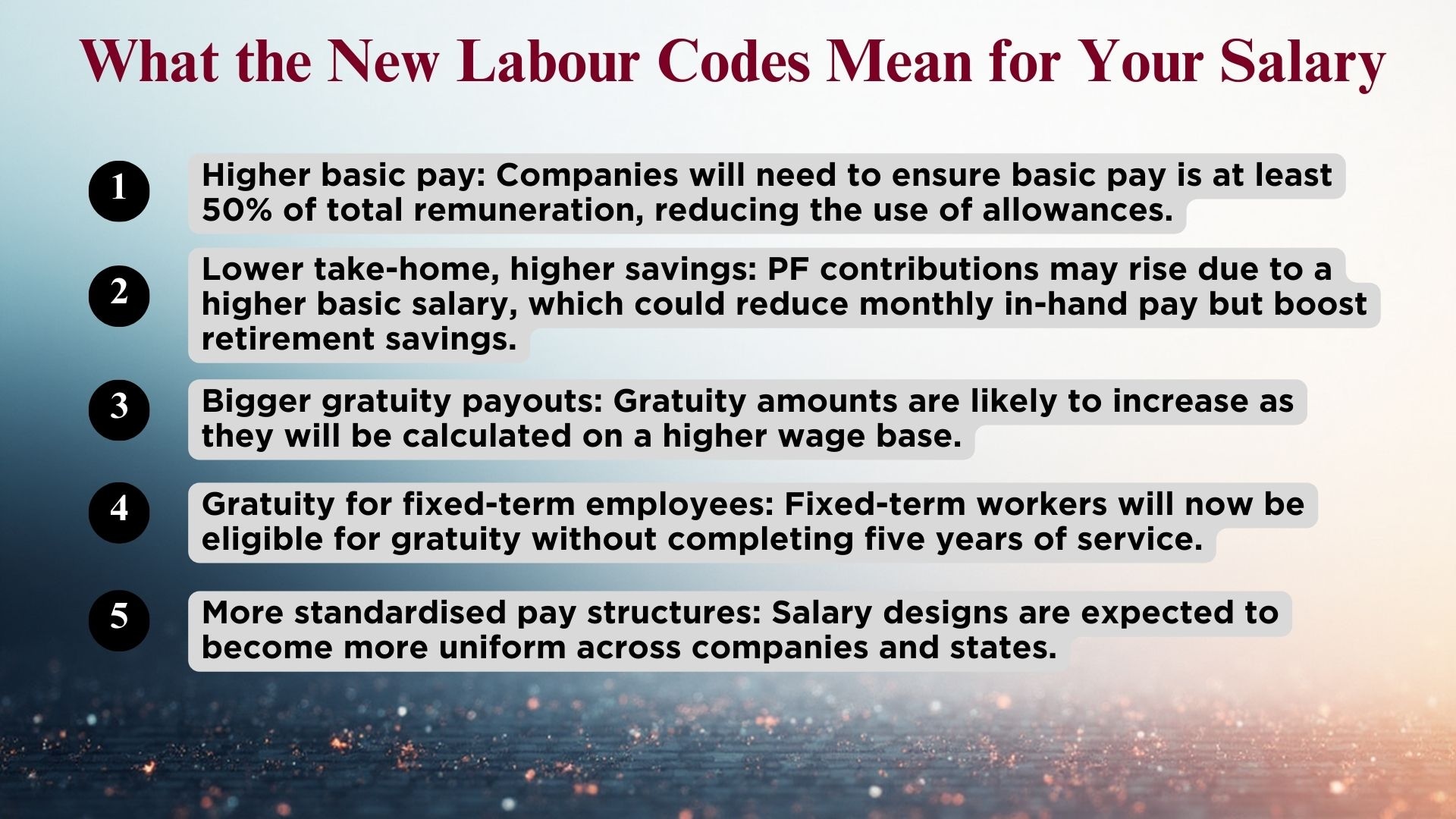
As 2025 draws to a close, the changes signal a long-term transition in India’s workplace ecosystem. For employees, the reforms promise improved social security and clearer wage structures, although with potential short-term impact on take-home pay. For employers, the focus has shifted to balancing flexibility with higher compliance costs.
With labour rules evolving and states continuing to fine-tune implementation, the full impact of these changes is likely to unfold over the next few years, making 2025 a pivotal transition year in how India works.