









What is the story about?
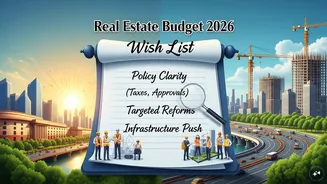
As the Union Budget 2026 approaches, India’s real estate sector is looking to the government for a policy framework that reflects rising urban costs, evolving buyer preferences and the growing role of institutional capital. Industry leaders believe the upcoming Budget could prove pivotal in sustaining housing momentum, improving affordability and unlocking long-term value across residential, commercial and mixed-use developments.
With infrastructure expansion reshaping demand patterns and Tier II cities emerging as new growth centres, developers argue that tax rationalisation, faster approvals and policy stability are now critical to the sector’s next phase of growth.
Institutional capital underscores confidence in NCR real estate
Recent fundraising activity continues to highlight strong institutional appetite for execution-ready real estate projects, particularly in the NCR. Bhumika Realty recently raised ₹170 crore from Aditya Birla Sun Life AMC, in partnership with global investor BGO, for a newly launched mixed-use project in Faridabad. The deal achieved full financial closure within just three weeks of launch, underlining investor confidence in projects with clear timelines and strong fundamentals.
Uddhav Poddar, CMD of Bhumika Group, said that while capital inflows remain healthy, tax frameworks have not kept pace with market realities. According to him, home prices across major NCR cities have structurally increased due to higher land, construction and compliance costs, even as tax thresholds and benefits have largely remained unchanged. He said revisiting capital gains norms and ownership-linked incentives would help improve market depth and buyer participation.
Affordability and mid-income housing move into focus
Industry executives say India’s housing market is gradually transitioning from a luxury-led upcycle to a more value-driven phase. Tanuj Shori, Founder and CEO of Square Yards, said the mid-income segment is expected to anchor growth as premium demand begins to stabilise. He noted that Budget 2026 should focus on improving affordability through enhanced tax relief for mid-income homebuyers, higher interest deduction limits and continued investment in urban infrastructure.
Ramani Sastri, Chairman and MD of Sterling Developers, echoed the need for affordability-led reforms, pointing out that despite strong aspirations for home ownership, affordability remains a major challenge for a large section of buyers. He said expanding the definition of affordable housing in urban areas and introducing interest subsidies for first-time homebuyers outside existing benefit frameworks could significantly boost end-user demand.
Luxury housing seeks calibrated, market-aligned reforms
Even as affordability dominates the broader conversation, developers in the luxury and premium segments believe high-end housing now plays a strategic role in India’s real estate ecosystem. Ashish Bhutani, CEO of Bhutani Infra, said the sector is looking for policy measures that strengthen ease of investment, accelerate infrastructure development and support sustainable urban growth.
He added that rationalising taxation, expanding metro and expressway connectivity, and incentivising green and wellness-driven developments could enhance investor confidence and unlock long-term value across commercial and mixed-use assets.
BK Malagi, Vice Chairman of Experion Developers, said ultra-luxury housing contributes meaningfully to employment generation while also attracting NRI and institutional interest. He said simplifying transaction frameworks and rationalising capital gains structures would help position Indian luxury housing as a globally competitive wealth-creation avenue.
Tier II cities emerge as the next real estate growth engine
A growing consensus among developers is that Tier II cities are increasingly driving residential and mixed-use demand, supported by infrastructure expansion and relatively affordable pricing. Rajat Bokolia, CEO of Newstone, highlighted Sonipat’s rise as a key investment destination within the NCR, aided by RRTS connectivity, metro extensions, UER-II and the Sonipat Master Plan 2031.
He said raising affordable housing limits, increasing home loan tax deductions and rationalising GST or stamp duties could further accelerate demand in Tier II markets, making them more attractive for both end-users and investors.
Yashank Wason, Managing Director of Royal Green Realty, added that Tier II and III cities are now offering infrastructure-led projects, superior amenities and larger homes at more reasonable prices, easing migration pressures on metros while delivering long-term investment stability.
Infrastructure, REITs and sustainability take centre stage
Consultants expect Budget 2026 to balance fiscal discipline with growth-oriented reforms. Badal Yagnik, CEO and Managing Director at Colliers India, said revising affordable housing criteria to reflect price realities in Tier I cities could provide a demand-side boost, while infrastructure augmentation would act as a long-term growth lever across real estate segments.
Yagnik also emphasised the need to encourage retail investor participation by making REITs and SM-REITs more attractive, alongside incentivising sustainability adoption in built structures and urban development plans.
Ease of doing business remains a critical concern
Across segments, developers continue to flag approval delays and land-related complexities as major bottlenecks. Harsh Jagwani, Managing Director of Notandas Realty, said a single-window clearance system, cleaner land-title mechanisms and stricter escrow enforcement under RERA would significantly reduce transaction risks and financing delays.
Sahil Agarwal, CEO of Nimbus Realty, said incentives for sustainable development, smart technologies and industrial-commercial expansion could have a catalytic impact on economic growth while attracting domestic and institutional capital into real estate.
Policy stability seen as key to long-term sector growth
Industry leaders believe Budget 2026 must lay the foundation for sustained long-term growth by providing policy clarity and execution efficiency. Gautam Kanodia, Founder of KREEVA and Kanodia Group, reiterated the long-standing demand for granting industry status to real estate, which he said would improve access to organised capital and financing efficiency for long-gestation projects.
As the sector navigates global volatility and evolving domestic demand, developers argue that continued infrastructure expansion, regulatory reforms and tax realism will be essential to keep real estate firmly positioned as a cornerstone of India’s economic growth story.
With infrastructure expansion reshaping demand patterns and Tier II cities emerging as new growth centres, developers argue that tax rationalisation, faster approvals and policy stability are now critical to the sector’s next phase of growth.
Institutional capital underscores confidence in NCR real estate
Recent fundraising activity continues to highlight strong institutional appetite for execution-ready real estate projects, particularly in the NCR. Bhumika Realty recently raised ₹170 crore from Aditya Birla Sun Life AMC, in partnership with global investor BGO, for a newly launched mixed-use project in Faridabad. The deal achieved full financial closure within just three weeks of launch, underlining investor confidence in projects with clear timelines and strong fundamentals.
Uddhav Poddar, CMD of Bhumika Group, said that while capital inflows remain healthy, tax frameworks have not kept pace with market realities. According to him, home prices across major NCR cities have structurally increased due to higher land, construction and compliance costs, even as tax thresholds and benefits have largely remained unchanged. He said revisiting capital gains norms and ownership-linked incentives would help improve market depth and buyer participation.
Affordability and mid-income housing move into focus
Industry executives say India’s housing market is gradually transitioning from a luxury-led upcycle to a more value-driven phase. Tanuj Shori, Founder and CEO of Square Yards, said the mid-income segment is expected to anchor growth as premium demand begins to stabilise. He noted that Budget 2026 should focus on improving affordability through enhanced tax relief for mid-income homebuyers, higher interest deduction limits and continued investment in urban infrastructure.
Ramani Sastri, Chairman and MD of Sterling Developers, echoed the need for affordability-led reforms, pointing out that despite strong aspirations for home ownership, affordability remains a major challenge for a large section of buyers. He said expanding the definition of affordable housing in urban areas and introducing interest subsidies for first-time homebuyers outside existing benefit frameworks could significantly boost end-user demand.
Luxury housing seeks calibrated, market-aligned reforms
Even as affordability dominates the broader conversation, developers in the luxury and premium segments believe high-end housing now plays a strategic role in India’s real estate ecosystem. Ashish Bhutani, CEO of Bhutani Infra, said the sector is looking for policy measures that strengthen ease of investment, accelerate infrastructure development and support sustainable urban growth.
He added that rationalising taxation, expanding metro and expressway connectivity, and incentivising green and wellness-driven developments could enhance investor confidence and unlock long-term value across commercial and mixed-use assets.
BK Malagi, Vice Chairman of Experion Developers, said ultra-luxury housing contributes meaningfully to employment generation while also attracting NRI and institutional interest. He said simplifying transaction frameworks and rationalising capital gains structures would help position Indian luxury housing as a globally competitive wealth-creation avenue.
Tier II cities emerge as the next real estate growth engine
A growing consensus among developers is that Tier II cities are increasingly driving residential and mixed-use demand, supported by infrastructure expansion and relatively affordable pricing. Rajat Bokolia, CEO of Newstone, highlighted Sonipat’s rise as a key investment destination within the NCR, aided by RRTS connectivity, metro extensions, UER-II and the Sonipat Master Plan 2031.
He said raising affordable housing limits, increasing home loan tax deductions and rationalising GST or stamp duties could further accelerate demand in Tier II markets, making them more attractive for both end-users and investors.
Yashank Wason, Managing Director of Royal Green Realty, added that Tier II and III cities are now offering infrastructure-led projects, superior amenities and larger homes at more reasonable prices, easing migration pressures on metros while delivering long-term investment stability.
Infrastructure, REITs and sustainability take centre stage
Consultants expect Budget 2026 to balance fiscal discipline with growth-oriented reforms. Badal Yagnik, CEO and Managing Director at Colliers India, said revising affordable housing criteria to reflect price realities in Tier I cities could provide a demand-side boost, while infrastructure augmentation would act as a long-term growth lever across real estate segments.
Yagnik also emphasised the need to encourage retail investor participation by making REITs and SM-REITs more attractive, alongside incentivising sustainability adoption in built structures and urban development plans.
Ease of doing business remains a critical concern
Across segments, developers continue to flag approval delays and land-related complexities as major bottlenecks. Harsh Jagwani, Managing Director of Notandas Realty, said a single-window clearance system, cleaner land-title mechanisms and stricter escrow enforcement under RERA would significantly reduce transaction risks and financing delays.
Sahil Agarwal, CEO of Nimbus Realty, said incentives for sustainable development, smart technologies and industrial-commercial expansion could have a catalytic impact on economic growth while attracting domestic and institutional capital into real estate.
Policy stability seen as key to long-term sector growth
Industry leaders believe Budget 2026 must lay the foundation for sustained long-term growth by providing policy clarity and execution efficiency. Gautam Kanodia, Founder of KREEVA and Kanodia Group, reiterated the long-standing demand for granting industry status to real estate, which he said would improve access to organised capital and financing efficiency for long-gestation projects.
As the sector navigates global volatility and evolving domestic demand, developers argue that continued infrastructure expansion, regulatory reforms and tax realism will be essential to keep real estate firmly positioned as a cornerstone of India’s economic growth story.