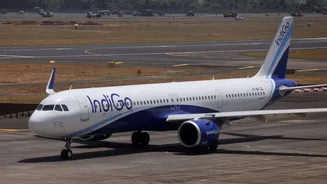

The guidance cut was issued in the aftermath of the recent flight disruptions that crippled operations, left passengers stranded, and resulted in heavy financial losses.
IndiGo now expects its Average Seat Kilometer (ASK), a key metric used by airlines to measure their passenger carrying capacity to grow in high single to early double-digits, compared to the earlier guidance of growing in "high teens."
As a result, the guidance for Passenger Unit Revenue Per Available Seat Kilometer (PRASK) has also been revised downwards to mid-single digit decline for the December quarter, compared to the earlier guidance of flat to slight growth.
The airline went on to add in its exchange filing that the overall financial impact cannot be quantified at this stage.
Also Read: Will IndiGo have to compensate affected passengers? Here’s what DGCA rules say
"Measures undertaken to reset our operations resulted in cancellations of around 4,500 flights during that week which has resulted in loss of revenue and we also continue to provide passenger support services for the operational disruptions, for which, additional expenses are being incurred," IndiGo's statement read.
IndiGo has submitted a revised flight schedule to the Directorate General of Civil Aviation (DGCA), who said that a "regular vigil" is being maintained to ensure real-time resolution of passenger grievances.
Multiple brokerages cut their price targets on IndiGo after the recent fiasco, but have maintained their bullish stance on the stock. In fact, IndiGo was also added to the Morgan Stanley "focus list" at the expense of Coforge on Wednesday.
Shares of IndiGo are trading 3.2% lower on Thursday at ₹4,650. The stock had declined another 3% on Wednesday, after having snapped a seven-day losing streak on Tuesday. The stock is now down 20% over the last one month and is on the verge of giving up all of its gains for 2025.