








What is the story about?
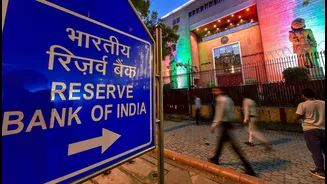
The Indian economy expanded at its fastest pace in the last six quarters in Q2 of 2025-26, supported by resilient domestic demand, even as global uncertainty eased from previously elevated levels, the Reserve Bank of India said in its December 2025 Bulletin released on Monday.
The monthly Bulletin includes the bi-monthly monetary policy statement for December 2025, four speeches, four analytical articles and current macroeconomic statistics.
In its State of the Economy assessment, the RBI said high-frequency indicators for November suggest overall economic activity has held up, with demand conditions remaining robust. Headline consumer price inflation edged up but stayed below the lower tolerance level, while financial conditions remained benign and credit flows to the commercial sector continued to be strong.
Externally, India’s current account deficit narrowed in Q2:2025-26 compared to a year earlier, aided by a lower merchandise trade deficit, strong services exports and robust remittance inflows. Globally, equity markets saw bouts of volatility amid concerns over stretched valuations, even as uncertainty indicators retreated further.
A second article, Government Finances 2025-26: A Half-Yearly Review, examined the fiscal position of the Centre and States during the first half of the financial year. It noted that the Centre’s receipts were broadly in line with Budget estimates, with moderation in tax revenues partly offset by strong non-tax revenues and non-debt capital receipts. Revenue expenditure was contained, while capital expenditure growth remained consistently robust.
States recorded growth in revenue receipts from both tax and non-tax sources, although grants from the Centre declined. While States maintained the pace of revenue spending, their capital expenditure improved during the period. Both the Centre and States also saw an improvement in expenditure quality, reflected in a lower ratio of revenue expenditure to capital outlay.
The third article introduced a Composite Leading Indicator (CLI) for GVA-Manufacturing, aimed at anticipating turning points in the manufacturing business cycle. Developed using a growth-rate-cycle methodology and advanced machine learning techniques such as Random Forest and XGBoost, the indicator draws on variables ranging from domestic demand and inflation to credit flows, sentiment surveys and global trends. The RBI said the proposed CLI leads the manufacturing GVA growth cycle by one quarter and has shown robustness both before the pandemic and during the post-COVID recovery.
The fourth study, Decoding Safe Asset Volatility Amid Geopolitical Risks Using Neural Networks, analysed how traditional safe-haven assets respond to rising geopolitical tensions. It found crude oil to be the most sensitive to geopolitical shocks, while gold continued to display strong price stability. Silver and US Treasuries showed moderate responses. Neural network-based models incorporating country-specific geopolitical risk indices were found to outperform conventional econometric models in forecasting asset volatility.
The RBI clarified that the views expressed in the Bulletin articles are those of the authors and do not represent the central bank’s official position.
The monthly Bulletin includes the bi-monthly monetary policy statement for December 2025, four speeches, four analytical articles and current macroeconomic statistics.
In its State of the Economy assessment, the RBI said high-frequency indicators for November suggest overall economic activity has held up, with demand conditions remaining robust. Headline consumer price inflation edged up but stayed below the lower tolerance level, while financial conditions remained benign and credit flows to the commercial sector continued to be strong.
Externally, India’s current account deficit narrowed in Q2:2025-26 compared to a year earlier, aided by a lower merchandise trade deficit, strong services exports and robust remittance inflows. Globally, equity markets saw bouts of volatility amid concerns over stretched valuations, even as uncertainty indicators retreated further.
A second article, Government Finances 2025-26: A Half-Yearly Review, examined the fiscal position of the Centre and States during the first half of the financial year. It noted that the Centre’s receipts were broadly in line with Budget estimates, with moderation in tax revenues partly offset by strong non-tax revenues and non-debt capital receipts. Revenue expenditure was contained, while capital expenditure growth remained consistently robust.
States recorded growth in revenue receipts from both tax and non-tax sources, although grants from the Centre declined. While States maintained the pace of revenue spending, their capital expenditure improved during the period. Both the Centre and States also saw an improvement in expenditure quality, reflected in a lower ratio of revenue expenditure to capital outlay.
The third article introduced a Composite Leading Indicator (CLI) for GVA-Manufacturing, aimed at anticipating turning points in the manufacturing business cycle. Developed using a growth-rate-cycle methodology and advanced machine learning techniques such as Random Forest and XGBoost, the indicator draws on variables ranging from domestic demand and inflation to credit flows, sentiment surveys and global trends. The RBI said the proposed CLI leads the manufacturing GVA growth cycle by one quarter and has shown robustness both before the pandemic and during the post-COVID recovery.
The fourth study, Decoding Safe Asset Volatility Amid Geopolitical Risks Using Neural Networks, analysed how traditional safe-haven assets respond to rising geopolitical tensions. It found crude oil to be the most sensitive to geopolitical shocks, while gold continued to display strong price stability. Silver and US Treasuries showed moderate responses. Neural network-based models incorporating country-specific geopolitical risk indices were found to outperform conventional econometric models in forecasting asset volatility.
The RBI clarified that the views expressed in the Bulletin articles are those of the authors and do not represent the central bank’s official position.