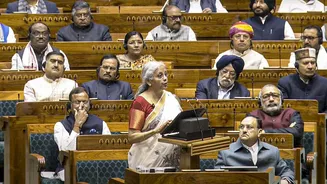

Finance Minister Nirmala Sitharaman on Monday dismissed claims that India is a “dead economy”, citing strong economic growth, improving sovereign credit
ratings and rising household consumption as evidence of sustained resilience.
Responding in the Lok Sabha to Opposition demands for a statement on remarks by US President Donald Trump, who had described India as a “dead economy” earlier this year, Sitharaman said such characterisations were at odds with both domestic data and global assessments.
India remains the world’s fastest-growing major economy, she said, having expanded by 8.2% in the September quarter. “An economy growing at this pace, and receiving credit rating upgrades, cannot be termed dead,” the finance minister told the House.
She noted that over the past decade, India has moved from a phase of external fragility to one of greater resilience. Global institutions, including the International Monetary Fund, have consistently raised India’s growth outlook, while rating agencies such as DBRS, S&P and Rating and Investment Information (R&I) have upgraded India’s sovereign ratings.
“Data must guide us, not stray remarks — no matter how influential the source,” Sitharaman said, urging lawmakers to rely on empirical evidence rather than rhetoric.
Trump had made the comment in July while criticising India’s continued purchases of Russian oil. Sitharaman said such remarks ignored the country’s economic trajectory and improving macroeconomic indicators.
On concerns over the IMF’s assessment of India’s national accounts, Sitharaman clarified that India’s overall statistical rating remained unchanged at a median ‘B’. She said references to a downgrade were misleading, explaining that the IMF had only flagged the need to update the GDP base year.
She also pointed to fiscal consolidation since the pandemic, noting that India’s debt-to-GDP ratio, which rose sharply after Covid-19, declined from 61.4% to 57.1% by 2023-24 and is expected to fall further.
Highlighting social and consumption trends, Sitharaman said growth over the past decade has been broad-based. Asset ownership among the bottom 40% of households has risen sharply, particularly in rural areas. Ownership of motor vehicles and refrigerators has increased several-fold, while mobile phone penetration has become nearly universal.
“The economy today is one of fortitude, not fragility,” Sitharaman said, concluding that India’s performance over the past decade reflected structural strength rather than stagnation.