
Click here to read the full article.
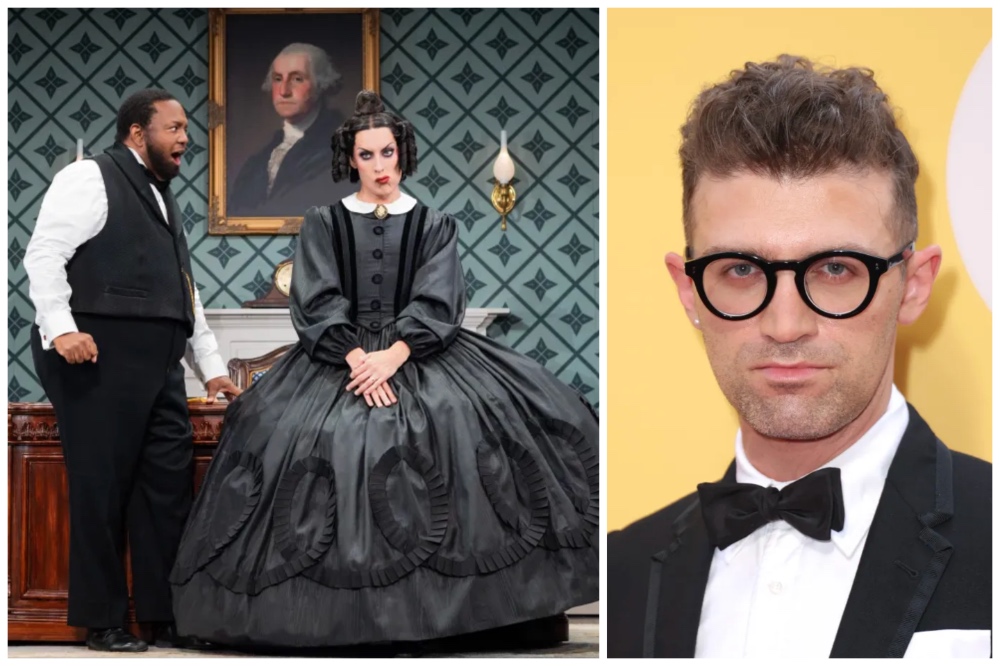
As most theater fans already know, “Oh, Mary!,” which is as hysterical as it is ahistorical, is the story of possibly unhinged presidential spouse Mary Todd Lincoln, and her thwarted aspirations to escape life in the parlors
of the White House for a career in show business. If there is anything Mary would appreciate, it’s a bigger room. So she would be deeply pleased with the production of “Oh, Mary!” that opens this week at L.A.’s Ahmanson Theatre, where the vast majority of seats for its nearly month-long run sold out in advance. That’s not something that happens with every engagement in the 2,100-seat theater, but Mary — and “Mary” — are a unique case, to say the least.
The wild comedic play, directed by Sam Pinkleton and written by (and originally starring) Cole Escola, became Broadway’s toughest ticket immediately upon opening in early 2024, after a smash off-Broadway run. The succession of actors eager to step into Mary’s dress in the last two and a half years has included both drag performers and cis women. On the national tour that is arriving in L.A., the leading lady is the indelicately named drag queen Alaska Thunderfuck, who has some big 19th century shoes to slip into. Even bigger, maybe, since she has a vaster balcony to project to than the one in Broadway’s Lyceum, which has less than half the L.A. theater’s capacity. But in an interview with Variety, Pinkleton suggests that putting “Oh, Mary!” in a larger space might work to the show’s advantage, given the potential contagion of that many ticketholders getting caught up in uncontrolled laughter, as tends to happen as the show grows progressively more outrageous.
Pinkleton is already known to some L.A. audiences for his 2024 Pasadena Playhouse production of “La Cage aux Folles,” and Broadway theatergoers are currently catching his revival of “The Rocky Horror Show” as well as “Oh, Mary!” He also talked with Variety about two other classic musicals he is set to bring back to New York. But first, his thoughts on bringing the thunder to L.A.’s Music Center. (Incidentally, the Ahmanson just announced that the demand for “Oh, Mary!” tickets will result in the show making a return engagement in 2027, for those with FOMO about missing out on the good seats this time.)
Sometimes, when we do a piece about a play coming in, we say something about how we’ll be “helping spread the news.” It might sound silly to say that about this show, though — ust about everyone in L.A. knows that it’s coming.
Well, that’s because there are so many flags on flag poles. It’s like a fascist “Oh, Mary!” state with all of those “Oh, Mary!” flags everywhere.
The tour has been in San Francisco, Portland and Seattle on its way to the Ahmanson. Assuming you must have come out west to see how it’s doing at at least one of those stops, any thoughts on how it’s working as a touring show?
I love this version of the show, and I’m not just saying that because it’s my job to say it to you right now. It’s because we’ve seen the play with so many different people, we’ve kind of learned how it can stretch, and I think that this version of the play is the play. I feel very happy with it. It feels like the play that Cole wrote. It feels like the play that I directed. They’re an incredible company; Alaska is so funny. I was a bit nervous about it in these big theaters, but I saw it in San Francisco at the Curran, and the play is not what one would call subtle, so it really works in these big rooms. It’s also just so fun to be with that many people laughing. So I’m sure that it will curse us because I said this to you, but I feel like it’s going pretty well.
So many of us are curious about how it will feel because you’ve got such a perfect jewel box environment there in New York. But you feel like, from what you’ve been able to see, you get a similar reaction?
Yeah. And you know, the big jump for us was from off-Broadway to Broadway. That was like: What the hell? How is this gonna work in a big theater? Because the Lyceum, the Broadway theater, is small, but it’s very tall, and I honestly thought it was gonna be a disaster on Broadway. I really thought it wouldn’t translate. But I actually think it plays better on Broadway than it did in a small theater. So running it on Broadway has given us the confidence to know how to kind of fill a room with it, and the adaptations we’ve made for the tour, I think, account for the different spaces very smartly.
I also think sometimes it’s easy to kind of insult the audiences at these big theaters. But if you go to the theater in Charlotte, a 3,000-seat theater, that’s your theater. That’s how you experience theater, so the fact that it is at that scale isn’t weird. You know, that’s how I met theater. I grew up in Richmond, Virginia, going to national tours, and I’m sure I saw tiny shows that got swallowed up by that big stage, but it was where I saw theater. So I feel very positive about it being in all of these massive theaters.
Occasionally I go onto Broadway message boards…
Wow, brave man.
…and before I ever got to see the show in New York, I was looking up message threads about “Oh, Mary!” to see whether the reaction was uniformly positive. It was, almost, but there was one discussion that had a header along the lines of, “Am I the only person who didn’t get ‘Oh, Mary!’?” He was confused that everyone in the entire theater was rolling in the aisles except for him. And it made for interesting reading, because a lot of the respondents were basically saying, “Yes, it’s just you… but I really expected there to be a lot more of you. I saw this off-Broadway and loved it but thought it would just appeal to downtowners or the gay comunity.” So people were saying they loved it but they were shocked that everyone else loves it. Obviously you knew that it had a broad appeal, but were you even a little bit surprised at how broad?
I definitely didn’t know it had a broad appeal at all. I think I was on the far side of cynicism there. We made it for a short run downtown, and were delighted that our dumb friends wanted to come, and that was enough, you know? It was like, mission accomplished! We got some gay people to laugh. Hooray! And it wasn’t until we were on Broadway, early on, that I looked around at a matinee and was like, “These people are not gay people from Brooklyn. These people are, like, Aunt Kathy who took the train in and wanted to see a Broadway show.” And Aunt Kathy deserves to have a good time, and God bless her. Aunt Kathy’s laughing at dick jokes, and that felt great. I watched my conservative father watch the show, and he was howling.
I think there could be a lot of explanations for that, but I think at its root, there’s something really old-fashioned about “Oh, Mary!” When people come to me and are like, “It’s groundbreaking, it’s radical!,” I’m like, “It’s actually not. It’s a play with a couch.” I think it’s well-written and I’m very proud of it, but fundamentally it’s a play with a couch, and you’ve seen a play with a couch before. So like I think the elements of it are familiar in a way that make it kind of approachable. It has a bit of Carol Burnett in it, it has a bit of “The Muppet Show” in it, it has a bit of “I Love Lucy” in it. So I didn’t expect it to have the appeal that it has, but I love that it does, and I love, love, love seeing audiences that you wouldn’t expect at this play laugh at some of these jokes. In Hartford, Connecticut, I was like, “How is this gonna go,” watching these older ladies, and they were so into it.
The pure physicality in a few scenes, where the audience in New York was just having waves of laughter, reminded me of seeing some of the old Sid Caesar “Your Show of Shows” sketches from early TV days where the live audience is practically going insane. But that’s part of the rollercoaster ride that the audience goes on, where the audience knows it’s going be outrageous, but it still surprises them with how outrageous.
Yeah. We try to really protect the secrets of it. And part of the fun of it is getting hit with those surprises.
Let’s talk casting. Why is Alaska Thunderfuck so great for this?
Well, Alaska’s known to most as a beloved, famous drag queen, and that she is. But I know Alaska as a great actress. We’ve done a few musicals together, and from the early days when Cole and I started to realize that other people were gonna play this part, Alaska was one of the first names that I brought up. She really can do it all. The thing that is so amazing to me about her is she has this super over-the-top, wacky, absurd public persona. But she is the most disciplined, rigorous performer. There’s no detail too small for her. She works so hard and is such a pro. And she has approached this like a drama — like she’s just a great actress in a drama. It makes it so funny, because she’s 1,000 feet tall and she’s in this massive dress, throwing herself all around, but she’s taking it so seriously.
A lot of people who are fans of the show probably wish that they could see every production of this with every actor, because it’s easy to imagine how wildly different all these Marys would be. It was originated as a role played in drag but you also have cis women doing it. When did you start thinking about how much you could open this up to different types of actors or actresses?
It was sort of a puzzle that was born out of necessity. We really didn’t think much about other people doing it, other than the amazing Hannah Solow, who was originally the standby and went on to take over the part for a while on Broadway. But when we knew that we were gonna keep running on Broadway and Cole needed to take a break, we were like, “Somebody else has to do it.” And Cole and I always took the play very seriously as a dramatic work, even if nobody else did, and so we wanted to make sure the first replacement for Cole wasn’t just a wacky person in a dress. And Betty Gilpin came up, who I think is one of our greatest living actors, and Betty completely got it and approached it like she was doing Chekhov, and it was so, so funny. By having Betty be the first replacement, I think it taught us how good the play is. Then the fun of it has been kind of bouncing… like, making your next move as far from the thing that came before it as possible. So we’ve been able to go from Betty to Jinkx Monsoon to Titus Burgess to Jane Krakowski to… You know, it’s just that Cole wrote a good play, so it can hold a lot.
Just in terms of the sort of extreme turns of the play, which we won’t reveal, I found myself in that tension of wondering if we should identify with Mary, or do we worry that she should be institutionalized immediately for psychosis? Or do we identify with her because she’s kind of psychotic and we have a psychotic side? We go along with her as she acts out in these repressive or strict situations, and it’s not always clear whether to cheer her on or recoil, though it’s understood we’re going to be on her side.
Yeah, I think many of the people who have played Mary… I’m gonna use as an example the great Meg Stalter, who did it on Broadway. The first thing Meg said to me was, “I’ve never seen myself on stage before like that.” And I do think that a lot of the Marys in particular really relate to her, and I think we all can relate to a feeling of being trapped somewhere — a feeling of believing something about yourself so intensely that everybody else thinks is a joke. I mean, I’m not trying to be funny. I do think it’s quite relatable. And there are some things in the play where she gets really honest, and I think on the best of days, those are played with complete truth. So I do think she’s an unlikely hero, but I root for her. Obviously it’s great when people laugh at the play, but I love when people are moved by it. And it can be surprising.
It’s good you mention that, because there is one scene in the play where a lot of us find ourselves thinking, “Wow, this got really kind of earnest for a minute.”
It’s super earnest.
It’s always interesting when things that tend toward outrageousness or even slapstick get briefly sort of serious before the comedy kicks in again. I always think of the movie “Kingpin,” where there is one scene in the middle where the main character talks about his unhappy childhood or something, and there is no laugh in the scene at all — like, “for whatever reason, we’re gonna ground you for just a minute before we go back to being bonkers.” And “Oh, Mary!” reminded me of that. Maybe Mary is an anti-heroine for all of us.
Yeah. I mean, she does outrageous things, but her situation… Maybe being the wife of Abraham Lincoln is not relatable, but I think a lot about her situation is relatable, very broadly.
You said somewhere recently that “The Rocky Horror Show” was your 10th Broadway show. Is that right? That’s a lot.
Somehow that is true. It is my 10th Broadway show.
You’ve had breakthroughs and popular hits before, but as an actual phenomenon, does “Oh, Mary!” feel like the biggest thing in your career at this point?
You know, I’ve had a lot of shows do well. I’ve also had a lot of shows not do well. But what has happened with “Oh, Mary!” and the way that it has kind of caught fire culturally is unique. I’m not a spring chicken, but I’m not on the rocking chair on the porch yet, you know? I’ve got a lot of energy left. And I’ve said to so many people involved in “Oh, Mary!” who have this ss their first Broadway show or their first play, “Guys, it isn’t usually like this. Don’t get used to this.”
So I can see how “Oh, Mary!” is unique in the success of it, but also, the thing I like about my job is directing, and directing is kind of the same whether you’re doing it in a basement in a church in Iowa or on a Broadway stage. So there’s a way that “Oh, Mary!” stands out, and there’s also a way that I just like making shows, you know? I like making shows, and I make a lot of shows, and I’m making a lot of shows right now, and I’m very grateful that “Oh, Mary!” gets to continue to be one of the shows that I’m making.
You’ve had a lot going on, including “The Rocky Horror Show” on Broadway right now, but is there more in the pipeline for you?
I’m doing a lot. I’m opening a musical in London that I love so much it hurts, which is called “Ceilidh,” which is an unspellable word. It’s a Scottish participatory dance musical. I’m doing “You’re a Good Man, Charlie Brown” at City Center with David Hyde Pierce, Ayo Edebiri and Danielle Brooks, this crazy cast. And then next year I’m going to direct the 50th anniversary Broadway revival of “Annie,” which is kind of a demented cousin of “Oh, Mary!”
A cousin how?
Oh, my goodness. I mean, you used the word “earnest” to describe a moment in “Oh, Mary!,” which I really love, and I think that there is an incredible sincerity to “Oh, Mary!” and an incredible exuberance to “Oh, Mary!” I really don’t have a lot of curiosity in things that roll their eyes. I just think the world is cynical enough without us making cynical things inside of it. And so “Annie,” much like “Oh, Mary!,” is just bright-eyed and exuberant and nasty, and it behaves badly, and it’s got teeth. I’m really excited about it. People always think I’m kidding when I say I’m excited about it. I’m like, “No, no, no, I’m so excited about it.” “Annie” is badass.
And what excites you about “Charlie Brown”?
Oh, gosh. I mean, I find the world of Charles Schulz to be so devastating and honest. And “You’re a Good Man, Charlie Brown” is as if Samuel Beckett wrote a musical. It’s so quietly devastatingly existential and sweet, and not cloying. When I started thinking about doing it with adults, and in particular with David Hyde Pierce as Charlie Brown, I was really moved by the simplicity of it. That’s the whole thing with Charles Schulz: Hpw can you kind of say the most with the least? That is, I think, kind of an amazing challenge to make theater with, and it’s not how I usually make theater. I’m usually kind of a maximalist. And “You’re a Good Man, Charlie Brown,” by virtue of Charles Schulz, is this invitation to be incredibly emotionally rich and also very spare with how we tell the story. I’m really excited about it. It’s so sweet.