
Click here to read the full article.
“I’m sure Julia Roberts or Jennifer Lawrence don’t constantly answer questions about Trump or Marion Cotillard about Marion Le Pen!” Speaking Thursday at the Black Nights Film Festival (PÖFF) panel “Women, War and Witness:
Cinema in Times of Global Crisis,” Iranian-born star Golshifteh Farahani (“Pirates of the Caribbean: Dead Men Tell No Tales”) didn’t mince her words about politics, who controls the narrative and cinema.
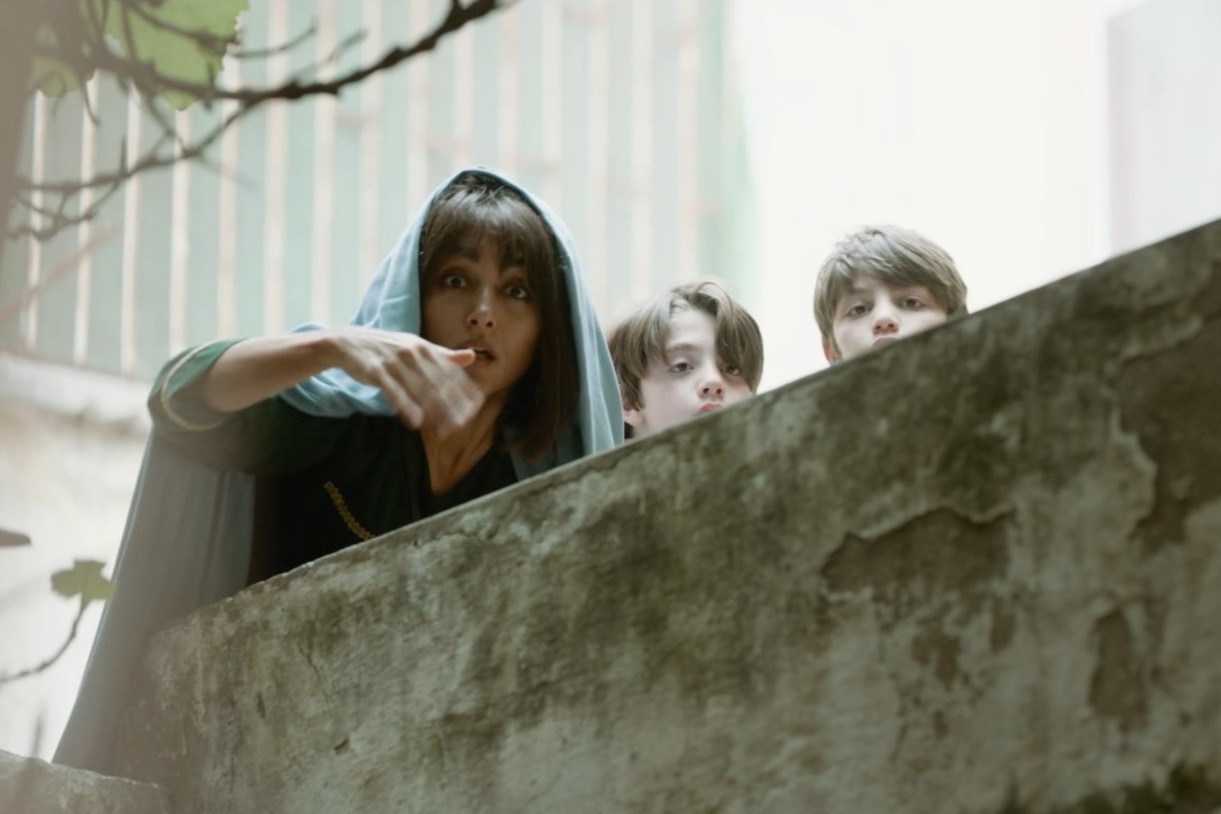
Farahani is attending the festival with “When She Hears the Bells,” which is competing for best first feature.
Sitting alongside Farahani during the panel was Halkawt Mustafa, Norwegian-Kurdish writer, director and producer of the film “No Paradise if You Are Killed By a Woman,” Iraq’s Oscar hopeful and earlier Venice out-of-competition entry, which will receive on Nov. 20 PÖFF’s first ever Free World Award, backed by the Ukrainian State Agency.
Sharing the discussion on Zoom with Mustafa and Farahani were Natalia Libel from Ukraine-based 2Brave Productions; and Mariia Vynogradova and Ksenia Bugrimova, co-founders of Talented U and the Women and the World International Film Festival.
Asked by moderator and Egyptian journalist Ahmed Sahwky if, as an international actor from Iran, she felt split between focusing on her art or discussing her country at war in the media, Farahani immediately hit back. “I’m sure Julia Roberts or Jennifer Lawrence don’t constantly answer questions about Trump or Marion Cotillard about Marion Le Pen,” she said.
“I would have loved to sit here and talk about cinema, but I’m always questioned unnecessarily about politics, because politics today are so polarized. It’s either black or white, and if you are neither of them, in the middle, you cannot exist. It’s very dangerous because harmony comes from the middle.”
Despite her quick digression, Farahani said she loved being “Yazidi women, Kurdish women, Afghan women, Lebanese women” on screen. “I somehow lived through this region of war; I can feel the suffering because of this black gold in the region that we are living in, unfortunately, or fortunately.”
Bouncing back on the question of women, war and cinema, Farahani said “if you’re coming from a country at war like Ukraine, you become that country’s representative, your individuality is taken away from you, as you need to be a flagship [of that country].”
Mustafa concurred, saying he’s been asked which flag he should raise, the Kurdish or Iraqi one, and if he shouldn’t have a Norwegian perspective with “No Paradise if You Are Killed By a Woman,” screening at Tallinn’s Best of Festivals’ section. Yet all that mattered for him was to draw with this film a portrait of a Kurdish woman, to remain as true as possible to her perspective, the one of a Kurdish Peshmerga sniper returning to the battlefield to rescue her younger sister from ISIS captivity.
For Farahani, who has spent 20 years in exile in France, it is people’s prejudice or distorted views of a person, living in a country at war, which is a heavy weight to carry.
“People enjoy “victimizing you and say, oh, poor Ukrainian people with the war. Oh, it must be so horrible in Iran. When you are in certain positions, you have to be in that box, and you’re not allowed to exist in that box. So not only are you imprisoned by bombs, war and oppressive regimes, you’re imprisoned by the world that is putting you in that box!”
Farahani who first gained international recognition for her role in “The Pear Tree,” had to leave Iran in 2008 after backlashes with local authorities following her appearance in Ridley Scott’s Hollywood film “Body of Lies.”
Answering Sahwky’s question about an artist’s moral dilemma regarding what project to board or not, she said once in the West, she had to fight new challenges about stereotypes.
“When I left Iran, it was the time Bush was calling Iran [part of] the axis of evil,” she told the audience in Tallinn. “I went to America, and all the parts that I was reading were either terrorists, or about someone involved in some terrorist action, or about some underground party scene in Tehran.”
She said coming from Iran, she could not accept any of those parts, despite being in a precarious financial situation. Still to this day, she sticks to her guts, her truthfulness, her dignity. “It’s just absolute bullshit what Hollywood shows of our region. It’s propaganda from the U.S., propaganda from Iran; we are victims of propaganda from both sides,” she complained.
But what about filmmakers, forced to fit into the system and exert self-censorship to be able to work? asked Sahwky, himself well aware of the pressures on artists from Egyptian authorities. “It comes down to Hollywood, writing and rewriting history,” Farahani said. “White supremacy [at U.S. studios], them deciding, giving money, writing and rewriting history.”
Vynogradova said her platform, Talented U, was contributing to change and helping filmmakers from countries at war. “We just give them an opportunity to be heard, to be seen, this is our main thing.”
Bugrimova said more responsibility should be on the producers, the industry or on bigger film festivals, which should “not just be a platform. They should make a difference for the filmmakers selected, coming from war zones, help them to find the right person in the room or help them spread the word [against war].”
Free World Award
The panelists praised PÖFF’s exceptional efforts as festival director and founder Tiina Lokk had just signed before the panel a document with Andrii Osipov, head of the Ukrainian Film Agency, officially launching the First Free World Award.
Presented annually to a film at PÖFF, the award is meant “to recognize cinema that champions freedom, human dignity and human rights.” It is a joint initiative with the Odesa International Film Festival, backed by the Ukrainian Film Agency, which signed with PÖFF a three-year memorandum.
“I am sincerely delighted that the first Free World Award will be presented to a film [“No Paradise if You Are Killed By a Woman”] that sheds light on acts of violence against the civilian population of the city of Mosul,” said Osipov, who described the film as “a deeply moving cinematic work by an outstanding director. The film upholds universal human values and is truly deserving of recognition.”
The symbolic award is meant to strengthen the ties between Ukrainian, Estonian and international film professionals. PÖFF was among the first festivals to promote Ukrainian films following Russia’s invasion in 2022. Since 2024, PÖFF’s Standing with Ukraine gives Ukrainian filmmakers a platform to share their work with international audiences.
Lokk will also receive at the festival’s closing ceremony Ukraine’s Order of Princess Olga, Third Class, an award in recognition of her dedicated support for Ukrainian cinema and its international promotion.