


Click here to read the full article.
When Alan Cumming was leaving drama school, everybody told him there was no point auditioning for Pitlochry Festival Theatre, because it only hired English actors. Four decades later he runs the place, and is closing
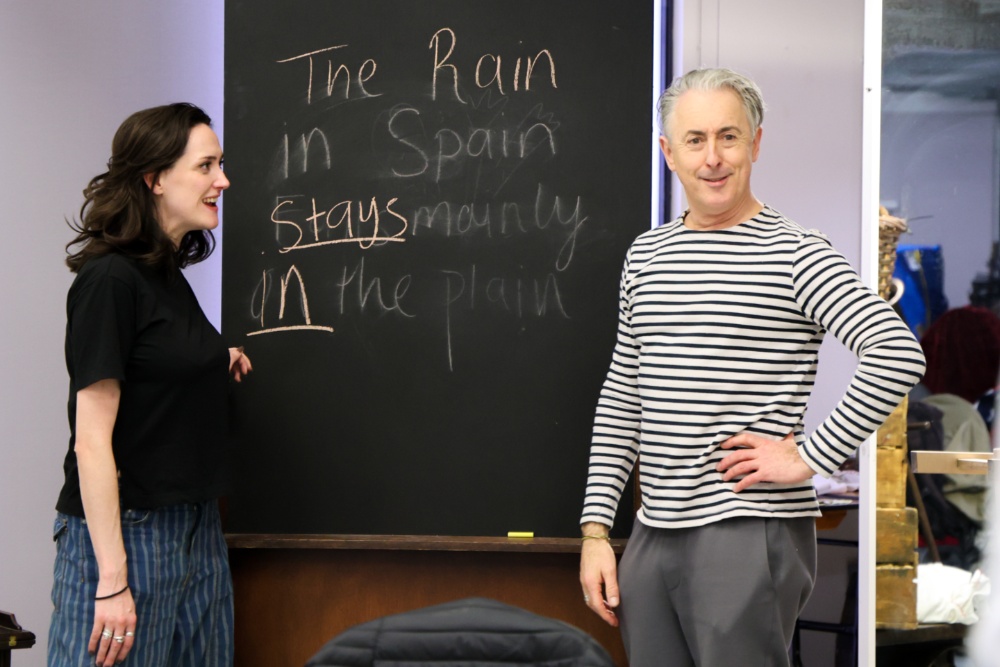
his first season as artistic director by playing Professor Henry Higgins in “My Fair Lady” opposite Glaswegian actor Verity Power’s Eliza Doolittle.
“Having two Scottish people playing the leads in a show that is about the misapprehensions and the prejudices that people have about accent — I think we very much understand that, being Scottish,” Cumming tells Variety.
Lerner and Loewe’s “My Fair Lady” will run at the Perthshire venue from Nov. 21 to Dec. 31. Maria Friedman, the director behind the Tony-winning Broadway revival of Stephen Sondheim’s “Merrily We Roll Along,” is staging it, and the production is a co-presentation with Sonia Friedman Productions.
The show came about almost by accident. Cumming says he was approaching artists he admired, Friedman among them, and it was she who pitched the 1956 musical. For a theater of Pitlochry’s scale, a familiar title made sense as one of the season’s tentpoles, he says, with riskier work sitting alongside it.
“It’s not your granny’s ‘My Fair Lady,'” Cumming says. “It’s going to have an edge to it, and I feel like casting me, casting Verity, it’s a bit more spunky than you might expect.”
Friedman’s reading starts with the two leads as mirror images. She sees a piece about patriarchy, class, status and the lack of opportunity for women, but above all about authenticity, with Higgins and Eliza as “two sides of a coin.” Both react to the world viscerally, and neither has been polished out of themselves.
“I think that Higgins is definitely spectrum-y, without any question, and Eliza is emotionally incontinent, but they’re both passionate people about the things that they love,” Friedman says. “The further Eliza gets away from her original — she’s so full of chutzpah and life force — the more ladylike she becomes, the lonelier she becomes.”
Asked how she handles a relationship long sold as a romance but built on power and control, Friedman says, “It’s absolutely easy. We just don’t go there. Love comes in all shapes and sizes, and so I’m looking absolutely at a friendship. Two people who can rub along with each other, are better off with each other than without each other, still living their own lives.”
George Bernard Shaw famously resisted a romantic ending for “Pygmalion,” the 1913 play the musical is based on. Friedman acknowledges its influence but says she has to make the musical’s script work on its own terms, steering consciously away from “any point of ever thinking that there’s a love affair. It’s not going to happen.”
Nor is anyone sanding down Higgins. Cumming calls it a period piece about the patriarchy, in which a strong woman comes in and tries to bash it, and says he is serving both the musical and Shaw’s play. “I’m not interested in flattening things out to make them uncontentious,” he says. “I am interested in finding a way to play people so that you understand them.”
Friedman, who last saw “My Fair Lady” when she was 21, says she has no idea what other productions have done with the role. She sees a Higgins whose short fuse comes from repression, a man who at first treats Eliza as a scientific experiment until “that kind of microscope looking at this specimen flashes out in front of him into a human being, which is most alarming for him.” Cumming, she adds, “can turn on a sixpence: one minute he makes you want to cry, then you’re roaring with laughter.”
For Power, the shadow of Audrey Hepburn and Julie Andrews was something to study and then mostly set aside. A Hepburn devotee who has watched the 1964 film since she was about 7, she says she kept perhaps 20% of the screen Eliza. “There’s a big, fat 80% which just has to come from me, otherwise it’s, you know, 100 girls all auditioning as Audrey Hepburn or Julie Andrews,” Power says. “Eliza is so close to who I am in terms of how overly emotional she is, and how reactive she is, and how she sort of likes to storyboard her life.”
Friedman says the search for an Eliza was a long one. “Verity walked in, and she is authentic,” the director says. “Somebody hasn’t ironed her out.”
The accent question runs through the entire conversation. Cumming describes enduring “a low-level racism, actually,” in London over his accent and the assumptions people made about his education and background. In New York, the same qualities were celebrated. “[As] a baby actor, I was sort of told to squash it or hide it,” he says. “Once again, it’s kind of what the show is about, your authenticity and all that sort of stuff being your biggest gift.”
Power, who says she mostly works in retail when she isn’t acting, describes sizing up customers to decide whether she can talk in her own voice or needs her “shop voice.” When she does put it on, people ask if she is from Edinburgh. “I go, ‘No, no, I’m from Glasgow,’ and they’ll be, ‘God, your accent’s not strong at all,’ and I’m like, ‘That’s because I’m trying to make your life easier!'” she says. “Every Scottish person I know has had those.”
Friedman’s other big move is scale. She is turning a show that would normally need around 30 performers into a chamber piece with 18, swings included, and a smaller orchestra. “These things are too expensive to put on. So it’s really, really hard for these shows to go on and have a life,” she says. “I want to make it into a piece that speaks to us today in a beautifully concentrated, chiseled-down version.”
That fits Cumming’s ambitions for Pitlochry’s musicals, which he wants to stand on their own and travel beyond Perthshire. He has, he says, “no interest in doing musicals that are just sort of regurgitations of West End things.” For that to happen, the shows “need to have idiosyncrasy and passion and panache.”
Power says Friedman has treated the show from day one “as a play where we just so happen to also sing sometimes.” Cumming describes a director who keeps pushing and questioning, and who is specific early. “Her energy is very, what’s the word, effervescent,” he says. “So it’s an exciting room to be in.”
Cumming’s own profile has shifted since he took on hosting duties for “The Traitors,” a job he accepted on a whim, knowing nothing about competition reality shows. He built a character for it, and the result has brought him commercials and wider visibility. The lesson, he says, is much the same as the play’s: value your authenticity and go with your gut. “I went with something that everybody thought I was bonkers to do, and it’s turned out into this kind of amazing thing for me,” he says.
Along with Cumming and Power, the cast includes Martin Ball as Colonel Pickering, Alexander Newland as Alfred P. Doolittle, Juliet Cadzow as Mrs. Pearce, Julie Legrand as Mrs. Higgins and Alex James-Hatton as Freddy Eynsford-Hill. Tim Hatley designs, with choreography by Ashley Nottingham, lighting by Neil Austin and musical supervision by Joel Fram.
Asked what will land hardest with audiences now, Power points to the pressure on women to be polite, sound right and look a certain way, citing the lip filler and Botox ads that appear unsolicited on her phone. “It happened then, and it happens now, and it will sadly probably happen forever,” she says. “But it is something that we can take hold of and scrunch up in a ball and chuck away and go, ‘No, we’re fab as we are.'”