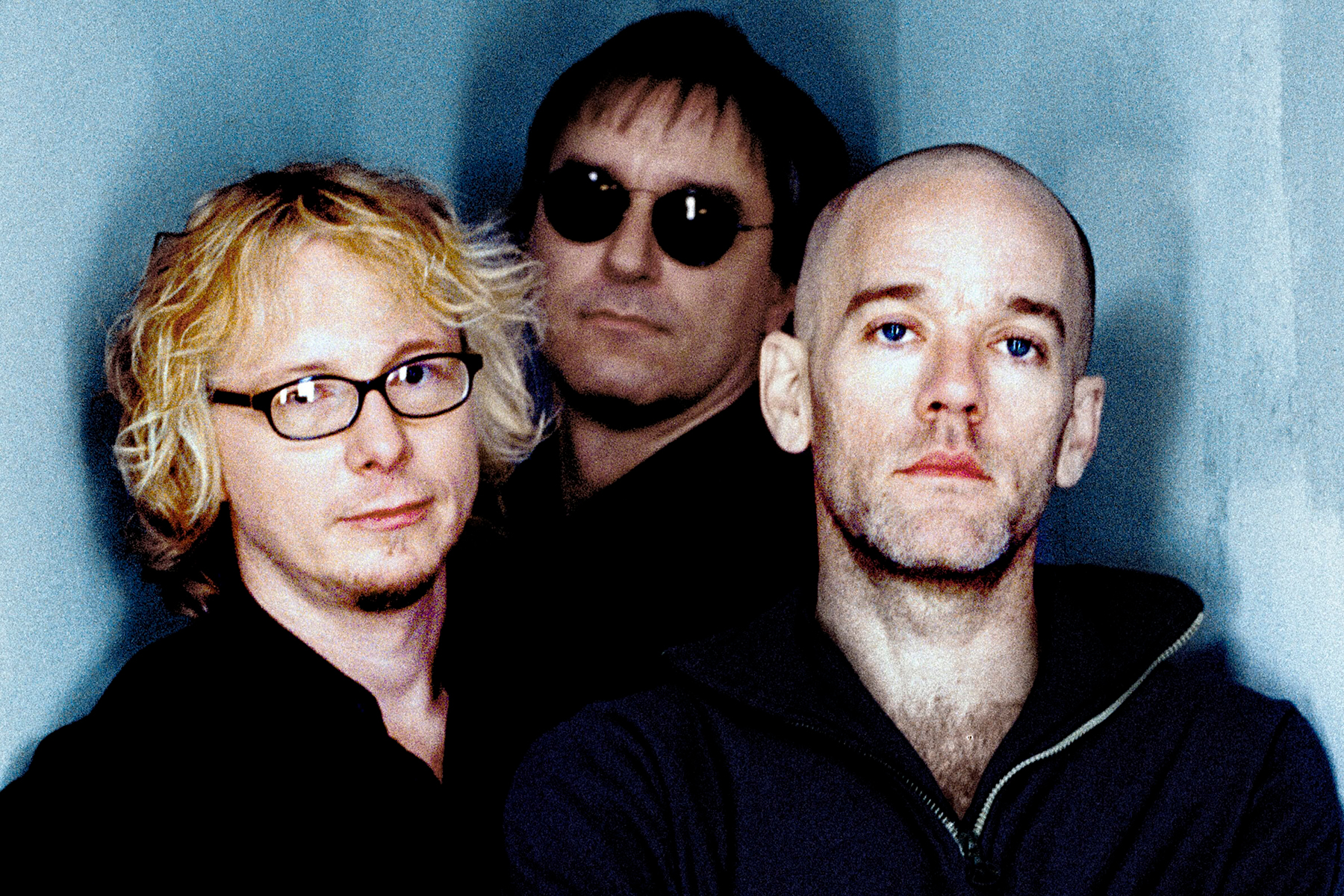

R.E.M. broke up in 2011, seemingly for good, but their story nearly ended even earlier than that. Making 1998’s Up, their first album without drummer Bill Berry, was a dark, fraught experience, and afterwards, they weren’t sure how to continue. But by
the time the remaining members of R.E.M. — Michael Stipe, Mike Bills, and Peter Buck — made it back in the studio for 2001’s lush, sonically adventurous Reveal, they had reached a new equilibrium that would last a decade longer. With Reveal (25th Anniversary Edition) due Friday, Nov. 20, Mills joined Rolling Stone by Zoom to look back at the making of that album and much more. The new edition includes The Black Sessions Revealed, a previously unreleased live set that R.E.M. recorded for Radio France in Paris in 2001. (Those live performances are also getting their own double-LP release.) Mills is also keeping busy with his new supergroup, Howl Owl Howl (featuring Darius Rucker and founding Black Crowes drummer Steve Gorman), who just released a new song and are planning a tour next year.
The band has described Reveal as a summer record, a joyful record. But it’s not that joyful.
No, it’s not. It’s more wistful. And the reason I see it as joyful is ’cause we had so much fun making it. We went to cities that we loved and worked with people that we loved, and we’d just gotten through all of the rough business of Bill leaving the band and trying to make Up without a drummer.
And so we were all just so happy to be done with all that and back on firm ground that to me, that’s the happiness of the record. Obviously, I listened to it a little while back and was like, it’s really not that happy. But we were happy. So it does capture, I think, the wistfulness of summer — fall is coming and you’ve got this free time, but it’s gonna end soon, and I don’t know, I think that’s in there as well.
It’s well documented that Up was painful, and you came out of it in a bummed-out place. How did you repair things enough to come into this record in such a positive place?
We had some come-to-Jesus moments, and we had to make that decision: What do we care about here? What’s more important? Or is R.E.M. worth fighting through losing a band member over? And we decided it was. We had a great meeting out in the middle of nowhere and had a facilitator and just reaffirmed our commitment to what we were doing.
‘Cause we had to. We had to do something like that or we were just gonna be done after Up, and nobody wanted to end on Up. You wanna end on an up note, but not on Up. So we just recommitted and reconfirmed and went into Reveal with a really clear head space.
By a facilitator, you mean a therapist?
I’m not gonna get into that, but we were at a point where we needed to do something drastic, so we did.
Did you see the documentary Some Kind of Monster, where Metallica had a therapist?
No, but I’ve heard about it.
Maybe we can talk about the facilitator on the 30th anniversary. Will people ever stop asking whether you’ll reunite?
Yeah, I’m sure when one of us kicks the bucket, it’ll stop. I don’t know how clear we can be. It’s like, I know that we got onstage with the Shannon-Narducy guys and Peter and I are in a couple of bands together and all of that stuff, but R.E.M. is done. R.E.M. as a recording and touring entity is over.
Short of a billboard every six months, I don’t know what else you can do.
I’m glad people still care. Yeah. It’s good. I want our music to be in the zeitgeist, I want it to be heard and thought about and talked about and appreciated. And it’s also gratifying that people care enough about the band that they would like us to reform. That feels good, and I don’t ever wanna dismiss that sort of concern and care from our fans, but it’s not gonna happen.
Back to Reveal. I know it’s always been one of your favorites.
It’s one of my favorites in the sense that I think our best records were cohesive, in the sense that they captured a feeling from the beginning to the end, which is what, to me, a record usually does. It captures the moment in time for the band when they were making it. And the more cohesive they are, the better feel you get for where the band was at the time. So Murmur, Automatic for the People, Reveal — I think they’re our most cohesive records, and I love them because of that.
Like Automatic for the People, Reveal is in a quieter mode, and you’ve made some of your best records that way. How conscious was it when you decided, “We’re in that mode”?
I don’t know that it was conscious. You write the songs you write because of whatever head space you’re in, even if you’re aware of it or not. And the approach, the production, the recording of that record was all done with — as I said, coming out of that period, the tough period before that — there was no sense of urgency. There was no sense of a sword of Damocles hanging over your head. There was no tour hanging over our head. A lot of times when you have a tour hanging, you think you gotta rock things up ’cause you’re gonna be playing them live. This one, we just weren’t worried about anything except sitting in those nice studios and making this record.
People reach for the Beach Boys as a comparison, but I’m not sure that’s what you were thinking, even on the lusher stuff.
No, not at all. For example, I was definitely thinking Brian Wilson on “At My Most Beautiful” when we made Up. That was just 100 percent everything I could think of to wave at Brian and say, “Hey, we love you.” That was “At My Most Beautiful.” This record, no, not so much. There are some Sixties pop elements to it, but that’s ’cause we all grew up with Sixties pop and we love it. Wherever the song needed that, I’m more than happy to put it on there. But there was very little Beach Boys thought going on, or even Sixties thought going on during this time.
There’s a Jimmy Webb, “Wichita Lineman” feel to “Reno,” and a Walker Brothers or Bacharach lushness elsewhere. If your touchstones weren’t Brian Wilson, what were they?
I think we were always careful about touchstones and things like that because that’s going to be in your thinking anyway, and if you consciously bring it up, then you might be a little more slavish to it than you intend to be. For us, I think it was more we’d put down what we would hear and then go, “Oh, that sounds like something Bryan Ferry might have done,” or whatever.
But no, we weren’t consciously thinking about that beforehand. It’s an after, post-facto thing rather than before.
As I understand it, you and Peter wrote the music, maybe 25 instrumental pieces to choose from. Were you writing in the same room, or bringing in half-finished demos for the other to add to?
You know what, that’s a really good question. I think that since we weren’t living together like we used to do many years ago, or even living in the same town necessarily, we did a lot of separate writing, but we also wrote in the studio. There’s a lot of downtime in the studio, and Peter and I would sit there with guitars, and as a matter of fact, I think it’s “Chorus and the Ring.” There was a guitar riff I was working on and I couldn’t get anywhere with it, so I just put it aside, but apparently Peter had been listening and he took that riff and created this brilliant song out of it. That’s the kinda thing that you can’t plan for, but it happens.
So there are songs on the album that were mostly one person’s until the band got hold of them?
Yeah. In our later iterations… Even at the beginning, it was like Lennon and McCartney in the sense that one person would write the verse and another one might write the chorus, and then who knows who would write the bridge. This stuff was a little less group-ish than that. It was definitely writing on your own and then bringing things in.
Reading the press from the time, and listening to the album, you were clearly determined not to repeat yourselves, or even to sound like R.E.M. Did that happen in the writing, or in choosing which pieces to use?
That actually began some years earlier, probably right around Green [in 1988] or just after Green, because Green was Green and then of course whatever the next one is, and I’m blanking on the big one… Out of Time [in 1991].
A lot of that was us rejecting what we’d been doing because you’re like a shark. You gotta keep moving or you’ll drown. Peter didn’t wanna keep playing the same electric guitar, so we decided to start shaking things up, swapping instruments, and that worked for a couple of records. But then about that point, we also said, “OK, we can write R.E.M. songs, quote unquote, forever, but that stagnates, and we gotta keep it moving both for ourselves and for the fans.”
You have to keep it fresh. So yes, we rejected a lot of songs over the last few years around that time for sounding too much like R.E.M. We wouldn’t even give them to Michael half the time. We’d just say, “No, that’s a great song. Let’s put it in the shelf somewhere and maybe we’ll use it later.”
Did you kill songs in the cradle at home because they felt too familiar?
That does happen, but at least in my case, it wasn’t because it sounded R.E.M. too much. I didn’t write as much as Peter did on this record, so I didn’t really have that issue. I don’t know what Peter thought while he was writing. He might’ve written 10 other things that he rejected because it sounded too much like R.E.M. “Imitation of Life” is on this record, right?
Yes, and I was gonna get to that.
Yeah, that’s very R.E.M.-y, but, you can’t deny who you are. We’re not trying to pretend that we are not R.E.M. anymore. We love the same sounds that we loved before, and we love the same approach to songwriting that we did before.
You just try not to repeat yourself. And “Imitation of Life,” though, is such a great song, that it doesn’t matter that it sounds like an R.E.M. song. We are R.E.M., so why not?
At the time, you guys, and especially Peter, sounded almost resentful of that song. You talked about leaving it off the album. What do you remember about that?
I think that may have been considered in the sense that we were trying to take a clear step in a different direction from the ’80s R.E.M. Even into the 2000s, we were still moving away, in our minds, from that. But on the other hand, it’s a great song, and you’d just be cutting off your nose to spite your face to say, “Oh no, that sounds too much like R.E.M., and out it goes.” That would’ve just been completely pointless and counterproductive.
Peter also sounded annoyed that everyone called it catchy, as if that were a dirty word. Do you remember that mentality in the band?
No, but it makes sense. I don’t remember that, but it does make sense. It feels reductive. Yeah, it’s catchy. Great. It’s a pop song. Big deal. Believe me, we had plenty of dumb pop songs, and we were always happy to have ’em. But I don’t think there was any of that on this record and catchy, it’s just too easy. It’s like, we’re not trying to write catchy songs. We’re trying to write good, solid songs with some depth and meaning to them.
2001 was the year of the Strokes, but you guys seemed to be in your own world.
We try to live in our world. Yeah. Especially making a record, because once you start, you have to be careful about the outside influences you let in. It can be very distracting. Yeah. And on the other hand, though, we’d go see a band and… Did we see the National around that time? I don’t know, but if you go see a band, they can —
Michael was very aware of Radiohead and Kid A.
Yeah. And U2. We’ve always been very much in awe of what U2 did and very related to how they approach things. But more in the sense of just being inspired, not bringing this sound or that approach into it. It’s more like, “Oh, wow, that was a great band. Let’s go home and make a great song and a great record.” That’s really what we get from other people.
Speaking of U2: In 1993, you and Michael joinedtheir rhythm section as Automatic Baby to play “One” at Clinton’s inaugural ball. What do you remember?
Oh, that was a super fun night. Got to meet Chrissie Hynde. Had a little chat with her that night. That was fun. Getting to play with Adam and Larry was very cool. Getting to do that great song at a very happy time, it was such a positive, forward-looking time that it was just a thrill to be a part of it.
Right before Reveal came out, you decided it was too long and cut a longer song, “Fascinating.” Which brings up something else: You’ve chosen not to release demos or outtakes. Why?
I don’t think we had enough for this record. I don’t think we had enough demos and outtakes. This was fairly focused. Yeah. The thing is, CDs were a curse and a blessing. With LPs, you had 40 minutes, give or take. With CDs, you could put 20 10-minute songs on there if you really wanted to. It gave a kind of freedom, but it also removed some of the boundaries that are good for bands when they’re making a record. We just tried to watch ourselves and not make it too long. You could put every song you like on there, but I think a 15-song record is just too long. We didn’t do it.
We finally got to hear “Fascinating” officially a few years ago and it leaked long before. It’s a great song.
Yeah. It is a great song. But something had to go. Yeah. And that is usually a very hard decision to make, ’cause if you’ve gone to the trouble to write it, record it, produce it, get it ready to go, then you obviously consider it on a par with everything else that’s on the record, but something has to go. Maybe because it was slower, there are already enough slow songs on the record, I think that probably had something to do with it.
What do you remember about “All the Way to Reno” coming together?
I loved that. When Peter brought that in I just said, “That’s beautiful, and that’s gonna work.” And I said, “Now I gotta come up with a bassline that matches that.” And then putting on the tremolo guitar just takes it into that Western zone that’s so nice. So yeah, I was really happy with that. I think that’s probably the high point of the record.
I really like “She Just Wants to Be.”
Yeah. There’s just some strange songs on this record — again, rejecting the R.E.M. template of how to write songs, you have to come up with different approaches and different things, and that’s one thing I do like about this record, is there is an R.E.M. song, quote unquote, or two on there, but mostly it’s innovative for us.
I think you’ve said that “Beachball” is another one of your favorites.
I really like “Beachball.” It’s kinda goofy. The string part I put on it is weird. There’s a part of it that’s kinda jarring. And I think [producer] Pat [McCarthy] said, “Are you sure you wanna do that?” I said, “Absolutely. That’s my favorite part of the whole thing.” ‘Cause it stays on the same half-step note longer than you feel like it might should have. But I really enjoy that. So I think “Beachball” is beautiful and wistful and just quirky enough to be good.
We don’t hear your voice much on Reveal, compared with other albums.
It’s not on there much. And I’m really not sure why. It just worked out that way. If I hear something, I’ll sing it. But I just didn’t really feel the need to insert myself so much on this record. I don’t know, I don’t remember why that is, and I don’t remember thinking much about it at the time, but it is true. I don’t sing very much on it.
The live sessions on the reissue are fun: instant live versions that already rock the songs up a bit. How clearly do you remember that session?
Oh, the Black Sessions? Yeah. Oh. That was just French TV, I think. Yeah. For the first 10 years, we were writing the songs and playing them live before we played them on the record. That really fine-tuned them. It rocked them up, because you wanna rock when you’re playing live. And then it got to a certain point where we were writing the songs, making the record, then playing them live.
And to your point, they would have rocked more had we played them live before we recorded them on the record. Going back to Up, “Walk Unafraid” live was just a straight balls-to-the-wall rocker. It was amazing, and that did not come across on the record.
Michael once said he was getting a lot of advice from Madonna on this record. Were you aware of that?
I don’t, I do not know. Maybe through the ether, or maybe they were in contact more than I’m aware of. I don’t know. I don’t remember a lot of Madonna being bandied about. And I’m OK with that. I have a lot of respect for Madonna, but I don’t wanna make Madonna records.
I just talked to Andrew Watt about Michael’s solo album, which seems to have really picked up pace. Have you heard any of it?
I have. He’s working his ass off on this thing. It sounds great. What I heard sounds really wonderful.
And you’ve got Howl Owl Howl, who just released another single, “Everybody Wants Her.” Did you finish the album?
Yeah, the album is done. I’m running around like a chicken trying to get the artwork done. I’ve never done the artwork for a record before … I’m putting together the packaging for this one, and it’s not something I ever hoped to do, but hopefully it’ll turn out all right.
How does the rest of the record compare with what we’ve heard?
“My Cologne” is a super power-pop song. There are a couple of others of those on the record, very similar in terms of approach to power-pop music. There are a couple of ballads. There’s a political song. There’s just some personal stuff. It’s more diverse than you would think just hearing that one song.
And you’re touring again?
Yeah, we’re going out in early February. It’s a smaller tour ’cause Darius has a big summer tour with Keith Urban coming up, so we had to downsize this one a little bit, but it’s gonna be super fun.
Really good venues and some different cities. Louisville, Milwaukee, I think Memphis, fun place, Charleston. Just places we didn’t hit before.
I hope Howl Owl Howl comes back to New York.
Not this tour, but hopefully one after that.
One last one from Reveal: “I’ll Take the Rain.” How did that one come together?
That was one of the last ones in Miami. I remember going in, it was at night. I’d been to dinner, had a couple glasses of wine. I didn’t like the bass part, so I went in with Pat McCarthy and I took my shirt off, because I got that from Michael.
When Michael wanted to deliver kind of a sexy performance, he’d go in the vocal booth without his shirt. So I said, “OK, I’m gonna do that,” and I stood in the control room, not out in the studio. It was really dark and pretty colored lights everywhere and I just tried to get as into the song as I possibly could for the bassline. That was a really fun recording session.
Is that your only shirtless bassline?
I think that’s probably the only shirtless bassline, yeah. Yeah.
We’ll have to listen for the difference.
[Laughs.] Oh, you won’t. You’ll never know, but it’s there.
Click here to read the full article.