



There are certain Neil Young stories that have been repeated so many times they now feel like folktales. They include his decision to head to a musical “ditch” after scoring a middle-of-the-road hit with “Heart of Gold”; his “More Barn!” command to crew
members who wired one set of speakers to his house and another to a barn while he listened to Harvest on a rowboat floating between the two; and the rock of cocaine lodged in his nostril during The Last Waltz that had to be removed frame by frame by Martin Scorsese’s editing team at tremendous expense.
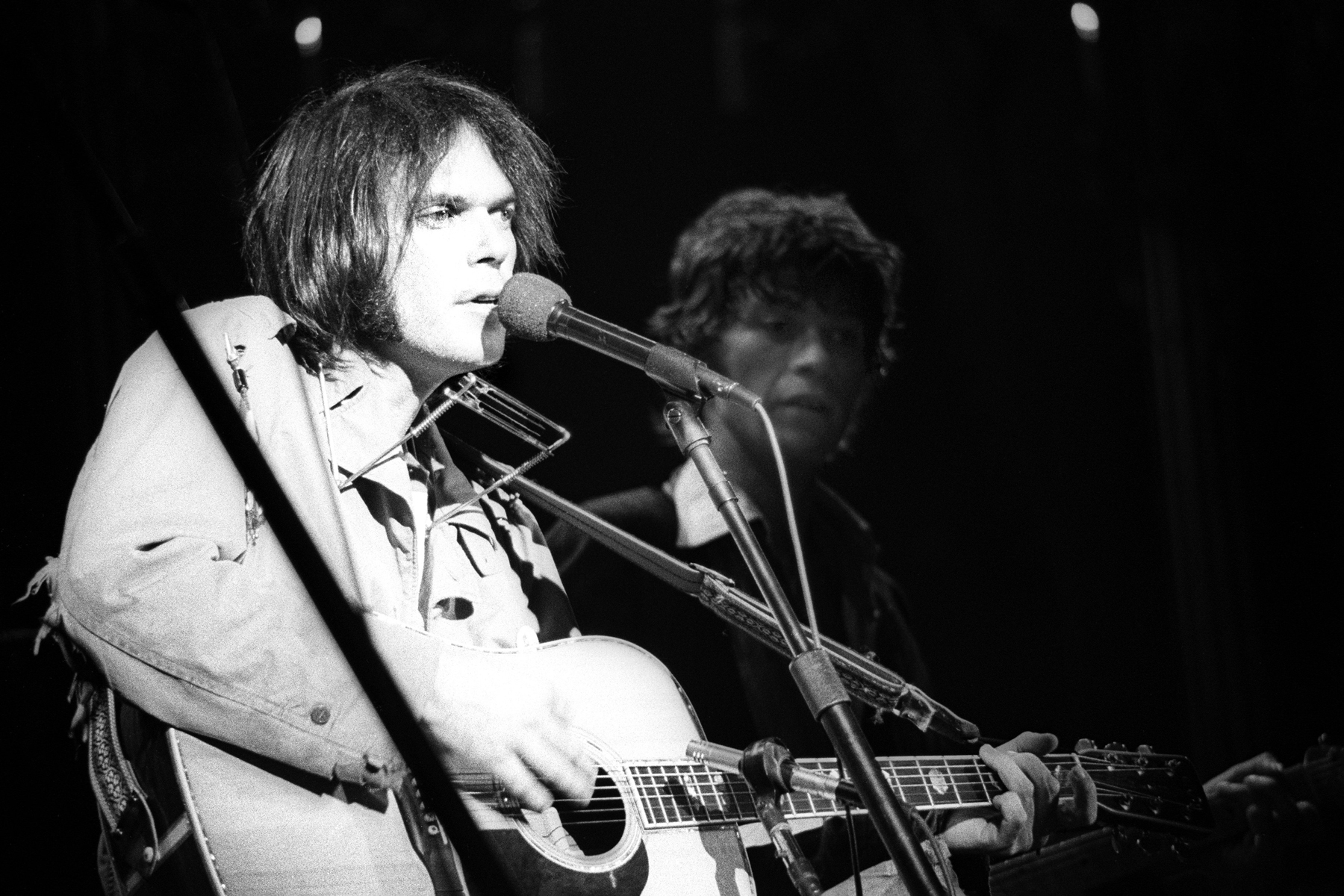
These are all true, but let’s focus on the latter one, since the Last Waltz concert took place 50 years ago today, and the cocaine incident requires some context. First off, Young was hardly the only one using cocaine during The Last Waltz or just about any other major rock concert of that time. The drug was everywhere back then, and most people didn’t fully understand the dangers.
Secondly, cocaine was likely one of the only substances on earth that could have gotten Young onto the Last Waltz stage, considering his psychotic schedule over the previous few weeks, and that day alone, which he started with a 1 a.m. concert more than 2,000 miles away in Atlanta before jetting across the continent to play with the Band at their last show with Robbie Robertson.
The Last Waltz was the culmination of the craziest touring year of Young’s career. It began with a run of dates in Japan and Europe in March 1976, chronicled on the live LP Odeon Budokan, that promoted Zuma and introduced audiences to new Crazy Horse guitarist Frank “Poncho” Sampedro.
These were stellar gigs, arguably some of the best Young ever played. They began with solo acoustic sets where he combed through his already vast catalog and dug out gentle songs like “Mellow My Mind,” “A Man Needs a Maid,” and “Too Far Gone,” before bringing out Crazy Horse after an intermission for fiery renditions of “Like a Hurricane,” “Down by the River,” and “Cortez the Killer.”
After somehow traveling all across Japan and then hitting Norway, Denmark, Germany, France, the Netherlands, Belgium, England, and Scotland in the course of a single month, Young flew to Miami to finish work on the collaborative album he had begun with Stephen Stills earlier that year. Buffalo Springfield were a distant memory at this point, and Young had already abandoned plans for the CSNY reunion LP Human Highway following their 1974 reunion tour, but he felt he had unfinished business with Stills.
The result was Long May You Run, credited to a new entity he called the Stills-Young Band. Young agreed to a summer tour with Stills three months before Long May You Run came out, even though Crazy Horse had assumed they were going to keep working with him on the road. “Neil doesn’t turn corners, he ricochets around them,” Sampedro told Rolling Stone in 2012. “So you just have to hold on to your hat.”
The Stills-Young Band hit indoor arenas and outdoor amphitheaters in June and July of 1976. Without Graham Nash and David Crosby, Young had to work extra hard on the harmonies. The result was totally unique renditions of CSN/CSNY standards like “Suite: Judy Blue Eyes,” where Young’s voice is very prominent instead of buried in the back or absent completely.
The tour didn’t last very long. In a 2020 interview with Rolling Stone, drummer Joe Vitale recounted how it ended much earlier than anyone imagined, especially the fans with tickets for the later shows and the promoters who had signed contracts.
“We had finished a show in South Carolina,” he said. “We sold it out, a big arena. We got on the plane and flew to Atlanta, Georgia. We got to the hotel. Remember, this is 1976. They were using telegrams in 1976. When we got there, we got our room key, our room list, and a telegram. We were like, ‘What?’ I’d never received a telegram in my life. It said, ‘Funny how things that start spontaneously end the same way. Oh well. Each a peach, love Neil.’ It said ‘eat a peach’ because we were in Atlanta, Georgia, the peach state. Everyone’s telegram read the same. I still have mine.”
A furious Stills brought in Chris Hillman from the Byrds to try and finish out the tour. “We tried to salvage the shows, but when Neil Young bails, so does the audience,” Vitale said. “The same thing would have happened if Stephen Stills had bailed. Both those guys were big ticket sellers individually. But together they were huge ticket sellers.”
The bad news for Stills was a blessing for Crazy Horse, since Young agreed to a U.S. fall tour with them, kicking off with a series of unannounced warm-up gigs at California bars. It began officially at the Dorothy Chandler Pavilion in Los Angeles on Nov. 1. They stuck to a single continent this time, but it was still a punishing schedule in which he often played two lengthy concerts in a single evening.
Near the end of the run, he played four concerts at New York’s Palladium in three days, went up to Boston for two shows in a single night, and then traveled down to Atlanta on Nov. 24 for an early show and a late show. “A special Thanksgiving eve concert!” read an ad in the paper that listed ticket prices as $7.00 and $8.00. “Two shows! Advance tickets available at all Tic-X-Press outlets.”
A tape of the early show has circulated for years, minus “Give Me Strength,” “Pocahontas,” and “A Man Needs a Maid” from the acoustic set. But the entire show is in Young’s vault, and he released “The Old Laughing Lady” and “The Needle and the Damage Done” on the 2018 live LP Songs for Judy.
It’s called Songs for Judy because of a rant that a delirious Young delivered early in the second show, which began around 1 a.m. “I saw Judy Garland down there tonight earlier,” he said, talking about the orchestra pit. “She was wearing a red dress with red lipstick and she had a little bit of music with her, one of those music folios. It said ‘Somewhere Over the Rainbow.’ Had a picture of her as a little girl looking up at me with the blue sky behind her. And there she was, Judy Garland, with a red dress with a piece of music, and she looked up and said, ‘How’s the business, Neil?’ You don’t have to believe me.”
It’s hardly surprising Young was hallucinating at this point, considering what he’d put his body through over the previous few weeks. “Neil and the band had imbibed and were on a particular plane, so the midnight show started around 1 a.m. in the end,” Joel Bernstein, Young’s longtime photographer and archivist, told Uncut in 2018. “It was an extremely rambling affair; I don’t think any of the Tonight’s the Night shows I saw were as drunken as this one.”
But Young was still able to dig deep at the late show and rip through “Down by the River,” “Cinnamon Girl,” “Cowgirl in the Sand,” and many other classics. A complete recording of the show is also in Young’s vault, but he’s only released “The Losing End,” “Here We Are in the Years,” “Pocahontas,” and “Sugar Mountain” from the acoustic set, and nothing from the electric one.
The show must have ended sometime after 3 a.m. It’s lost to history exactly when Young got on a plane in Atlanta and flew to San Francisco for The Last Waltz, but the three-hour time difference worked in his favor, and the show didn’t begin until 9 p.m.
With all of this in mind, the only surprise about the infamous cocaine rock was that he didn’t have another lodged in the other nostril. And when you watch him play “Helpless” and “I Shall Be Released” with that glazed look in his eyes, remember what he was doing at 1 a.m. that same day. He was probably seeing Clara Bow, Lillian Gish, and Douglas Fairbanks all seated in the first few rows of the Winterland Ballroom. He’s lucky he didn’t start talking to them.
It’s easy to understand why Young decided to have a very mellow year in 1977, playing only club gigs with his bar band, the Ducks. They did 20 shows in the summer of 1977, and every last one of them took place in Santa Cruz, California. After the wild year he had in 1976, he was more than ready to stay put in a single place. When you start having visions of Judy Garland seven years after she died, it’s time to come home for a while.
Click here to read the full article.