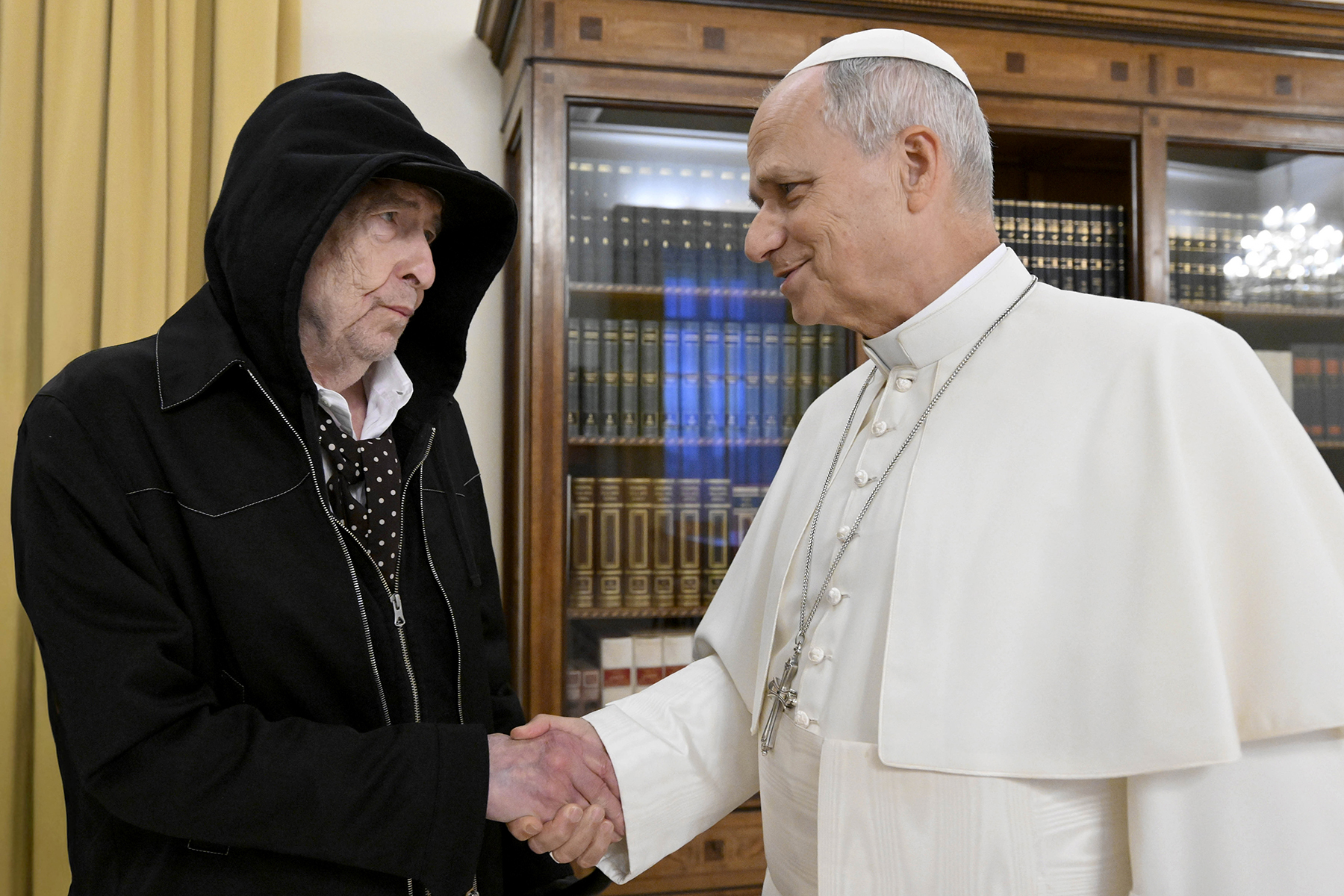



Timothée Chalamet fever aside, nothing Bob Dylan has done in the wild in recent years has been so widely discussed by mainstream media — and so instantly meme-ified — as the photos of Dylan, in a hood pulled up and over his head, meeting Pope Leo XIV
at the Vatican on Nov. 4.
That one wore black, the other white had Twitter tripping over itself to make pithy comments like it was a New Yorker cartoon caption contest. And Dylan’s hoodie was instant headline fodder. The Wall Street Journal clutched their pearls. GQ announced that Dylan dressed like Chalamet. The Daily Beast reported outrage! Star Wars was mentioned… a lot.
But Antonio Spadaro, a Jesuit priest serving as undersecretary for culture and education at the Holy See who brokered the meeting, says Dylan’s attire spoke so loudly that people missed the larger message.
“People talked a lot about what Dylan was wearing that afternoon and very little about what the pope had written,” Spadaro says, referring to the fact that the pope quoted “Go Away You Bomb” — an unpublished 1963 Dylan work — in the preface of his 2026 book, Disarmed and Disarming: Peace Is a Gift.
In the work, Dylan wrote to the bomb: “I hate you cause yer man-made and man-owned, an’ man-handled.”
“In 1963, a young man just past 20, in New York, told a bomb to its face that it was the work of human hands,” Spadaro says. Sixty-three years later “the author of that sheet of paper — which no one had wanted to buy at auction — shook hands with his most authoritative reader. For anyone who believes in the weight of words, it is a small parable. The hood, by comparison, is a side note.”
Since the musical and papal summit, Spadaro — a native of Messina, Italy, and former editor-in-chief of La Civiltà Cattolica, who now writes a Substack — has been doing the Lord’s work by sharing photos of the Midwesterners’ meeting on social media.
He posted a few shots of their handshake. One photo, which he posted twice, was striking: A zoomed-in shot of Dylan’s hand clasping the pope’s.
With its blue veins, purple-ish hue, and dry white powdery skin, Dylan’s hand looking every minute of his 85 years. But the appendage was also a peek behind the curtain. A lift under the hood. That papery hand seemed to say: “I’m human and I need this spiritual touch as much as the next guy.”
We asked Spadaro, 60, to elaborate on the photos he posted on Instagram. Via email, the priest and author — whose most recent books are A passo d’uomo with a foreword by Patti Smith, and Conversations on Faith written with Martin Scorsese — shared his thoughts on hands, hoods, and how David Sedaris fits into all this.
I was so moved by the photo you posted on Instagram, a close-up of their hands clasped. Almost like a Renaissance painting detail, a meeting of two old sages. What prompted you to zoom in that close?
The hands said what the hood kept hidden. Bob’s face was in shadow; his hands, though, were bare, and he had bared them himself, taking off his gloves to greet the pope. That handclasp holds the hand of the young man, just past 20, who typed out “Go Away You Bomb” in 1963, and the hand of the pope who quoted it against nuclear rearmament 63 years later.
You’re right to think of painting. I thought of Dürer’s “Praying Hands,” the 1508 study in which the veins and the worn skin tell an entire life.
By tightening the frame, I took away the fame and the colors of their clothes. What remained were two men well along in years, clasping hands, and it seemed to me the truest photograph of that afternoon.
Dylan morphs over the years, sartorially. When he was in his Nudie-suit-and-cowboy-hat-phase, he wore that to meet Pope John Paul II. I love that Dylan stayed true to his current phase here. Did the pope have a reaction to that? Did anyone?
One detail about 1997 makes the story even better. In Bologna, Dylan performed in his cowboy hat, but when he climbed the steps toward John Paul II, he took it off. This time the hood stayed where it was, and what came off were the gloves, so he could shake the pope’s hand. In 1997 he bared his head; in 2026, his hands.
The only one who hesitated, I admit, was me. At St. Anne’s Gate, I asked his team whether it might be better to lower it, and they explained that the hood, these days, is part of how Bob moves through the world, onstage and off. That was enough for me.
Leo looked the man in the eye, and the hood receded into the background. On social media, some people brought up Emperor Palpatine [from Star Wars]. The scene was much simpler. The pope was perfectly at ease, as if he already knew Bob would show up that way.
What sparked this meeting? Did Dylan want to meet the pope or vice versa? How did you get involved?
The wish was there on both sides: Bob wanted to meet the first American pope, and the pope needed no convincing. A man who has already quoted you in a footnote is ready to receive you.
I knew the right people on both sides, and I found myself in the middle, as a kind of hub. The real work was scheduling. Dylan played Milan on Monday and was due to play Rome Thursday. The pope was leaving for Latin America on Friday. That left Wednesday, a day when Bob had no show. That was all it took.
The pope seems to be a Dylan fan. He quoted from “Go Away You Bomb” in his book —that’s a deep pull. I’m a Dylan nerd, and had to Google it. I could only find 2013 articles about those lyrics going up for auction at Christie’s. They never even sold. Is the Pope a hardcore Dylanologist?
It depends on what we mean by Dylanologist. The word makes me think of A.J. Weberman, who in the early 1970s went through Dylan’s trash in Greenwich Village. In that sense, I’d say definitely not.
[That] you had to Google, though, says a lot. “Go Away You Bomb” isn’t on any record. Dylan wrote it in 1963 and never recorded it. It was meant for a songbook against the atomic bomb that Izzy Young, of the Folklore Center, never managed to publish.
The sheet stayed among Young’s papers for half a century, then went up for auction at Christie’s — that’s how the lyrics became public. The pope came to it as a reader, so much so that in the footnote he calls it a “poetic composition” and places it next to Augustine and Paul VI, with title and year.
He could have chosen “Masters of War,” which everyone knows. I don’t see a Dylanologist so much as a reader who knows where to look.
You wrote about Jim Musselman, the pope’s Villanova classmate, on Instagram. Tell me more about their Dylan connection.
The two met at Villanova in the 1970s, in a philosophy class, and immediately found common ground in two things, baseball and Bob Dylan.
After Leo’s election, Musselman recalled that the two of them talked about music a lot, and that he had given his friend an essay arguing that Dylan was the great poetic talent of their generation. Which essay, I don’t know.
I really like the rest of his story. Musselman founded a folk label, Appleseed Recordings, and for years released records by Pete Seeger and other singers of social conscience. Leo’s Dylan comes from there: from a classmate with a passion for songs that set out to change things.
Dylan had a private talk with the pope. You said you weren’t there.
No, and I think that’s as it should be. I understood that Bob wanted to be alone with Leo, and we left the room. I saw the before and the after.
Before: two men sitting across from each other at a table in the library, some light banter, the exchange of gifts, a rosary on one side and a signed copy of Chronicles on the other.
After: Bob walking out in silence, deeply absorbed, with the look of a man who is happy and has no intention of explaining why. Then again, Dylan has spent 60 years not explaining his songs. He certainly wasn’t going to start with that conversation.
Dylan signed your copy of 64 Lyrics. I love that he used your four-color BIC pen. People jumped on that detail on social media.
“64 Lyrics” is a bilingual anthology published in Italy by Crocetti in its poetry series: 64 songs — English on one side, the Italian translation on the other. It was edited by Alessandro Carrera, Dylan’s Italian translator, and Carlo Feltrinelli, his Italian publisher, who was with us that afternoon in the Apostolic Palace.
At some point in the afternoon I asked him if he would sign it for me. He smiled and said “maybe,” and I pulled the pen out of my pocket. I love those pens. I clicked down the black myself.
I understand why people had fun with it. On an afternoon of loggias and gendarmes, the object everyone remembers is a pen that costs pocket change. To me it seems perfect: even a Nobel Laureate, when the moment comes, signs with whatever pen is at hand.
You also connected Patti Smith’s meeting with Pope Leo this past summer.
Patti and I have known each other for five years. We met in Amsterdam, at a debate held by the Nexus Institute, which had invited us both; then I interviewed her in New York, and a friendship grew out of that, made mostly of long breakfasts near her home. When I’m in town we get together.
After the election of Leo, at some point it became clear to me that she wanted to meet him. In late July, Patti was touring Europe and was due to play Rome. That was the opportunity. The pope said yes, and I made two schedules fit together.
What was that like to witness? Again, I love the post you shared on Instagram — she’s gazing at the pope, almost like a kid.
I saw a woman who has sung in front of enormous crowds become almost speechless. [Her] first sound was “Hi,” and anyone who knows “Wave” knows where that comes from. In that 1979 song, Patti imagines talking to John Paul I and begins exactly that way.
Forty-seven years later, the imagined conversation became real. Leo caught the reference right away. They talked for about 40 minutes, and at the end she took her leave with “Bye. Bye.” Between those two tiny words was a conversation between two people from Chicago who recognized each other.
I interviewed David Sedaris about meeting the pope. Afterward, he visited the papal tailor, Gammarelli. He told me he still wears the cassock. He went with Stephen Colbert and a slew of comedians — Whoopi Goldberg, Conan O’Brien, Julia Louis-Dreyfus. Were you there?
I was there, and I had a great time. That meeting was an initiative of the Dicastery for Culture and Education together with the Dicastery for Communication. If you think about it, it’s a nice counterpoint to the Dylan story: the humorist left the Vatican in search of a cassock, and the singer-songwriter came in wearing a hood.
Click here to read the full article.