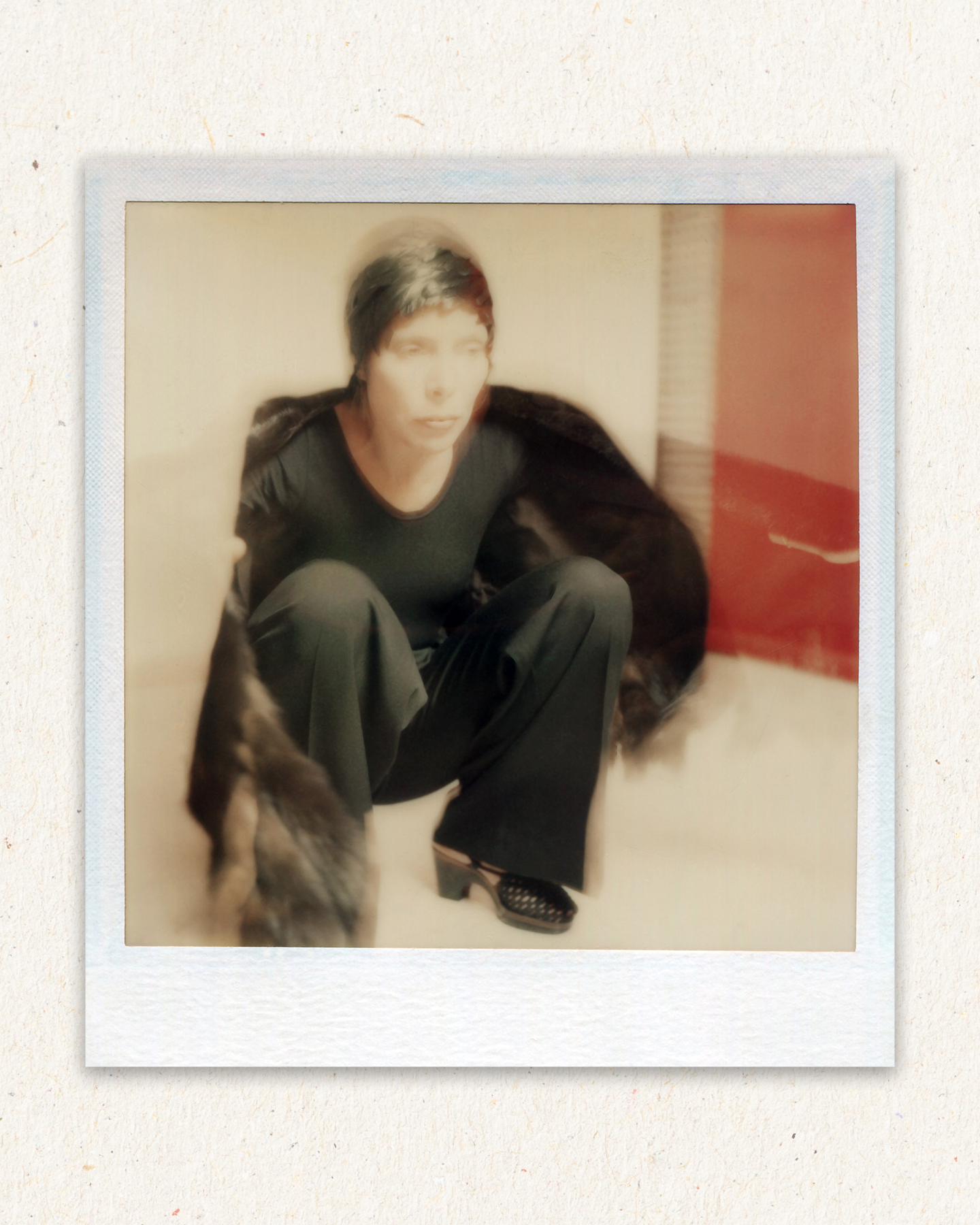




Joni Mitchell wanted to go ice skating. It was February 1976, and she was standing on the edge of a frozen Lake Mendota in Madison, Wisconsin, wearing a black ermine cape and a black wool hat. All she needed were black skates to match. “I had a hell of a time
getting the guy to give me black skates,” she recalled to Cameron Crowe, decades later. “He said, ‘Black skates are for, for men, madam.’ I said, ’No, no, you don’t understand. I’m having a funeral for my dead tour. I need black.”
Mitchell had recently cancelled the remainder of her Hissing of Summer Lawns tour, performing her last show at the nearby Dane County Memorial Coliseum. She was exhausted, battling a cocaine addiction, and reeling from the breakup with her drummer John Guerin, which she’d later describe as “one of the most special relationships” she’d ever had. This was her wake for it all, a farewell ride through the ice — not so different from the “River” she dreamt about skating on just five years prior. The ice was starting to thaw, and there were loud crashing sounds coming from the nearby trees, a sound she likened to “cases of Coca-Cola smashing.” She began to skate anyway, her black outfit standing in stark contrast to the backdrop.
Legendary photographer Joel Bernstein captured this moment, which would eventually appear inside the gatefold for her next album: Hejira. On the front cover, taken by Norman Seef, she’s wearing a black beret and holding a cigarette, stoically staring at the camera (she wanted it to look like an Ingmar Bergman film, she said), as a wide, open road is juxtaposed below. The artwork indicated the mission statement of Hejira — in the same way she skated away on that ice and didn’t look back, Mitchell got in her car and drove. “The Hejira album was written mostly while I was traveling in the car,” she told Crowe, in her 1979 Rolling Stone cover story. “That’s why there were no piano songs, if you remember. Hejira was an obscure word, but it said exactly what I wanted. Running away, honorably.”
Mitchell took three journeys while making Hejira: a portion of Bob Dylan’s all-star Rolling Thunder Revue Tour in late 1975, her short-lived Hissing trek in early 1976, and a cross-country drive she made in a white Mercedes without a license (she’d often wear a red wig in disguise, and go by names like Charlene Latimer and Joan Black). Released in November 1976, the album is a timeless travelogue of jazz-folk magic, when Mitchell left it all behind in search for more. “I’m porous with travel fever,” she sings on the aching title track. “But you know I’m so glad to be on my own.”
It’s impossible to pinpoint the genius of Hejira on just one track. There’s the opener “Coyote,” about the affair she had with the playwright Sam Shephard on the Rolling Thunder tour. That song is now immortalized in a viral video from Martin Scorsese’s documentary, where she casually performs it for a stunned Dylan, Roger McGuinn, and Gordon Lightfoot. There’s “Furry Sings the Blues,” about her encounter with the Memphis blues legend who didn’t exactlytake a liking to her (yes, that’s her longtime pal Neil Young on the harmonica). The stunning “Amelia,” named after Amelia Earhart, was her ode “from one solo pilot to another …sort of reflecting on the cost of being a woman and having something you must do.” Hejira is arguably her most cohesive body of work, featuring the fretless bass of Jaco Pastorius — whom she called the bass player of her dreams — plus guitarist Larry Carlton, percussionist Bobbye Hall, and others.
Looking back, Mitchell knew she was at the height of her powers. “I feel a lot of people could have written ’Chelsea Morning,’” she said. “But I don’t think anyone else could have written the songs on Hejira.” In honor of the 50th anniversary of Hejira, Rolling Stone spoke with musicians and actors about its legacy, and why it continues to resonate with listeners today. And in a full-circle moment, Crowe, who is currently working on a Mitchell biopic, pays tribute to the record he discussed with Mitchell in this very magazine, all those years ago.
Kara Jackson: ‘She Distills the Feeling of Loneliness’
I’ve been a Joni Mitchell fan for a really long time, since I was a kid. And one of my best friends who passed away, we were obsessed with her. She was the one who actually introduced me to Joni Mitchell through Blue, because we would just listen to the album all the time. So through a general obsession with her, I just eventually went through all of her albums. And I really remember being particularly attached to Hejira when I was a teenager. I would go on long walks around my neighborhood [in Oak Park in Illinois], listening to that album, and just be really emotional.
Jaco’s bass literally captures the feeling of being on a trip and moving. He uses his bass as a vehicle on that album in such a cool way. And Joni’s lyrics feel like being on a road trip, listening to somebody’s stories. It reminds me of being with my parents, driving. We always drive from Chicago to Georgia where my family’s from, and just being on the road and talking.
The album itself feels like a departure. She’s going on a journey and choosing to go away from the industry for a minute, and that is captured sonically in a really interesting way. With Hejira, she distills the feeling of loneliness in a way that she hadn’t done before. Each song is dealing with loneliness, but she puts it into these different scenarios and narratives. They all come together to tell this one story of being a woman who’s alone, just traveling.
Jamie Lee Curtis: ‘Hejira Helped Me With the Complexities of Life, Love, and Longing’
In Martin Scorsese’s film The Rolling Thunder Review: A Bob Dylan Story, there is a moment where Joni plays her new song, “Coyote,” at Gordon Lightfoot’s house. I love that there is footage of the early creation of this song. The lyrics change a little on the album, but you can see in her eyes the memories are very powerful as she sings and remembers. She had just written “Coyote” on a bus when she was with the tour, as she looked out at the “white lines on the freeway,” after she had a brief, tumultuous affair with the playwright Sam Shepard. Most of us have had these youthful, quick assignations, and I love being in her head as she reconciles the moment through her poetry and lyricism. Hejira is filled with emotion and hunger and as a young woman. Hejira helped me with the complexities of life, love, and longing.
Producer Nigel Godrich: ‘I’m a Teenager Again When I Listen to It’
It’s something that stayed with me my whole life. Being somebody who makes records and always having trouble listening to records because you’re just always thinking about technically how they were made, it’s a beautiful example of just being so disconnected from any kind of process. It doesn’t bear examination. I just find it 100 percent an emotional reactive experience. It conjures up something that I am so desperate to hold onto in my life. Basically what I’m saying is, I’m just a sad, pathetic fan, really.
Those things get chipped away gradually, as you meet all your heroes and make a lot of music. You never really listen to music the same way. But I’m a teenager again when I listen to it. I don’t know if it’s the imagery or the fact that she has this incredible way of weaving a narrative that is just so difficult to do in song. I mean, poetry is powerful, but the combination of melody and poetry is this kind of witchcraft that has always cast a spell on me.
She’s my favorite artist. And this record is an apex of confidence. She’s really just doing what she wants, to the nth degree. She’s this crazy sort of enigmatic, weird figure. You hear all these stories about her. She’s a manifestation of something that is so rare and special that my version of her that I have in my heart and my idea of who she is, I’m just clinging onto it for dear life. It’s like a hero I never want to meet. She could be the nicest, warmest person on Earth, but she wouldn’t be this person that she’s created in my mind personally, by my personal relationship with her music.
Danielle Haim: ‘There’s This Constant Sense of Motion’
I remember hearing a long time ago that Joni wrote most of Hejira while she was on a road trip across America, and ever since then, I’ve always listened to it on long drives. It just makes so much sense to me. The whole record feels like it’s constantly moving, whether you’re speeding down a highway or sitting in traffic watching the sun go down.
As a drummer first, I’m always listening for the drums and percussion on records. To me, they’re kind of the heartbeat of any modern album. I know a lot of Joni’s records don’t have much drumming on them, but the fact that Hejira is constantly chugging along without a lot of full kit drumming continues to blow my mind. And I think Jaco’s bass playing adds this whole other rhythmic dimension to her music.
I’ve always thought of Joni as a percussionist in her own way. The way she attacks the guitar strings, the rhythms she creates with her strumming, it’s unlike anything I’ve ever heard from another musician. It’s one of the most fascinating things about her playing to me. And then you have Jaco on bass, another absolute master of rhythm, and the two of them create this incredible, almost hypnotic pulse that runs through the whole record.
And Bobbye Hall’s percussion adds so much to that feeling. It’s never overpowering, but there’s so much movement and texture in what she’s doing. All these little rhythmic details that somehow make the music feel even more alive. Between the three of them, there’s this constant sense of motion, like the music is always pushing forward but never in a hurry to get anywhere.
Clairo: ‘Her Truest Self’
Hejira was the Joni album that helped me meet Joni. I feel like her truest self comes through on this record so beautifully, and it’s an anchor on tour when the roads are never ending and the bus forever rumbling. My favorite song is “Coyote.”
Dawes’ Taylor Goldsmith: ‘Her Whole Catalog Was Leading to This Moment’
Hejira is Joni’s culmination to my mind. Her greatest songs, the greatest band, the greatest recordings, the most revelatory. The signature Roland Jazz Chorus guitar amp tone. Jaco Pastorius truly unleashed. The concepts and material mined into their seventh and eighth minute in some cases. I like to believe her whole catalog was leading to this moment. She’s at the height of her powers, and the masterworks that follow (Don Juan’s Reckless Daughter, Mingus, Night Ride Home, Turbulent Indigo, etc.) feel possible because of what Hejira unlocked. The writing is perhaps the most challenging, but the experience remains incredibly propulsive; you’re carried along by bearing witness to a human truly unrestrained by self-doubt, by adhering to any kind of rules or any kind of culture, someone in the midst of their quest to express their purest self. Maybe that sounds vague, but anyone that knows the record knows exactly what I’m talking about. When I’ve been asked about it, I’ve jokingly replied, “It’s as far as music has come.” But maybe that’s actually true.
Beck: ‘It’s a Thing to Behold’
I was touring extensively through my twenties, and I think it was at least 10 months of the year I was just on the road constantly. It was such a grind, but music had become a companion. We all had our headphones, and you’d sit on these long plane rides and bus rides listening to records. So it’s a lot of time to take a lot of deep dives. The whole Odelay tour, I was listening to Joni on the bus. It was pretty much Joni, Françoise Hardy records from the mid Sixties, and Morricone soundtracks — but not the Westerns, the weirder stuff. And then I had a CD of a rainstorm in Hawaii. That was all I listened to. It was like Joni and a Hawaiian rainstorm.
Hejira is the sound of an artist who has evolved so deeply into their own voice and their own craft. It’s a thing to behold. It’s a place that not a lot of artists even get to. Either they’re not really on that search to cultivate that rarefied place in their work, or they’re distracted by success and fame and touring, which happens to anybody who gets caught up in the sort of mechanics of the music business. So I think it’s even more of a singular achievement that she was able to make this after being on such a nonstop, relentless decade of making albums and touring. Usually at that point, somebody would just want to disappear for five years.
The music doesn’t necessarily sound like anything she had done before. One thing that’s really striking to me is the guitar sound. The effect on her guitar is a chorus pedal. The first one came out the year she was making the record. This was brand new technology. So this is like, “This new weird thing came out, and I’m going to put it on my entire album.” Not even, “Let’s vet this and see if this is cool. Is this going to be trendy? Is this going to sound dated?” This chorus pedal becomes the sound of whole genres afterwards. I don’t think it really becomes part of the palette of popular music till maybe the early 2010s. You listen to almost all of indie rock, from Mac DeMarco, to pop artists.
And then you also get the guitar sound of Prince’s Purple Rain, which comes from this record, without a doubt. It is interesting that something that is uncompromising, and not even her most popular album or most iconic, still managed to have an imprint on pop. Honestly, I think the sound of this even filters into shoegaze and Cocteau Twins. I don’t know if people have put those things together, but I see it clearly.
She is so mature as an artist on this record. I mean, it would take you more than a lifetime to get to that maturity. Somehow, she did it.
Lizzy McAlpine: ‘Hypnotic and Deeply Meditative’
I first listened to Hejira in full on a tour bus driving through Europe. Highway rushing past, barren fields and long stretches of countryside out the window, the way Joni intended (I think). It struck me immediately as a timeless record. None of the songs are shorter than four minutes, the longest one being almost nine, but somehow they all feel intentional. She doesn’t waste words. I was so intrigued by that concept, of letting the story speak for itself, and setting up a bed of guitars that could support it. It inspired my writing a lot during that time, specifically a song I wrote while on that tour called “Our Strange Ways.” This record feels hypnotic and deeply meditative. And listening to it as I felt, quite literally, like a prisoner of the white lines on the freeway, was an experience I will never forget. One of my top Joni records of all time.
Fleet Foxes’ Robin Pecknold: ‘My Deepest Musical Attachment’
Long country drives are still my favorite way to pass the time, and Hejira captures why better than any other record I’ve heard. There was a year maybe where I’d point the car in some direction and only play Hejira, on a loop, until I’d memorized every melodic variation and phrase, as if getting a handle on the twists and turns of those infinite songs would give me a better handle on the twists and turns of life itself. I love the interior drama, the humor, the mise en scène, the acceptance of uncertainty and change. The chords, the tunings, obviously. My dad idolized Jaco growing up and makes his own fretless basses, so I hear my dad playing with Joni on the Jaco songs.
Once when I was making lectures for a songwriting class I was undeservingly teaching, I tried writing one about, forgive me, the “multi-perspectival sublime.” I wanted to relate Hejira to the painting “Las Meninas” by Velázquez and how, the longer you look at both, the harder it is to make sense of you-the-viewer’s place in it. Looking at “Las Meninas,” at first the viewer feels that everyone in the painting is looking baldly at them, but as you look closer, you realize the “viewer” is in an impossible position, and likely isn’t in the room at all. The songs on Hejira do this for me. They seem to be about the self, but the perspective shifts rapidly, from a man and a woman sitting on a rock to a blue motel room to a marble bowling ball, from a roadside gas station to the cosmos, a chimney becomes a flag reflected from a bank window into a hotel room — the center is always shifting, to such a degree that the viewer loses their sense of self and surrenders to liminality in a sort of holy way.
I didn’t finish the essay because it’s hard to write about a feeling like that without reducing it to platitudes, and I’m no Peter Schjeldahl. But Hejira really does help me transcend the self, with its trick mirrors and micro-to-macro shifts and its sense of spiritual surrender and leggerezza. It’s my deepest musical attachment, no question.
Lennon Stella: ‘She Always Reminds Me That There Are No Rules’
God, this record. I had a dream once where Joni was sitting on a dock on a lake in Canada singing “Coyote,” with all my family in the water, singing along in the sun. Needless to say, this record and Joni’s voice has been extremely influential to me, even making its way into my dreams!
The freedom in this record, the six-, seven-, eight-minute long songs, her storytelling, taking you on the long and winding road with her. She always reminds me there are no rules. I think my favorite song is “Amelia”: “It was the hexagram of the heavens/It was the strings of my guitar.” She is the master. I am so grateful to have been introduced to Joni so young, her voice as a North Star.
Diana Silvers: ‘Joni’s Lyrics Hold a Mirror Up to Whoever Is Listening’
Something I love and admire about Joni is that she never made the same record twice, even though she easily could have, considering how strong her lyrics are on their own. I love the way Joni uses the electric guitar on Hejira. To me, it sounds like rain running down the window of a moving car, which feels so fitting when you think of the record as a kind of travel diary.
I remember the first time I heard “Amelia.” I kept thinking, how does she write a song about someone or something so far removed from my own life, and yet make me see so much of myself in it? Or the way she uses the Cold War as a metaphor in “Blue Motel Room.” That’s what Joni’s lyrics do. They hold a mirror up to whoever is listening without ever seeming to try too hard. Something I often ask myself when I’m writing, especially when listening to a song like “Blue Motel Room,” is how to bring the wider world into the microcosm of everyday life. How do you take something so vast and make it feel so intimate? Joni does that beautifully, and I think it really shines through on Hejira.
Emma Ogier: ‘She Always Provides a Well of Inspiration’
Joni Mitchell is one of those songwriters that I go to whenever I have writer’s block — she always provides a well of inspiration. My song “Keep You” is a direct homage to “Coyote” that evoked a scandalous song about love through a free spirit. Lines like “you’ll be brushing out a brood mare’s tail” were scrubbed into imagery like “brushing out the mane of a silver healer.” I love to pull from Joni’s work. She is a huge inspiration to me.
Amy Allen: ‘I Was Living Every Lyric in Real Time’
I don’t even know where to begin with Hejira, because it has touched my life in so many profound ways. At first, when I was little and just old enough to hum along to the melodies. Again, when I was a few years older and learning how to play “Coyote” on the guitar. And then a few years later, when I started reading the lyrics of songs I liked and being inspired to start writing my own, which led to my career in songwriting. I remember driving from Maine to L.A. in pursuit of my dream, during which I, of course, listened to Hejira, because I felt as though I was living every lyric in real time. Now as a 34-year-old woman, I continue to return to it as if it’s a friend going through all the same growing pains I’m going through — constantly in search of something, and simultaneously asking if the big dream is worth the loneliness that often comes with it. Even though it’s nearly impossible to choose a favorite song from the record because they are all so intertwined to me, if I had to pick, I’d say “Amelia.” Everything about it. The chord changes. The guitar tones. And of course the perfectly poetic yet heart-wrenchingly clear lyrics that describe two women choosing ambition, exploration, and the unknown. I’m forever grateful to Joni for this album, and my life would be drastically different without it.
Cameron Crowe: ‘Hejira Sounds Like Music From Another Planet’
Hejira lives in its own world, a sonic-travelogue written on Mitchell’s 1976 journey across America. It’s her most cinematic album too, filled with restless wonder and the characters she’d met along the way. The album was born out of the end of Mitchell’s relationship with drummer John Guerin. They’d lived and toured together. “We had a hard time letting each other go,” says Mitchell today. Her popularity was at a peak after Court and Spark, but a tour of America’s arenas left her missing the intimacy and sound of smaller venues and clubs. She cancelled an upcoming European tour, went skating on Madison, Wisconsin’s icy Lake Mendota (the “bird in flight” series was memorably captured by photographer Joel Bernstein) and headed back to California with the notion that it was time to travel, soak up life, seek new inspiration, and find a course-correction before she became “another scribe writing about the life of a rock singer, a minority experience to be sure.”
Life soon arrived with an invitation. Mitchell’s old friend from Toronto, Australian race-champion Vic Wilson, visited Mitchell with his flight-attendant friend Steven. Wilson was looking to borrow a car for a road-trip to Damariscotta, Maine, where he planned to collect his daughter, Larissa, and return to Australia. Mitchell not only loaned them the Bluebird, her white Mercedes coupe, but enthusiastically joined them with guitar, a suitcase, and sketchpads. (Her car would soon break down and need to be replaced on the road.)
Parting company with her road-trip buddies in New York city, Mitchell rode back alone. It was America’s Bicentennial summer. With roadmaps (and no driver’s license), she worked her way down the East Coast, through Charleston, South Carolina, the pageantry of small town parades, pinball buddies, flag-draped cafes. Though the disguise rarely escaped close examination, Mitchell often wore a red wig and traveled by the name Charlene Latimer. At night she collected the thoughts of the day and wrote songs filled with longing and delight and raw introspection. “I knew it was a growth step for me,” she reflects today, listening to “Song For Sharon” and other songs from the album. She adds one small disappointment. Nearly back home from her solo return, Mitchell stopped to join Bob Dylan’s Rolling Thunder revue for a show in Ft. Worth. Her artist’s portfolio containing all the Hejira drawings were stolen from her hotel room.
The songs remain. Each one is filled with memory and detail and stunning reflection, but don’t forget to listen to Hejira as a whole. There’s a movie in every full-listen. To further appreciate Hejira, it’s also fun to consider what popular music sounded like in the summer of 1976. It was the peak of disco, radio was filled with the Bee Gees, the thump-thump-thump of post-Saturday Night Fever. Heard in context today, especially with the bass explorations of Jaco Pastorious, Hejira sounds like music from another planet. For any fan who joined the Joni Mitchell journey with Blue, the elixir of Hejira is the adventure you didn’t expect. Mitchell’s own rules for writing the album: “Summon a melody and some chords, write the words …then ask yourself if you’ve done anything like it before. If you have, start over.”
Click here to read the full article.