






Peering into HATS-75b
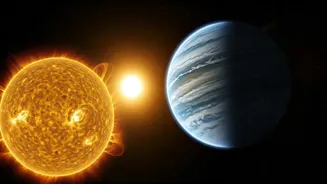
Scientists from Johns Hopkins have embarked on an exciting investigation of HATS-75b, a colossal exoplanet that orbits a star significantly smaller than
our Sun. Their primary tool for this exploration is NASA's remarkably advanced James Webb Space Telescope (JWST). The method employed involves meticulously observing the exoplanet as it traverses the face of its host star, an event known as a transit. By analyzing the subtle shifts in starlight during these transits, astronomers can infer the composition and characteristics of the planet's atmosphere. This particular exoplanet, HATS-75b, presents a unique case study due to the nature of its parent star, offering valuable insights into the complexities of exoplanetary atmospheric analysis.
The Starspot Complication
A significant hurdle in understanding HATS-75b's atmosphere arises from the inherent variability of its host star. Stars, much like our own Sun, can exhibit dynamic surface features such as starspots – cooler, darker regions – and brighter patches. These phenomena can significantly distort the light that reaches us, making it challenging to disentangle the planet's atmospheric signature from the star's own activity. When the JWST observes a transit, the light filtered through the exoplanet's atmosphere is what astronomers analyze. However, if the star's surface is uneven, with dark spots or bright areas, the amount of light that is blocked or passes through can be misleading, potentially leading to misinterpretations of the atmospheric data. Therefore, accounting for these stellar irregularities is paramount for accurate exoplanet characterization.
Clarifying Distant Worlds
The findings from the study of HATS-75b underscore a critical necessity in the field of exoplanet research: the indispensable need to account for the quirks of host stars. Stellar variability, including the presence of starspots and faculae (bright regions), can introduce significant noise into the data collected by telescopes like the JWST. By understanding and modeling these stellar imperfections, scientists can achieve a much clearer picture of the atmospheres of exoplanets. This detailed analysis is particularly crucial when studying rare or unusual exoplanets, such as HATS-75b. The ability to correct for stellar influences allows researchers to derive more reliable information about the chemical makeup, temperature, and potential habitability of worlds located light-years away, pushing the boundaries of our cosmic understanding.