






A Stellar Puzzle
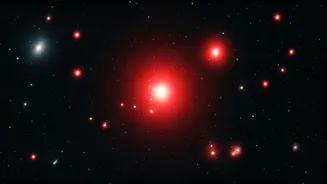
For more than a century, the star known as gamma-Cas has been a cosmic riddle, baffling astronomers with its erratic and intense X-ray emissions. This
peculiar celestial body has long defied simple explanations, leaving scientists in a state of persistent curiosity since its unusual activity was first noted back in 1866. The star's unpredictable outbursts have been a recurring topic of discussion and research, but until recently, the exact cause remained elusive, creating one of astronomy's more enduring mysteries. The scientific community has explored various theories, from unusual magnetic field interactions to exotic stellar phenomena, yet none fully accounted for the observed behavior. This prolonged period of uncertainty underscores the complexity of stellar astrophysics and the challenges involved in studying distant celestial objects.
XRISM's Revealing Gaze
The veil of mystery surrounding gamma-Cas has finally been lifted, thanks to the sophisticated instruments aboard the XRISM spacecraft. This advanced observatory has provided incredibly precise data, confirming what many astronomers had long suspected: the star's dramatic X-ray activity isn't solely due to its own internal processes or simple magnetic interactions. Instead, the evidence overwhelmingly points to a less visible, compact celestial companion. This companion, believed to be a white dwarf, is actively engaged in a process of material transfer, effectively stealing gas from gamma-Cas. This continuous act of cosmic larceny is the direct cause of the intense X-ray flares that have puzzled scientists for generations. The detailed spectral analysis and high-resolution imaging capabilities of XRISM have been instrumental in isolating this interaction.
Insights into Stellar Evolution
The groundbreaking discovery about gamma-Cas offers far more than just a solution to an old puzzle; it provides critical insights into the complex evolutionary paths of massive stars when they exist in binary systems. Lead researcher Yael Naze highlighted the significance of this finding, emphasizing how it helps scientists better comprehend the dynamics and ultimate fate of stars that orbit each other. Understanding these binary interactions is crucial because such systems are not uncommon and play a significant role in galactic evolution. This research also sheds light on other enigmatic celestial objects known as Be stars, which exhibit similar, albeit less extreme, spectral characteristics. The findings, recently published in the journal Astronomy and Astrophysics on March 24, 2026, are expected to stimulate further investigation into the diverse ways massive stars live out their lives in the cosmic dance of binary companionship.