







Cosmic Collision Experiment
In a bold stride for planetary defense, NASA orchestrated a dramatic experiment in 2022. The mission, aptly named the Double Asteroid Redirection Test
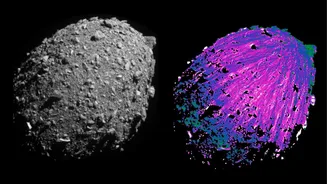
(DART), involved intentionally crashing a spacecraft into the asteroid Dimorphos. The primary objective was to rigorously test humanity's capacity to divert potential asteroid impacts that could pose a threat to Earth. Recent analyses have conclusively affirmed the success of this ambitious endeavor, revealing that the impact not only shifted Dimorphos's orbital path but also influenced that of its larger celestial partner, Didymos.
Binary System Dynamics
The chosen target for NASA's DART mission was the binary asteroid system comprising Dimorphos and Didymos. These two celestial bodies are locked in a gravitational dance, orbiting each other while simultaneously circling the Sun. This unique configuration provided an ideal scenario for observing the effects of the impact. Post-mission data reveals a permanent reduction in the orbital period of the Didymos-Dimorphos pair around the Sun, amounting to less than a second. Specifically, the change in their orbital velocity was measured at a mere 1.7 inches per hour, a testament to the precision and sensitivity of the data collection, as highlighted by Dr. Rahil Makadia, the lead author of the corresponding study published in Science Advances.
Orbital Shift Significance
Dr. Makadia underscored the profound long-term implications of even minute alterations in an asteroid's trajectory. Such subtle shifts, he explained, can be the critical factor determining whether a potentially hazardous object will strike our planet or safely bypass it. The DART mission marks a pivotal moment, representing the inaugural instance where a human-made object has demonstrably altered the orbital path of a celestial body within our solar system. This groundbreaking success significantly bolsters the potential for developing future strategies to defend Earth against incoming asteroid threats.
Ejected Material Impact
Further insights from the study indicate that the significant volume of material ejected from the asteroid system during the DART impact played a role in augmenting the orbital velocity of both space rocks. This ejection process contributed to a reduction in their combined orbital period by approximately 0.15 seconds. To meticulously measure this subtle yet crucial change, astronomers relied on a combination of ground-based observations of the Didymos system and data derived from stellar occultations. Stellar occultations occur when an asteroid passes directly in front of a star, briefly obscuring its light, allowing for precise tracking of the asteroid's position and speed over time. These observations were conducted systematically between October 2022 and March 2025.
Global Observation Network
The veracity of the study's conclusions was significantly bolstered by the collective efforts of global observers. The findings were predominantly based on an impressive compilation of 22 stellar occultations, meticulously recorded by a dedicated network of volunteer astronomers positioned across the globe. Steve Chesley, a senior research scientist at NASA's Jet Propulsion Laboratory, emphasized the indispensable nature of these widespread observations in accurately calculating the orbital modifications induced by the DART mission. He remarked on the challenging circumstances often involved, stating that such work is heavily dependent on prevailing weather conditions and frequently necessitates travel to remote locations, with no guarantee of successful observation.
Measuring Tiny Changes
Patrick Michel, the principal investigator for the European Space Agency's follow-up Hera mission, expressed his astonishment at the team's ability to precisely measure such an infinitesimally small alteration in the asteroids' orbits. He acknowledged the prior expectation that a minor orbital adjustment would occur, posing no immediate threat to Earth, but emphasized that the actual measurement represented a formidable challenge. Michel commended the team for their exceptional success in overcoming this significant hurdle. Further detailed observations and measurements pertaining to DART's impact are anticipated once the Hera spacecraft reaches its orbital position around the asteroid system.