






Comet's Brightening Event
NASA's SPHEREx telescope recently made a fascinating observation of comet 3I/ATLAS, noting a sudden and significant increase in its brightness during December
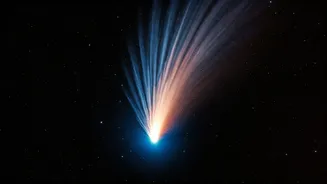
2025. This celestial visitor, which hails from beyond our solar system, had just completed its closest approach to the Sun a couple of months prior. As it journeyed back into view, the comet put on a spectacular show, enveloped by a vast cloud composed primarily of carbon dioxide and water ice that were directly sublimating from solid to gas. Accompanying this gaseous envelope was a prominent dust tail, formed by particulate matter so dense that the pressure of sunlight was insufficient to dislodge it, thus allowing it to trail behind the comet.
Interstellar Voyage and Trajectory
The journey of comet 3I/ATLAS through our solar system is a remarkable one. Its existence was first brought to light in July 2025 by astronomers located in Chile. Following its discovery, the comet embarked on a path that saw it pass by Mars in October of the same year. The comet's trajectory also suggests a potential future encounter with Jupiter's orbital path. For a period last autumn, observers were able to track the comet in the night sky until September. Subsequently, it moved too near the Sun to be safely observed. By the beginning of December, it had reappeared on the opposite side of the Sun, allowing astronomers to resume their studies of this rare interstellar visitor.